Link: Iraqi government forces close in on Ramadi.
With recent events in Syria and Paris dominating the international press, the Iraqi government's much-publicized offensive to retake Ramadi is no longer front-page news. Actually, the struggle to retake Ramadi has taken much longer than the government and the Iraqi people expected. Combat around Baiji and in the Kurdish areas of northern Iraq have made for much more interesting journalism, as the average person begins to consider that the Ramadi campaign has become a stalemate. Fortunately, in the last few days, news reports from the Iraqi government and the Pentagon indicate that the Iraqi Armed Forces are getting very close to recapturing the capital city of Anbar Province. It is estimated that ISIS has roughly 600 to 1000 fighters still hunkered down in the few downtown neighborhoods that government forces have yet to reoccupy. The fact that the Iraqi government is determined to complete this operation according to plan, with minimal casualties and damage to infrastructure, is very encouraging. Its true that the campaign to retake the city has not followed the most ideal timetable, but the Iraqi authorities have been able to carefully search areas formally occupied by ISIS, in order to remove any improvised explosive devices or abandoned munitions.
Last Wednesday, Iraqi forces took possession of the Palestine Bridge in the northwest part of the city. The bridge, which spans the Euphrates River, was a vital link to food and other supplies for ISIS. The coalition air campaign continues to harass ISIS by strafing supply routes and bombing key defensive positions. In fact, air support has proven particularly effective in destroying explosives that were purposely planted in abandoned structures in the downtown part of the city. Aggressive action by the coalition air support has been instrumental in saving the lives of ground troops, as explosives disposal teams prepare to enter neighborhoods that have been cleared of ISIS snipers. Iraqi authorities fully expect the remaining ISIS operatives to fight to the death.
Once the military campaign to liberate Ramadi is complete, the Iraqi military will focus on bringing relief to Haditha, which although occupied by Iraqi forces, has been under assault by ISIS for most of the year. In recent weeks, coalition air attacks have successfully targeted ISIS positions and prevented the delivery of supplies to ISIS operatives near Haditha. Al-Asad Air Base in outside of Haditha, and presents a valuable target for ISIS. U.S. troops have been present at Al-Asad for some time, providing important training to Iraqi personnel. For some inexplicable reason, the Obama Administration made no attempt to keep this particular bit of information confidential. Once the international media got wind of the presence of U.S. troops at Al-Asad, ISIS wasn't far behind. Can you imagine if ISIS were to overrun that base and take our young men and women prisoner? Fortunately, recent combat in the Haditha area has severely compromised ISIS' ability to conduct offensive activity. No doubt the Iraqis are also determined to remove ISIS from Fallujah, which sits northeast of Ramadi and is actually closer to Baghdad (as the crow flies). The various Shi'a militias were more-or-less assigned the task of retaking Fallujah, while the Iraqi Regular Army and Special Police targeted Ramadi. At various times over the past six months, it appeared that Fallujah would fall first. The fact that Ramadi will indeed be reoccupied by government forces before the Iranian-backed militias have removed ISIS from Fallujah will be celebrated in Baghdad, where the populace has begun to voice its annoyance at what is perceived to be Iranian interference in Iraqi affairs.

Showing posts with label Anbar. Show all posts
Showing posts with label Anbar. Show all posts
Monday, November 30, 2015

Wednesday, October 7, 2015
ISIS continues attacks on provincial targets, as civilain casualties mount.
Link: Rare ISIS VBIED in Basra.
As the Iraqi Security Forces (ISF) continue to inch closer to the strategic areas of Ramadi, ISIS reminds Baghdad of the breadth of its reach, as Vehicle-Born Improvised Explosive Devices (VBIED) are detonated in suburban areas of Baghdad, Diyala Province, and south of Basra. The attack in Zubair, south of Basra was especially concerning as only one previous VBIED has ever been detonated this far south. The weekend of bloodshed is a clear indication that ISIS will not deter from its overall plan to make the provinces of Iraq more and more difficult to govern. Nowhere is this more apparent than in Diyala Province, where a VBIED in the town of Khalis casts doubt on the success of recent security measures taken by the militias/Popular Mobilization Units (PMUs). With much of the police manpower at the front, supplementing the Armed Forces, the PMUs have taken a more visible role in providing security on the streets of Iraq. The PMUs have elaborate mechanisms in place to defeat the attempts to successfully detonate a VBIED. All of the roads are monitored closely, with numerous checkpoints and roadblocks. Somehow, ISIS continues to get VBIEDs on the roads. Almost every VBIED has been driven by a single male, usually in his 20's. Unfortunately, in Iraq, the highways are full of cars whose only passenger is the young man behind the wheel. The only truly effective way to eliminate the use of vehicles as moving bombs is to force everyone to either walk, bicycle, or use public transportation. Sadly, this would probably result in the use of buses as mass killing machines.
With recent VBIED attacks in Baghdad, Diyala, Basra and Salah al-Din Provinces, ISIS continues to demonstrate basic freedom of movement. The ISF has also ben unable to permanently cut the roads between Fallujah and Ramadi. ISIS is able to move personnel and supplies into Ramadi, although with the Allied Air Campaign in full swing and the ISF artillery getting more and more accurate, I wouldn't chance a trip on that road. Why haven't all the roads leading into and out of Ramadi and Fallujah been completely destroyed? Is it out of concern for the number of civilians who still live in these communities and rely on the roads for food, medical care, and as a means of last-minute evacuation? No one has been able to come up with a reliable figure as to how many civilians remain in Fallujah and Ramadi (it appears that Fallujah is less deserted than Ramadi), but it can't be a pleasant place to be at the moment. What is most frustrating is that while the government is training its resources to the breaking point in an attempt to recapture Ramadi, ISIS is able to plan and execute daily VBIED attacks in Baghdad and numerous bordering provinces. The giant pink elephant in everyone's living room at present, though, is Ramadi- what is going on in Ramadi? Are the special police units and military actually making daily progress in retaking the city, or have we passed the point for reasonable expectation of victory? In fact, does evidence exist that the ISF has broken off offensive operations in Ramadi and Fallujah? Is the government just waiting for the best time to spill the bad news? Serious fighting continues in and around Baiji and in Salad al-Din Province, and the Kurds in the north regularly find ways to ambush ISIS patrols, so how important is Ramadi? From a confidence perspective, it means everything. If the government announces a general retreat from Anbar, then they had better be prepared to invite the Iranian Army across the border, because someone has to stop ISIS before they storm Baghdad. Actually, a military collapse would provide just the justification for direct Iranian military intervention. The players would then be in place for Putin's grand scheme. The Russians destroy Assad's opposition in Syria, then tackle ISIS head-on, while the Iranians engage ISIS in Iraq. Ideally, in the end, with ISIS vanquished, the Russians and the Iranians would meet up and shake hands, like the Russians and the Americans/British did in April 1945 at the River Elbe in Germany. Putin would be hailed as a tremendous leader and the man of the hour, and the Iranians would have totally reformed their image, and could for the most part dictate the state of affairs in the Persian Gulf. Lets meet in year, same time, same place, and see how my prognostications played out.
Thursday, September 24, 2015
Iraqi Security Forces remain committed to retaking Ramadi.
Link: Political troubles distracting Iraqi government from ISIS campaign.
In spite of recent efforts by the Shi'a militias/Popular Mobilization Units (PMUs) to oppose and discredit the reform agenda by Iraqi Prime Minister Haider Abadi, the Iraqi government continues to voice confidence in the Iraqi Security Forces (ISF) attempt to retake Ramadi. Drip by drip, local Sunni Tribal Militia recruits complete training in Habaniya and join their compatriots outside Ramadi. The Iraqi Army and its Special Police Units have been making very slow progress, but ground is being taken. The ISF is not attacking Ramadi from only one direction; the effort is to invest the town from the east, west, north, and south. Ideally, this would have led to the isolation of Ramadi more quickly, but it hasn't happened. ISIS continues to have access to its forces in both Ramadi and Fallujah. The ISF has identified the roads which allow both cities to be accessed, and an effort is underway to shut them down. One road which is still open to ISIS actually leads from Fallujah to Ramadi. Why the allied air campaign hasn't turned this road into dust is a mystery, although if it continues to be heavily traveled by civilians, then bombing would be out of the question. What if ISIS disguises their reinforcements and supplies as civilian traffic, as they have done repeatedly in both Syria and Iraq? That is a question that as of yet has no answer.
The PMUs continue to destabilize the situation in Baghdad, as ISIS increases its attacks in the city and also in Baiji and Thar Thar, south of Samarrah. Its obvious that ISIS is attempting to exploit the showdown between the Iraqi government and Shi'a militias, by securing territory already occupied and launching attacks on fresh targets. The Iraqi government has the obvious support of the great majority of the population, including the Shi'a. But this is a population that has seen tremendous violence and has been terrorized for decades from the end of a gun barrel. The militias are threatening to treat any pro-reform demonstrations as a security threat, and as they have already declared themselves the de facto authority in both Baghdad and Basra, it must be assumed that they won't hesitate to shoot unarmed protesters. Abadi knows that the popular support of the people, along with the consistent support of Shi'a religious leader Ayatollah Ali al-Sistani, are all he can rely on as the ISF and police are occupied in Anbar. But Abadi appears understandably hesitant to call the people to the streets, for the showdown that would result which he cannot hope to win. With the army and police occupied on the front lines, there is some question as to why the militias haven't attempted to remove Abadi from office by force. Certainly there are enough Maliki supporters and Iranian hacks in the Iraqi government and Parliament for a new cabinet and administration to be formed, one that wouldn't try to enact all of the anti-corruption reforms that threaten Maliki so much. The reality is, any effort to remove Abadi would have to be approved by Tehran, and right now the Iranians are basking in the glow of their new-found reputation as Russia's partner in countering ISIS in Syria. The Iranians are just as anxious to move into the vacuum left by the United States, to take up a leadership role alongside the Russians in Syria in Putin's plan to stand up to ISIS. This effort, along with the new nuclear treaty written by the United States, a few European countries, and Iran, make Iran so squeaky clean that they can barely stand themselves. An Iranian-sponsored government change in Baghdad, with the battle of Ramadi raging to the west, would not be seen as a productive development. For this reason more than any other, Abadi is safe....for the moment.
Sunday, August 30, 2015
Block by block, Iraqi forces begin to dislodge ISIS from the outskirts of Ramadi.
Link: ISIS kills two Iraqi generals in separate attacks on the same day outside Ramadi.
Everyday brings more news from Iraq regarding both the military situation in Anbar Province, and political developments generated by the reforms of Prime Minister Haider al-Abadi. The Iraqi Security Forces (ISF) that are presently engaging ISIS in Ramadi, consist of Iraqi Army units, specialized police, and members of various Sunni militias, and they are pressuring ISIS forces from both the east and the west. For all practical purposes, ISIS is hemmed in, and the regular use by ISIS of SVBIEDs is an indication that the ISF has penetrated ISIS' exterior line of defense. In a somewhat urban setting like the outlying neighborhoods of Ramadi, which consist of some low-level residences and businesses, and also four and five story structures, ISIS will utilize snipers and ambushes at every opportunity. At this stage, ISIS is both unwilling and unable to engage the ISF in a conventional battle; the use of SVBIEDs and VBIEDs are ISIS' usual modus operandi, because they do not have the numbers or the equipment (tanks, armored personnel carriers, mobile artillery, etc.) to confront the enemy in a conventional fashion. Besides, ISIS believes civilian casualties are worth more than military deaths on the battlefield. Civilian deaths terrorize the population, making it difficult for the government to administer. People try to flee the area, which clogs up the transportation network and creates more opportunities for SVBIEDs with greater casualties. Civilian casualties can also lead to pressure on the government to compromise (see Ukraine). All in all, ISIS will always want to encourage destabilization in areas occupied by its enemies; destabilization distracts the enemy from what should be the primary goal: the destruction of ISIS. The ISF appears to have played this one properly from the beginning of the offensive in July. Almost as soon as the offensive to retake Anbar was announced, ISIS began an SVBIED campaign in Diyala Province, later to extend to Salad ad-Din. As further means of distraction, ISIS stepped up efforts to seize Haditha, and also turned the heat up on Baiji. The Provincial Administrations began screaming for military help, demanding that the ISF return provincial soldiers who were part of the Anbar Offensive (playing into ISIS' hands). Credit goes to the Iraqi government and the military High Command for not budging, and staying on course regarding the long-term strategic goals of the offensive.
Now that the battle for Ramadi has started to focus on neighborhoods and other urban areas, including industrial sites, universities, and hospitals, ISIS will continue to make use of SVBIEDs, but the ISF will be forced to go building to building, block to block, all the while being harassed by snipers. The ISF has gone down this road before, clearing out Ramadi once before, but it appears that ISIS has booby-trapped and mined everything short of the cockroaches. This is where the Army bomb-squads and the specially trained police units will prove most valuable. With Ramadi being squeezed on all sides, it is unlikely that ISIS will be able to resupply or reinforce its forces. The question remains, how long will the ISIS fighters hold out? Are they as determined as the last bunch were, to die firing an AK-47? The ISF will certainly accommodate, but it would be great to see the remaining defenders surrender en masse. It would send a message to all who fight for ISIS, that it isn't necessary to give up your life for the cause. Inevitably, if fewer ISIS fight to the death, then fewer Iraqi soldiers die as well.
The news from Fallujah has been sparse as of late. The Shi'a militias/Popular Mobilization Units (PMUs) that have been tightening the noose on ISIS in Fallujah, have been not surprisingly less-accessible to the press. But ISIS has its hands full in Fallujah as well; will Fallujah fall before Ramadi? If ISIS in both towns decides to fight to the bitter end, the clean-up operation will take some time. You can bet that the ISF will not rest on its laurels, as Haditha is next in line for a house-cleaning. This last week, ISF units in Haditha actually took to the offensive, clearing out ISIS from the outlying sub-district of Baghdadi. Again, the allied air support has been on-target and very welcome in the last month, as the current situation appears to favor the ISF and its allies. But we have been lulled into a false sense of optimism before. ISIS can rebound from defeats like no military organization we have seen. In fact, its very construction allows it to recover quickly from setbacks, like an animal that has its foot caught in a trap. ISIS will chew off the foot, and regrow it later on its own schedule. ISIS occupied Ramadi once before, only to lose it, and re-occupy it again. One of the keys to ISIS success is its mobility and the apparent self-sufficiency of its units. ISIS has a presence in every Iraqi Province, even though it does not have a guaranteed method of resupplying and reinforcing those units. It is up to the units, which are purposely small, to equip themselves from the enemy, or to put themselves into position to be re-equipped. What makes ISIS so dangerous is its ability to adapt, because we have seen ISIS fight conventional battles in Syria and in northern Iraq. At different times in 2013 and 2014, ISIS captured all sorts of heavy military equipment from the Iraqi Army. Previously, ISIS had captured a Syrian Air Force Base, with Migs sitting on the runway, fueled-up and ready to go. We don't know what ISIS has done with all of the military booty that it has collected, although a good deal has been destroyed from coalition air attacks. At the end of the day, ISIS is a very dangerous enemy; it can sneak up on you in the desert and it can give you hell fighting street-to-street. We are very encouraged by the recent disciplined and united approach that the ISF and the PMUs are presenting as they methodically pound away at ISIS positions.
The Iraqi Parliament Council of Representatives have approved Speaker Salim al-Juburi's reforms, which were introduced on 11 August alongside Prime Minister Abadi's reform package. On August 27, the Council of Representatives passed the Political Parties Law, which bans political parties from receiving foreign funding and maintaining paramilitary wings. No doubt the later of the restrictions will be met with strong opposition by a number of the Shi'a parties, who are inseparable from particular militias. The reform wave has also attempted to sweep up the Iraqi judiciary, but the head of the Supreme Judicial Council, Mehdat al-Mahmoud, an ally of former Prime Minister Nouri al-Maliki, vigorously defended its integrity. Mahmoud has some clout, and he will certainly attempt to keep some level of influence in government for Maliki and his supporters. Whether or not he will be able to keep the Iraqi Judiciary reform-free is another question altogether.
Thursday, August 13, 2015
Update on military developments in Anbar and Diyala Provinces, Iraq; Ayatollah Sistani continues providing vital support for PM Abadi's reforms.
Links: A. ISIS claims responsibility for deadly attacks in Diyala.
B. Iraq Parliament votes in support of Abadi's reforms, abolishing Maliki's post.
C. Allied air attacks hit ISIS targets in Syria and Iraq.
In the last week, ISIS has demonstrated both its ability and determination to continue terrorizing the people of Diyala Province with SVBIED attacks. On Monday at a market in Huwaider, at least 58 persons were killed by an ISIS terror attack, which comes on the heels of last months attacks which killed over 115 people. ISIS has chosen the SVBIED as the most effective method of delivering terror because of its relatively cheap cost and the ease with which an attack can be planned. All that is needed is a vehicle, explosives, and a lunatic suicide driver/bomber to deliver the carnage. Given the plethora of vehicles of all varieties that choke the roads of Iraq's cities and towns, it is very difficult for security officials to intercept these attacks before its too late. People are very enterprising. In Kosovo, I once a saw a washing machine that had been turned into a vehicle with the edition of a drive train, four wheels, gas tank, and a small tractor engine. Some of the interesting patched-together vehicles I saw in Iraq were just as unique, as people make do with what equipment is at hand. If the Iraqi Security Forces (ISF) were to stop and inspect every vehicle that looked unusual, traffic would come to a standstill. ISIS has found its method of choice for delivering terror, and it appears that the only way to eradicate the problem is to remove ISIS.
No doubt ISIS continues its reign of terror in Diyala in an effort to force the government to remove troops from the Anbar front for duty in other Provinces. Although the ISF expected ISIS to contest Ramadi to the last, the government and the General Staff expected the city to have fallen by now. In fact, it appears as if the ISF has been able to make no progress in Ramadi over the past few weeks, which will only increase calls from the Provinces to return soldiers for local use. As the ISF struggles outside Ramadi, the Badr Organization, one of the Popular Mobilization Units (PMUs) attempting to encircle Fallujah, has also been unable to close the deal. ISIS would like nothing more than to see units from the ISF Ramadi front withdrawn to Diyala, alongside the Badr Organization outside Fallujah. From the beginning of the Anbar offensive, ISIS made clear that it was developing Diyala as a secondary front, to distract the ISF and PMUs from their operational goals. They may just succeed with their intention, as the attempts to retake Ramadi and Fallujah meet stiff resistance. On July 26, the ISF recaptured Anbar University. However, four weeks into the operation, the government forces have failed to make inroads into Ramadi itself. By contrast, during the operation to retake Tikrit, the goal was accomplished within four weeks.
On a positive note, Grand Ayatollah Sistani continues to lend his support to the Abadi government, as it moves to institute political reforms approved by the Iraqi Parliament. Included in these reforms is the abolition of the posts of Deputy Prime Minister and Vice President. Given that Nouri al-Maliki was Iraq's Vice President, and he had been using his position as a bully puppet to denounce the government, Abadi's success at pushing these reforms through the sticky Iraqi political system is quite an achievement. All things being equal, which they never are in this part of the world, Abadi should be able to consolidate his victory by unifying the Shi'a political movement and using the Parliamentary vote of confidence and Sistani's approval, to continue conducting the war as he believes is best. Abadi has been very careful with regards to conducting military operations. Unlike Maliki, who wouldn't hesitate to involve himself in military matters, Abadi seems content to let the General Staff and their U.S. advisors formulate the plans to defeat ISIS. As a bit of a balancing act, Abadi has allowed the Iranian advisors currently embedded with the PMUs, to provide aggressive strategic counseling. We have been waiting patiently for word of the allied air campaign and its efforts regarding the Anbar offensive, but updates have been sporadic at best. Link C mentions a number of attacks approved by the Iraqi government and conducted in early August, but given that ISIS has no Air Force, why hasn't the allied air campaign flattened ISIS positions in Ramadi? Has ISIS blended in with the local community, in order to discourage air attacks? What of the new Iraqi F-16s delivered last month? Have any Iraqi pilots been operational with these new fighters?
We can hope that the quick response by the Iraqi Parliament and the continued support by a variety of Shi'a leaders will allow Abadi to move forward from this political victory, and lead the military to re-energize itself in the battles to retake Ramadi and Fallujah. No news from Haditha, where the local population is faced with daily random free-fire and artillery attacks from ISIS; as the offensive in Anbar continues to target Fallujah and Ramadi, ISIS focuses on secondary fronts in Haditha, and in Diyala and other Provinces, in an attempt to force the Iraqi government to return troops to their Provincial bases. Abadi must stay strong and not dilute his forces, which will almost certainly allow for the Ramadi front to evolve into a stalemate. The ISF must find the resolve (and, ideally, reinforcements) to push through and take both targets, which will logically lead to the relief of Haditha, and make it more difficult for ISIS to provide resources for continued attacks in the eastern Provinces.
Tuesday, August 11, 2015
Shi'a in Iraq in conflict as reforms being introduced by Abadi threaten to create a schism within the community.
It was too good to be true. The Americans were leaving, the Iraqi government was controlled by the Shi'a political parties, and the crisis involving the Islamic State was providing an opportunity for even more direct Iranian involvement in Iraqi affairs. For all practical purposes, it appeared as if the Iranians, supported by the majority Shi'a population, might be able to mold the new Iraq into a client state, under the guise of the Islamic Supreme Council of Iraq (ISCI). But as we have seen played out time and time again in politics, success breeds jealousy and corruption. Iraqi Prime Minister Haider al-Abadi, with the all-important support of Shi'a Grand Ayatollah Ali al-Sistani, has decided that the time has come to enact sweeping political reforms and to reshuffle his cabinet. In particular, Abadi is asking for Parliamentary approval to remove the positions of Deputy Prime Minister and Vice President. Since the current Vice President is former Prime Minister Nouri al-Maliki, Abadi is, for all practical purposes, calling for a Civil War within the Iraqi Shi'a community, to determine if the future will be under his guidance, or under the leadership of Maliki. The timing is not ideal, as the Iraqi Security Forces (ISF) and the Shi'a militias/Popular Mobilization Units (PMUs) are currently throwing everything but the kitchen sink at ISIS in Anbar Province, to attempt to dislodge the terrorists from Fallujah and Ramadi once and for all. Iraqi allies in Washington DC and Europe are becoming more and more concerned everyday with the length of time it is taking to push ISIS back into the western deserts of Anbar. If the military campaign fails, it will send warning signals all the way to Diyala Province and down to Basra, that the ISF and the PMUs have lost the battlefield, and that Baghdad is at serious risk. Would Maliki handle the military situation better than Abadi has? Would the Shi'a unite more effectively under one as opposed to the other? Sistani, who has always wielded tremendous influence in the Iraqi Shi'a community, has thrown his entire weight behind Abadi, and still the situation seems unresolved.
Last month, we wrote a post regarding former Iraqi Prime Minister Nouri al-Maliki's not-so discrete efforts to discredit the Abadi government. Maliki took every opportunity to paint Abadi as a Sunni puppet, and to criticize his handling of the war. Obviously Maliki was aware of Abadi's legislative intentions, and was trying to pre-empt the Prime Minister. The question on everyone's mind should be, who will the Iranians support? The answer is simple: the Iranians will support whoever will give them more influence over the governing of the country. The fact that Iraq has, until recently, been governed by Sunni royalty followed by a Sunni despot, is not lost on Iran. During the 1982-1988 Iran/Iraq war, Iran's revolutionary leaders regularly preached about the Holy War to free the oppressed Iraqi Shi'a population, and to this day, the Shi'a continue to constitute a majority. Many of the most revered Shi'a Holy Sites are in Iraq, and Iran is being very pragmatic and careful vis-à-vis Iraq. In reality, the Iranian Armed Forces could have eliminated the ISIS presence in Iraq in short order, but an outright military intervention of that magnitude would be condemned internationally and in the United Nations. Instead, Iran is showing great patience, as its image and reputation internationally continues to be upgraded. The as-yet unratified nuclear treaty with the United States will go a long way in that regard. Iran wants its presence in Iraq to be viewed positively by the international community, therefore any heavy-footed actions are to be avoided. The PMUs consist of Iraqi Shi'as, aided by Iranian military advisors; as opposed to Russia in Ukraine, there is no evidence of Iranian military hardware crossing over the border. Its possible that the situation may become so dire that the United Nations and the international community welcome Iranian military intervention to save Iraq from ISIS. I can only imagine....Iran, with a history of funding terrorist activity in the Levant, defeats the worst terrorist threat the world has yet faced. The word "Irony" just doesn't cover it.
Back to the present and the current Iraqi government's determination to isolate and minimize the influence of Nouri al-Maliki. There is no question that Abadi's efforts to combat ISIS and keep Iraq from splintering have been made more difficult by Maliki. Abadi's political reforms are not solely designed to cripple Maliki; these reforms are necessary to make governing less cumbersome and battle corruption. As things are today, Iraq has a President, Fuad Masum, a Vice President, Nouri al-Maliki, a Prime Minister, Haider al-Abadi, and three Deputy Prime Ministers. Today, one of those Deputy Prime Ministers resigned, in what is widely believed to be part of Abadi's anti-corruption initiative. The truth is, the Executive Branch of the Iraqi government needs to be streamlined. It also needs an independent investigator-general in the worst way. Even in the midst of the threat from ISIS, the Iraqi people are clamoring for an end to what has become endemic corruption in government and politics. The real reason Abadi chose to enact these reforms at this time, is because he had no choice. How long before the Iraqi people, who must pay a tax for this, and a bribe for that, finally get the red-ass and start stringing up these thieves from the nearest trees?
How much influence and debts-owed Nouri al-Maliki continues to possess will be determined within the next month or so. Abadi sees the opportunity to create a united Shi'a political movement, to represent the majority population in an appropriate manner. Maliki does have influence with the Sadr movement and certain militias. I have always awarded tremendous authority to Grand Ayatollah Sistani, and he has made it clear that he supports Abadi and his reforms. Am I overestimating Sistani's power? Does Maliki command the loyalty of enough movers and shakers in the Iraqi Shi'a community, to defeat the reform effort? If so, Abadi will be forced to call for new elections, and then its anybody's guess what happens.
With regards to Abadi's reforms, how with the Sunni respond? They spend so much time lamenting their loss of power that they probably haven't really considered a responsive strategy. With Anbar under siege, and ISIS establishing itself deeper into Diyala and Salah ad-Din Provinces, I can't imagine what the Sunni community must be going through. This war was originally fought in the backyard of the Kurds, but since has made the contagion of Sunni communities in central Iraq its battlefield. The Shi'a towns and villages of Hillah, Najaf, Kut, Samawah, Nasiriyah and Basra have yet to endure an ISIS occupation. But the Sunnis have suffered terribly. I'm sure the Sunni parliamentary representatives will represent the best interests of the Sunni community, with regards to political reform. But the political fight that threatens to split the Shi'a community doesn't appear to involve them, at least not at the moment. The military events next month will probably determine the fate of Anbar Province, and the political developments of the next month will give us an indication of what kind of government Iraq will have as it continues, in fits and spurts, to hold itself together and fight a war of survival.
Tuesday, June 9, 2015
Iraq threatening to descend into all-out war, mirroring Syria.
Link: ISIS threatens water supply to Iraqi civilians.
Last year, the Islamic State (IS) used its control of certain dams to impact the Iraqi civilian population's access to water. In the end, their actions led to the flooding of Ramadi and other smaller, nearby communities. The IS is again threatening to use its control of dams to further its military objectives. The IS has already closed the Warrar Dam, north of Ramadi, jeopardizing water supplies to Habaniya and Khalidiya, two towns east of Ramadi. There is concern that the IS as also closed the Fallujah Dam, south of Fallujah. These developments can only increase the pressure on the civilian population, and bring Iraq that much closer to a humanitarian crisis. In the big picture, these events demonstrate the rapid break-down in civil authority throughout Iraq. The central government in is control of maybe fifty percent of the country. In fact, the Shi'a south, from Hillah and Najaf down to Basra (and east to the Iranian border), appears to be the only part of the country that has not been infiltrated by the IS. Anbar and Salah al-Din Provinces are war zones, as is Diyala Province, which borders Iran. Dohuk, Arbil, Kirkuk, and Nineveh Province in the west have been scenes of sporadic fighting and numerous SVBIED (suicide vehicle-borne improvised explosive device) for the past year. Basically, whatever authority exists in the north is attributed to Kurdish forces. As long as the IS occupies large parts of Anbar and continues to pressure the Iraqi Security Forces (ISF) in Diyala, Salah al-Din, Baiji, and numerous other strategic areas, the authority of the Iraqi central government is diminished.
The operational execution of the IS forces continues to impress. There is an obvious long-term focus on all offensive maneuvers, and every opportunity to exploit the lack of training and discipline of the ISF is exploited to the furthest degree. The maturity exhibited by the strategic planning and decision making conflicts with the unnecessary civilian executions, although some will argue that the brutalization of the civilian population is intended to create a pliable and easy to govern people. The IS is not a typical terrorist organization by any stretch. With the exception of the Taliban (and this claim is open for discussion), the IS is the first terrorist organization with a true conventional military capability. This fact is one of the reasons that we suspect a much more cordial relationship exists with Al-Qaeda than what has been demonstrated for the media. President George Bush was determined to force Al-Qaeda into a conventional military confrontation in Afghanistan and (eventually) Iraq. Once Saddam was defeated, it was imperative that Al-Qaeda not sit idly by as an infidel army occupied an Islamic nation. Al-Qaeda took the bait, and from 2005 to 2008, was surprisingly resilient. But in the end, George Bush was able to expose a flaw in the Al-Qaeda structure: it was not built for conventional combat. By 2010 (thanks to the Sunni "Great Awakening" and the ultimate sacrifice of over 3,000 American heroes), Iraq was well on its way to building a middle class and reviving from decades of totalitarianism. The one development which could torpedo all the progress, would be the rash and speedy withdrawal of U.S. military forces from Iraq. You see, the ISF was not yet prepared to defend Iraq. The U.S. military was following a timetable that they had been led to believe, was "in stone". The plan was to train the Iraqi security forces, police and special ops folks included, until they showed the capacity to protect their own people. Instead, we announced to the world (and the IS, who were sitting in Syria, licking their chops, so to speak) that the U.S. military was leaving the security of Iraq to the ISF and departing Iraq on a fast timetable.
Even before the IS moved into Iraq, the organization had shown its ability to conduct conventional military operations. Syria was the ideal location to try out the world's first conventional terrorist army. The most important factor for the IS is discipline. Second is resources. The IS does not seem to have any problem attracting volunteers, but, like any army, they can't be useful until they are trained and equipped. The IS trains its recruits, and uses them where they are most useful. Language is considered a valuable tool, especially in the media war. The IS enjoys nothing more than shocking the folks sitting down to tea in London, with the image of a beheading carried out by a young man with a striking Cockney accent. One of the factors that continues to impress us is the IS' ability to access and deliver resources to its units stretched out all over Syria and Iraq, and in the middle of an Allied Air Campaign, no less. At least the IS has lost the element of surprise; they won't be sneaking up on anyone anymore, with "ISIS" being a dirty word in just about every language. As it exists, the IS really is nothing but an army, fighting a conflict in Syria and Iraq. The IS does not occupy the Executive Mansion of any particular country, nor does it have a representative political party that dominates a parliament somewhere. Aside from sycophants and recruiters, ISIS is whatever we have before us in Iraq and Syria. Which begs the question, with the dastardly and evil deeds they have committed, why haven't they been destroyed? With the entire U.N. condemning their actions, and their every move likened to "terrorism", why are they still hanging around?
Friday, June 5, 2015
The Sunnis of Iraq..what does the future hold? (Part II)
In 2009 and 2010, the future was really looking brighter for the people of Iraq. The country now boasted of three international airports at Baghdad, Basra and Mosul, and the ex-pat community which was spread out all over the globe, began to make its way back home, with an eye to investing in the new Iraq. Schools were overflowing and Iraq was refining oil again. The Iraqi people, Shi'a Kurd and Sunni, celebrated the success of Iraq's international sports teams, and that all-necessary middle class began to make an appearance. No doubt, a smoother political transition would have been welcome, but it seemed par for the course in this part of the world. The Shi'a/Sunni political split should have been seen as a hugely negative but predictable development. In hindsight, the CIA should have created and financially supported a political party that included both well-known and respected Shi'a and Sunni. But no one was really complaining because Iraq was on the move in the right direction. So what happened? Its 2015, and the country is under siege, and the nascent economy that had begun to grow is now in tatters. The oil refining capability of Iraq, which is its lifeline, is in shambles. And all this happened because of our rapid withdrawal from Iraq. Is it unfair for me to lay all the blame at the feet of the Administration? Lets take a look at the evidence:
How can I blame the Administration for ISIS, a terrorist group that originated in Syria? Wrong - ISIS originated in Iraq. After the death of Abu Musab al-Zarqawi and the "Great Awakening" (the Sunni movement to oppose Zarqawi and the insurgency), his organization went into hibernation. It eventually found its way into Syria, and took advantage of that conflict to rebuild and rebrand. This was the creation of ISIS. No doubt that there aren't many left over from the Zarqawi days, but can it be only a coincidence that the leader of ISIS is Abu Bakr al-BAGHDADI? Regardless, ISIS found the perfect environment for reconstituting itself and created a new, sexier manifesto. Since the bad guy in Syria wasn't the United States, a more flexible statement of motivation was necessary. ISIS identified itself with an effort to unite various nations in the Levant under the flag of a Sunni extremist Caliphate (with Baghdadi as the first Caliph, I assume). This declaration allowed ISIS to claim all sorts of enemies (the U.S., Europe, Israel, moderate Arab States, etc.), and at the same time, all sorts of support, including money and volunteers. By the time the United States had just about completed its military departure from Iraq, ISIS was healthy and in a prime position to extend its operations outside of Syria. Iraq, with all of its internal squabbles and still trying to train and equip a legitimate national army, was a juicy target. And I'm sure the irony was not lost in the minds of Baghdadi and Ayman al-Zawahiri, post-Bin Laden leader of Al-Qaeda. The American people can provide Iraq with freedom at the cost of thousands of young U.S. soldiers lives, and everything can be turned to shit with one selfish, stupid, political decision. We understand that a promise was made during the election to remove U.S. military from Iraq, but why didn't the Administration follow the recommended plan put forth by the Pentagon? The greatest flaw of this Administration has been its determination to fill every high-level USG job with a political appointee, regardless of experience or qualification. When you choose this course of action, then it should be no surprise that people with the wrong background are making bad military decisions. What sense does it make to put Bill Clinton's former Chief of State and a career numbers guy, in charge of the CIA? Wouldn't you think that the person chosen would have at least a smidgeon of experience with the intelligence community? Not according to President Obama. This problem, which will take years to correct, has manifested itself everywhere, especially at the State Department, where under first Hillary Clinton and now John Kerry, Foggy Bottom has now become reactive to world events as opposed to proactive. We seem to always be about five minutes behind. It sucks when you arrive on the scene even after Portugal, for goodness sake.
My biggest concern regarding the Sunni of Iraq, is the continued presence of the Shi'a militias and their Iranian advisors. The Sunni no longer see the U.S. military, unless they just happen to have some business at al-Asad Air Base out in the middle of nowhere, Anbar Province. Its true that a number of U.S. non-military personnel continue to function in Iraq in support of the central government (and the U.S. government as well, of course), but to the Sunni in Anbar and Salah ad-Din Provinces, this means nothing. Those Sunni tribal leaders who were so instrumental in 2007 and 2008, well, they are still around, and they are keeping a close eye which way the wind is blowing. Fortunately, His Eminence Grand Ayatollah Ali-al-Sistani is still alive, and seems as determined as ever to thwart any Iranian attempt to use the Iraqi Shi'a to deliver their own country into the hands of Tehran. The Shi'a of Iraq listen to Sistani, as do the Sunni; as long as he continues to preach a moderate message of peace and unity, I believe that the Sunni will stay loyal to the government in Baghdad. But once Sistani dies, and reactionary Shi'a cleric Muqtadah al-Sadr becomes the titular head of Iraq's Shi'a, then all bets are off. Sadr is poised to take over after Sistani (there really is no one else), and he has been cultivating the poor, young and angry Shi'a for years. Most importantly, Sadr is in the front AND back pocket of the Iranian Ayatollahs in Qom, and this fact is no secret. If Sistani were to expire, we would have to seriously consider the possibility that the Sunni tribal leaders abandon the Shi'a dominated Iraqi government in Baghdad and throw in with ISIS. For them, it may be a matter of survival.
Thursday, May 28, 2015
The rise of a terrorist superpower: the Islamic State in 2015.
Most analysts and military strategists in the United States have focused on the activities of Daesh (Islamic State) in Syria and Iraq. After all, our equities appear to be most at risk in those two particular theaters. We have been conducting an Allied Air Campaign in both areas of conflict for roughly a year, and today, for the first time, we have learned exactly how aggressive this Air Campaign has been. The Allied Air Campaign (which includes the United States, Qatar, the United Arab Emirates, Saudi Arabia, Jordan and Bahrain) is averaging fourteen missions per day against Daesh targets. In comparison, the U.S. Air Force averaged 800 missions per day against Iraqi and insurgency targets in Operation Enduring Freedom. When questioned about the low number of missions, the Pentagon pointed out that the targets are more complicated, and the coalition is determined to avoid hitting civilian targets in error. I will leave that comment to stand on its own. Recently, Daesh has become more visible in its efforts to expand into other countries. Saudi Arabia has started to suffer from internal bombings conducting by Daesh operatives, and the presence of Daesh has been noted in Algeria, Mali, Libya, Egypt, Pakistan, Yemen, and Armenia (this includes countries with Islamic extremist groups who have declared their allegiance to Daesh). Currently, the Islamic State has the momentum in both Iraq and Syria. In fact, with only the remnants of the regime left to oppose their advance, Syria is beginning to look like a done deal, at least as far as Assad is concerned. Last week, Daesh operatives captured the Syrian/Iraqi border town of al-Tanf (al-Waleed in Iraq), which is a major victory for the extremist group. Controlling this entry point will allow Daesh to resupply its forces in Iraq more quickly, and vice versa. It solidifies their communication and transportation network between the two countries, and will undoubtedly bring more pressure on the Iraqi Security Forces (ISF) in Anbar Province.
Outside of Saudi Arabia and a few isolated incidents in other countries, Daesh has yet to conduct a major operation in a theater other than Syria and Iraq....at least as far as we know. This group continues to impress with its planning and patience, and its ability to transform financial support into military equipment and supplies. No doubt its recent successes on the battlefield have increased the flow of volunteers. Last summer, when the United States appeared to be taking this threat seriously, there was hope that the Daesh movement would be limited to Iraq and Syria. But the organization has executed a much more successful military strategy than the United States and its allies. We celebrated when the Kurds won a few victories in northern Syria, and we rejoiced when the ISF recaptured Tikrit. But each minor Daesh setback was followed by a major military operation against weak targets. Although Ramadi wasn't thought to be a weak target. It became one when the ISF deserted its positions and equipment/vehicles, and left the people of Ramadi to fend for themselves. The example that the Iraqi Army continues to set (with the exception of a modest-sized number of well-trained, disciplined troops that get deployed whenever the government in Baghdad needs a headlining-grabbing victory somewhere) is only encouraging scores of Sunni in Anbar and elsewhere to back the winner, which at this stage is Daesh. Each little step east, closer to Baghdad, allows Daesh to seed Sunni communities with locals who have become supporters. No doubt, actual Daesh operatives are already in place in the bedroom communities of Baghdad.
From a larger perspective, the EU and the United States had better recognize the danger of Daesh "sightings" in Africa and in other Middle East countries. This extremist group is nothing like we have seen before, with the exception of the Taliban, on a much smaller scale. It has brought a conventional military capability to an extremist agenda. These groups feed off the poverty and misery of the third world to recruit and spread a message of hate and blame. Sadly, in 2015, they have no shortage of expansion opportunities. We have been concerned for some time with the activities of Al-Shabaab in East Africa, and the potential for recruitment in the townships of Kenya. There is no doubt that Al-Shabaab and Daesh are in regular communication, and that Daesh is already considering ways to tap into the mountain of discontent that exists in East African townships. Another troubling development is the easy manner in which Daesh seems to co-opt existing guerilla movements, sometimes even groups that are not Sunni in affiliation. One would have though that the mass executions and beheadings would have damaged the brand at least to some extent. But the reality is, at the end of the day, what really impresses is success, which at the moment, Daesh is enjoying in Spades. Anyone that is able to make the United States appear reactionary and unresolved will always attract a certain element of bad guys, but Daesh has managed to force the United States, Saudi Arabia, the EU, the Emirates, and even the Assad regime, stand behind the same target. As far as Daesh is concerned, they have one enemy that just happens to speak different languages and wear different uniforms. It would be in our best interest if we also adopted the same approach, instead of continuing with this obsession of separating the motivations of various extremist groups that all share the same goal: the expansion of Islamic extremism and the destruction of the western way of life.
Friday, May 22, 2015
Thoughts and observations on Iraq and Syria.
[ALink: Washington Post blames Iraq for ISIS success.
A quick read of the Washington Post's latest analysis of the conflict in Iraq has left me a bit disappointed. The Post seems content on laying the blame for the disaster that is Iraq at the feet of the Iraqi government. They would be absolutely correct in their assessment. They would also be displaying a sad lack of journalistic integrity and follow-through. Once the Iraqi Security Forces (ISF) retook Iraq without the assistance of the Shi'a militia, the Obama Administration was quick to take as much credit as the press corps would allow. Its probably accurate to opine that Tikrit would not have fallen as quickly if it weren't for the air support provided by the Obama Air Coalition. The fact that Tikrit was retaken without the militias gave support to the idea that the ISF and the Air Coalition could successfully defeat the Islamic State (IS) alone. All the while, analysts with a bit of experience and patience to their credit, were politely reminding the excited Administration folks that trouble was brewing in Anbar. The truth is, trouble never stopped brewing in Anbar. The IS had every intention of an offensive to take Ramadi and isolate Haditha and the al-Asad Air Base, long before the retaking of Tikrit. If anything, it made the task easier by withdrawing the more experienced and reliable elements of the ISF (undeniably necessarily now that the militias have lost favor) from defensive positions in Anbar to the assault on Tikrit. As we expected, Joe Biden's celebration of the fall of Tikrit was short-lived, as everything since has turned to shit. Baiji will probably fall (the Obama Administration is already negating the importance of Baiji by reminding the press that the facility does not have the adequate professional staff on hand to properly function), as will other small pockets of ISF resistance, and Baghdad will begin to sense the noose.
Today we learned that IS had taken Palmyra, and if the Islamic State follows its usual game plan, then antiquities from the time of the Old Testament are likely to be destroyed. We've heard this refrain before, as every sacred archeological site in Mesopotamia seems to either be ruined on or the chopping block. Call me uncaring and cold-hearted, but the loss of Nineveh, Babylon and Palmyra aren't what gives me a case of the Red-Ass. What really burns me up learning about all the vehicles and equipment that the ISF left in Ramadi! I want to know, was this equipment LOANED to Iraq, or was it sold to them? We went through this once before, in the Battle for Tikrit Part I. At that time, the equipment that was deserted on the battlefield and picked up by IS fighters, was all donated to the Iraqi military. But this time around, I expect some accounting! Anyone in the Democratic Party ever heard of financial accountability? How about, "once-burned, twice shy"? I know at least twenty Humvees were left for the IS to confiscate, but what really worries me is, what about artillery, rocket launchers, mortars, ammunition? Did the U.S. taxpayer AGAIN pay for equipping the IS? From this point forward, I suggest we require payment UP-FRONT for any military equipment.
Lets chat a bit about the "Free Syrian Army" (FSA). That's all we can do, is chat a bit, because no one has ever really spoken about it. True, the FSA has a nice introduction, which provided a narrative which the press corps was supposed to read between the lines. The not-so discreetly hidden message in the narrative was that this FSA was supposed to act as the surrogate ground force that the Obama Administration was unwilling to introduce into the conflict. Its my understanding that extensive training was undertaken in Jordan, with careful steps taken not to rush the issue. Well, folks, the issue appears to have rushed itself. I have no clue where the FSA is located and if they have actually seen any action. In fact, I was relying on some form of engagement, so that I would have an idea what side they would be fighting. We can assume that the FSA would not engage regime forces, so would IS forces be the main target? Well, they might want to get moving, because the IS seems about ready to pin-the-tail on this donkey.
I wouldn't advise anyone to keep a lookout for the FSA. I assume that given recent developments, it would be difficult to stop the IS and Jabhat al-Nusrah from finishing off the Assad regime. Certainly the FSA, if it had the numbers, could cause all sorts of problems for the IS in the area south of Damascus and near the Jordan border and the Golan Heights, but I wouldn't advise getting too close to areas patrolled by the Israelis. So yes, the FSA could cause trouble for the IS in the area of Damascus (and south), but what would be the point? All it would accomplish is possibly provide a lifeline to Assad, although even that seems unlikely. The smart move is to disband this army of modern-day mercenaries and give them a bit of cash for their troubles. What worries would be some brilliant military strategist in the Administration making the argument that the FSA should be used in Iraq to fight the IS. Ideally, forcing the IS to defend its western border in Anbar sounds like a smart move. But I have always been opposed to surrogate armies. If the cause isn't important enough to use U.S. troops, then it must be someone else's war.
Sunday, October 26, 2014
Battle Of Baghdad.....The End Of the Beginning
Links: A. Iraqi Army Struggles On In Anbar
B. Suicide Attack In Baiji
I'm hoping to eventually stumble onto a blog that is exclusively devoted to disseminating articles about Iraqi military engagements. I am fascinated with the Iraqi Defense Force and its attempt to combat the Islamic Front in Anbar Province. The conflict in Syria is ugly, disorganized, and hidden most of the time. But for us armchair generals, Iraq presents the opportunity to watch at least one army as it pursues strategic goals. The Iraqi Army is attempting to engage and destroy elements of the Islamic State in The Levant (IS) in Anbar Province. Over the past month we have taken a close look at the strategies of both parties as the Iraqis seek to defend greater Baghdad. Since its initial military movements in northern Iraq, the IS has presented a difficult target. I had fallen into the trap of expecting IS forces engaged in Iraq to resemble the IS elements that had been engaged in Syria since 2012. I was taken by surprise with the IS and its use of heavy weaponry (artillery in particular). I had grown accustomed to groups of men riding around in Toyota pick-ups that had been rigged with an anti-aircraft or large caliber machine-gun in the bed. From the beginning, the IS has shown a military sophistication in Iraq that includes the ability to effectively use artillery, strategically move large numbers of fighters from one area to another, and to control extensive resupply lines. Most importantly, the IS has demonstrated the ability to adapt. The IS appears just as comfortable using guerilla tactics as they do utilizing heavy weaponry and fighting in larger units.
The IS rarely makes a public statement without barking something or other about the creation of an Islamic Fundamentalist Nation. They seem to prefer the word, "Caliphate", but who gives a shit. This beast, which rose like a phoenix from the ashes of Abu Musab al-Zarqawi and Al-Qaeda in Iraq, has a true organizational structure. If we were in a boardroom and I had a flip chart, I could probably draw a nice diagram (and one of the numerous people sleeping would fart in appreciation). We have the political IS and the military IS; the talented folks in CTC at Langley have the complete political picture, no doubt. At the moment we here at MB are solely concerned with the military wing of the IS. Link A seems to be a carbon copy of a situational update that I read last week in the NY Times. Who controls Fallujah, the IS or the Iraqi Army? And Ramadi? The truth is that the only time the Iraqi Army makes any headway in Anbar is when they participate in a U.S.- planned ground attack (with armor) coordinated with allied air attacks. The current state of the Iraqi Air Force seems to be a complete mystery. They were supposed to receive 18 F16s over a period of two years. The pilots are currently training in the United States, but Iraqi Prime Minister Nouri al-Maliki, in a typical show of Iraqi ingratitude, complained about the F16 and purchased five second-hand Sukhoi (Su) 25's to counter the IS threat. (Entertaining side note: Iran generously "gave" Iraq a handful of Su-25's as well, as a show of solidarity against the IS. And by the way, the majority of the Su-25's that arrived from Iran were ex-Iraqi Air Force planes that had fled Iraq at the start of the Gulf War, rather than face sure death in combat with U.S. Air Force F16s.) So we know that the Iraqi Air Force has a few Migs and Su-25s, not to mention a handful of Russian Helicopters. Does anyone know if the Iraqi Air Force is participating in the allied air campaign?
Link B is a reminder that the IS is very familiar with urban-warfare tactics. The suicide car bombs were a specialty of Zarqawi and Al-Qaeda in Iraq, and the Iraqis are experiencing them all over again. Even though the heavier elements of the IS forces are engaged with the Iraqi Army in Anbar (and with allied air attacks in Syria), the plan to seed the poorer Sunni neighborhoods of greater Baghdad is in full swing. From today onward, You can be sure that any mortars launched toward government buildings, military targets, or foreign diplomatic property in Baghdad, will originate from the poor Sunni bedroom communities of Baghdad. And the car bombs will be built in the same neighborhoods. The IS is conducting this war in a very sophisticated manner, successfully engaging in what is a three-front war (In September Secretary of Defense Hagel was quoted as saying that the goal was to force the IS to fight a three-front war). The current areas of conflict include Syria, Anbar Province in eastern Iraq, and Kurdistan/northern Iraq. I am surprised at the IS's ability to function so effectively. I had anticipated that IS fortunes would suffer somewhere, but it hasn't happened. They are hanging tough in Kobani, staying on the offensive against regular Syrian forces, threatening again in northern Iraq, and giving the Iraqi Army fits in Anbar. Just this morning I learned that the IS had restarted the "Great Yezidi Roundup of 2014". Yee Ha. You would think that after a while they would run out of Yezidis.
I'm going out on a limb and predicting that as the days go by, the focus of this conflict will become less on Syria and more on Iraq. The IS is determined to capture Baghdad. It hasn't always been a target, but once it became apparent that Baghdad could be captured, the IS created a plan. Seed the poorer neighborhoods with operatives, play-up the Sunni/Shia conflict, conduct daily car bombings and mortar attacks, and destabilize the city. With no U.S. ground forces, the IS will have little trouble taking Baghdad one street at a time, the same MO presently in use in Ramadi and Fallujah. I think we can call the last week of October 2014, the end of the beginning of The Battle of Baghdad.
Friday, October 17, 2014
Kurds Taking It To The Islamic State
Links: Islamic State Suffers Losses In Kobani
Turkey Waits And Watches
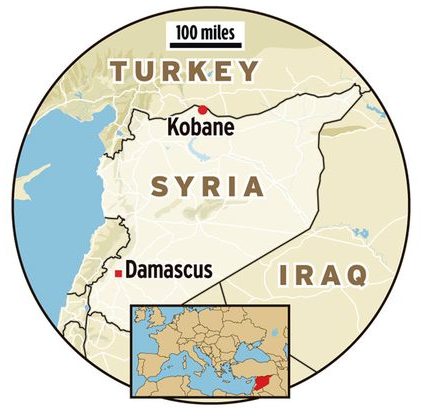
We could all use a bit of good news. I am pleased to observe that the U.S. air campaign against the Islamic State in the Levant (IS) has really made an impact, at least for the Kurds and the poor still stuck in Kobani.
 I had hoped that the Turks would have moved in by now, and wiped out the IS forces with a massive armor blitz, but it hasn't happened. Believe me, the Turks are more than capable of sweeping up IS like an ardvaark finishes off an anthill (language lesson: aardvark comes from the original Afrikaans work "erdvark", which translated means "earth pig"; I dig Afrikaans). Instead, the good
guys have to rely on the Kurds to defend Kobani, and they will, to the last man or woman. Thursday's solid, well-timed and well-targeted air strikes proved what can be accomplished with air power alone. On the other hand, it demonstrated the importance of ground forces. Rats like the IS love to dig holes in which to hide. The U.S. Army learned a great deal in World War Two and in Vietnam about the digging of holes and tunnel networks that can reach for miles. It demonstrated the usefulness of the flame thrower, that's for sure.
According to the first link, the IS now controls only 30 percent of Kobani, as opposed to yesterday's 50 percent. Interestingly enough, the IS has not made use of any of the armor that it has captured over the past six months. My sources tell me that the fighting in Kobani has been house-to-house, street -to-street. Booby-traps and all variety of homemade mines and other exploding weapons are being used. The IS units are well-armed, although as should be expected they carry a wide variety of weaponry. I'm hopeful that the air campaign alone can lift the siege of Kobani. Obviously ground units are needed, but the Kurds are still there, and if we can get the IS to abandon Kobani, it should be a victory. Why? Not for the obvious reason that we liberated a town from those hateful bastards, but because it proves the usefulness of an air campaign in disrupting the flow of supplies and replacement troops to the battlefield. Its great to see video clips of U.S. bombs taking out an IS outpost, but the analytical guy in me is much more interested in how successful we have been disrupting their flow of supplies. Every army, no matter how small, needs supplies and needs to eat. Deprive the IS of this element, and the citizens of Kobani will wake up in the morning with a particularly nasty stench removed from the air . . . the IS will be gone.
A couple weeks back I wrote a post about the defense of Baghdad. It has been one of the more popular posts since I began this blog in late August. I received a number of fascinating emails, and I would like to encourage folks to make these comments here on the blog (at the end of each post) or on Twitter @mukhabaratbaby, so we can get a conversation started. I can't think of anything more interesting than for all of us armchair generals to plan the defense of Baghdad together! Back to the post I mentioned . . . I believe the key to defending Baghdad is the proper use of air resources. Once the IS raised its black flag in Fallujah, the allied air forces should have been on top of them like Bill Clinton on a pair of XL panties.
 The IS is using the same strategy in Anbar as it has used in northern Iraq and in Syria. They like to be mobile, and they strike quickly. Once the IS has a foothold in the bedroom communities of Baghdad, the only way to save the capital city is with U.S. ground troops, which we know won't happen. So we have to look at the battle map and decide how best to halt the IS advance from western Anbar. My sources tell me that the IS is already implementing its version of law, courts, etc., in the recently captured Anbar communities. If these guys are out in the streets, parading around, staging the odd public execution, then where is the allied air force? I realize that towns like Fallujah and Ramadi guarantee collateral casualties, but this isn't the time to nit-pick. Let's just do our best to avoid civilians, and lets rain havoc down on the IS. We need to come at them, day and night, no schedule, so they have no opportunity for sleep. Anything that remotely resembles an IS vehicle should be a target. One thing to keep in mind, any resupplying of IS in western Anbar cannot be done unobserved. Its a bloody desert, for goodness sake. I know, I've been there. I've had that sand up my ass, and I've seen it from the air. Granted, the IS will take what it needs from the local Sunni population. But the key is, to not give the IS the time it needs to seed the poorer Sunni neighborhoods of Baghdad with operatives. I realize we may be too late, but since we are still playing the game, lets play to win.
Turkey Waits And Watches
We could all use a bit of good news. I am pleased to observe that the U.S. air campaign against the Islamic State in the Levant (IS) has really made an impact, at least for the Kurds and the poor still stuck in Kobani.
 |
| www.mirror.co.uk |
According to the first link, the IS now controls only 30 percent of Kobani, as opposed to yesterday's 50 percent. Interestingly enough, the IS has not made use of any of the armor that it has captured over the past six months. My sources tell me that the fighting in Kobani has been house-to-house, street -to-street. Booby-traps and all variety of homemade mines and other exploding weapons are being used. The IS units are well-armed, although as should be expected they carry a wide variety of weaponry. I'm hopeful that the air campaign alone can lift the siege of Kobani. Obviously ground units are needed, but the Kurds are still there, and if we can get the IS to abandon Kobani, it should be a victory. Why? Not for the obvious reason that we liberated a town from those hateful bastards, but because it proves the usefulness of an air campaign in disrupting the flow of supplies and replacement troops to the battlefield. Its great to see video clips of U.S. bombs taking out an IS outpost, but the analytical guy in me is much more interested in how successful we have been disrupting their flow of supplies. Every army, no matter how small, needs supplies and needs to eat. Deprive the IS of this element, and the citizens of Kobani will wake up in the morning with a particularly nasty stench removed from the air . . . the IS will be gone.
A couple weeks back I wrote a post about the defense of Baghdad. It has been one of the more popular posts since I began this blog in late August. I received a number of fascinating emails, and I would like to encourage folks to make these comments here on the blog (at the end of each post) or on Twitter @mukhabaratbaby, so we can get a conversation started. I can't think of anything more interesting than for all of us armchair generals to plan the defense of Baghdad together! Back to the post I mentioned . . . I believe the key to defending Baghdad is the proper use of air resources. Once the IS raised its black flag in Fallujah, the allied air forces should have been on top of them like Bill Clinton on a pair of XL panties.
Tuesday, October 14, 2014
Baghdad In The Crosshairs
Links: Iraqi Army Teeters On The Edge
Original Goals Of The Campaign
"It is the Iraqis in Anbar who will have to fight for Anbar". So says U.S. Secretary of State John Kerry. Even though Iraqi provincial governors and a number of military officers have stated bluntly that only U.S. ground forces will stop the Islamic State (IS). I have a few questions for the Secretary of State, beginning with:
~ Where is the air support for the Iraqi Army in Anbar province? I can't help but think that if the U.S. Air Force re-established itself at Baghdad International Airport with the necessary equipment, then the IS would have trouble holding Anbar province.
~ Does a campaign strategy exist for the U.S. air involvement in Iraq? If so, then why aren't we bombing these bastards day and night? Nothing about this air campaign, be it in Syria or Iraq, rises to my expectations. I know what the United States Air Force is capable of, so why aren't we doing it? I remember a conversation I had once with a CIA pilot, who had flown a bomber in the Vietnam War (for the U.S. Air Force...I don't think the CIA had any bombers at the time). He told me that at certain times, bombing campaigns over North Vietnamese and Viet Cong territory would leave nothing moving for extended periods. I'm sure that he was referring to carpet bombing, Agent Orange and all sorts of things we don't do anymore. But the strategy is sound: Use as much force as is appropriate for the mission, which in this instance is to kill operatives of the IS.....right?
On September 23rd, U.S. Army Lt. General William C. Mayville, Jr., director of operations for the Joint Staff at the Pentagon, stated that the overarching goal was to, "degrade and ultimately destroy" the Islamic State; first by directly attacking the group in Iraq and Syria, then severing its supply lines and disrupting its supply of arms and money. Interestingly enough, yours truly was calling for the same strategy in my late-August early-September posts. I'm flattered that the Joint Staff at the Pentagon reads my blog. And I hope they're reading it today, because events don't seem to be playing out as expected. True, the strategy hinges on the training and successful operational actions of three military elements: the Free Syrian Army, the Kurdish Peshmerga, and the Iraqi Army. Ideally, those three military elements would form a pincher to surround and suffocate the IS, as the air campaign would continue to harass IS units from the sky and to disrupt supply lines. First and foremost, its obvious to me that the planners did not envision the difficulty involved in standing up an Iraqi Army. You can fly in as many instructors as you like, and provide as much modern weaponry as exists, but you can't make a man put his life on the line in combat. The allies may have some success training and equipping the Free Syrian Army, and the Peshmerga is always a good bet, but this Iraqi Army thing? It just ain't happen'. I know the Generals at the Pentagon are beginning to realize this fact, but speaking up is just not an option. Why? Because the only alternative to an Iraqi Army on the ground to defend Baghdad (and ideally move offensively against the IS), is U.S. ground forces.
As I laid out last week in my post about the defense of Baghdad, do not expect the IS to attempt some traditional frontal assault, armor et al, on Baghdad. Lacking any air support, this strategy would be suicidal. Instead, they will continue with what has been successful before. No doubt they have already infiltrated the poorer Sunni neighborhoods of Baghdad, promising everything that the current "Shia government" has been unwilling/unable to provide. The IS will occupy Baghdad, piece by piece, neighborhood by neighborhood, street by street (this strategy doesn't need a schedule, which is a major benefit). In my previous post I outlined a strategy for combatting this subtle IS campaign, but my plan of action depended upon an overpowering air presence by the U.S., French, or other ally. This is what has me concerned. The Iraqi military efforts in Anbar province to hold the Hadithah Dam and to attempt to hold Ramadi (Fallujah is a lost cause) should have been accompanied by overpowering air support. Where was that air support? Are we to believe that the Iraqi Army deserted its posts even under the cover of Blackhawk gunships and F16s?
I guess it's possible, and I admit I don't know much about air warfare/strategy. But I do know this: we are losing the war in Iraq even before our surrogate army has taken the field. The Peshmerga are fighting for their lives in northern Syria and Iraq, and the IS is sweeping up the Iraqi Army in Anbar as it sets its sights on the minarets of Baghdad. I would have written about the Peshmerga crisis in Kobani, but I just don't have enough information to comment. The fact that the Turks are prepared to watch the IS smother the Peshmerga and take root in Kobani screams volumes about the absolute BALL-LESS nature of the Obama Administration's diplomacy. I suppose we should now expect this administration to follow precedent and apologize to the Turks for something in the hopes they will lend a hand to the Kurds in Kobani. I hope I am wrong and this administration has learned that in this part of the world too much apologizing is seen as submission and weakness when what we need to be showing is strength and leadership.
Subscribe to:
Posts (Atom)