Link: Violence between right-wing protesters and police outside Kiev Parliament.
The announcement by Ukrainian officials of a ceasefire with separatists has resulted in angry demonstrations from conservative and right-wing protesters outside of Parliament in the capital city of Kiev. The conservative political groups in Ukraine have traditionally been strong, and the crisis in the east of the country has only added to their influence. Ukrainians living in the west of the country are particularly incensed with the lack of progress in combatting the separatists, and the shaky coalition that President Petro Poroshenko requires to stay in power is under great pressure. Conservative Ukrainians were not satisfied with the provisions of the "Minsk II" agreement, which really never got off the ground, because the separatists began violating the agreement almost as soon as it was announced. Some of the more controversial provisions of "Minsk II" never saw the light if day, until now, when they were repeated as part of the new ceasefire agreement, scheduled to begin on Tuesday, September 1. The Ukrainian right-wing objects to the agreement for declaring a "special status" for the disputed areas, and also for introducing the idea of autonomy to the negotiations. On the other hand, the government claims that the ceasefire agreement only calls for the decentralization of authority, designed to give more power to local government. In reality, the demonstrations in Kiev were coming, sooner or later, as Conservative Ukrainians grow more dissatisfied everyday with the current situation in the east. The number of Ukrainian troops in the east is almost matched by the number of volunteers, who have picked up weapons and transported themselves to the front line, "to fight for the freedom and integrity of Ukraine", as one protester explained. Poroshenko and his EU puppet masters must understand that this outpouring of rejection is not only in response to this latest ceasefire agreement, but also a message that the people of Ukraine do not believe in any more treaties with the separatists.
Since the genesis of this crisis, every agreement with the Russian-backed separatists has been violated by the rebels. Actually, the modus operandi of this movement mirrors typical fascist behavior. Violate every agreement, but continue to sign them, as long as the enemy is stupid enough to continue negotiating under the pretense of "good faith". While the separatists continually violate agreements, the Russians keep lying about the involvement of the Russian military and use of Russian equipment. The obscene fact that even after the overwhelming amount of evidence, the Russian government and the separatists still refuse to admit that a Russian "Buk" missile destroyed Malaysian Airlines flight 17 (MH17), killing all 298 on board. in July 2015, a draft resolution to set up an international tribunal into the MH17 air disaster was put before the United Nations Security Council. Malaysia had requested a tribunal to take place, but the proposal was blocked by a Russian veto. It was the only nation on the 15-member UN Security Council to oppose the request. There can be only one reason why the Russian government would oppose an investigation by the world's leading experts on the subject: to hide its complicity. We don't believe the Russians themselves fired at the airliner. We are convinced that the basically untrained separatist volunteers who were manning the Buk missile launcher, mistook the airliner for a large Ukrainian Air Force cargo plane, a hypothesis which is supported by evidence, including recorded cell phone conversations from one separatist unit to another.
The citizens of Ukraine who are opposed to the current agreement stood by Poroshenko for some time. He was a sympathetic figure, attempting to do his best to appease the European and U.S. governments, and also continuing to look strong in the face of Russian aggression first in Crimea, and then in Donbas. Poroshenko was forced to walk a tricky tight rope. From his perspective, Ukraine would be lost without the steadfast support of Europe and the United States; therefore, if France, Germany and the Obama Administration advised compromise, then Poroshenko would compromise. Hollande, Merkel and Obama told Poroshenko that the Russians would eventually be obliged to back down, because the sanctions regime was going to cripple the Russian economy. As we predicted last year on this blog, Putin never had any intention of backing down because of the sanctions. He understood as we did; that the Russian people take particular offense at that type of punishment. The Russians are made of tougher stuff than that. They won't be made to compromise because a few items disappear off the shelves and everyone has to tighten their belt a bit. So the sanctions have failed, and Poroshenko has authorized negotiators in Minsk to compromise with the separatists and Russians, as directed by the Europeans and Americans. What was the result? Two agreements that were violated by the separatists before the paint was dry. In the last year, the separatists have expanded the territory under their control, to include the strategic town of Debaltseve. There has been no offensive activity on the part of the Ukrainian Army, not really.
So its clear why most Ukrainians have lost faith in Poroshenko and why demonstrators were protesting in Kiev. Its not just for this terrible agreement, but for the previous two which were violated, and for the failed sanctions regime, which was supposed to force Russia to compromise. Putin is winning this chess game hands down, because Europe and the United States are too frightened to allow Ukraine to take any Russian pieces. Earlier this year, we called for the United States to begin providing weapons to the Ukrainian Army, including F16s and Abrams tanks if necessary. The Ukrainian people have no love-lost for the Russians, and they have already watched Putin steal the Crimea right from under their nose. They are anxious to settle this issue on the battlefield, but the Obama Administration has hamstrung the Ukrainian Armed Forces by refusing to sell them weapons and equipment. Why don't the Ukrainians just go to someone else to get weapons? Because everyone else who is not in Russia's orbit, is following the lead of the United States. Its a tremendously depressing situation. Poroshenko would probably like to be more militarily aggressive, but to be so would probably cost him the support of France, Germany and the United States. We expect the Ukrainian people to bring about another change in government, which may result in full deployment of the Ukrainian military to eastern Ukraine for the purpose of ending the illegal separatist movement. But if the Russian military becomes directly involved, the Ukrainians will be hard-pressed to keep up, without an influx of new equipment and supplies. The end of this drama will probably result in a new Ukraine, minus the industrial southwest. And Putin will be man of the year in Sevastopol and Donetsk.

Showing posts with label Obama. Show all posts
Showing posts with label Obama. Show all posts
Thursday, September 3, 2015

Sunday, March 15, 2015
Islamic State Weakesses Exposed In Iraq; Netanyahu Struggling To Get Electoral Traction
Links: A. Islamic State Losses Mount In Iraq
B. Netanyahu Facing Difficult Election
The Obama Administration and the governments in Tehran and Baghdad have reason to breathe a long sigh of relief. It seems as if only yesterday, the Islamic State (IS) was aggressively expanding its military presence, to include Diyala Province and the Shi'a holy cities in central and southern Iraq. The allied air campaign appeared to have little impact against an enemy that was comfortable using the weather forecast in its operational planning, and the Iranian government was faced with increased international attention because of intended diplomatic discussions with the Obama Administration regarding its Nuclear Program. The IS was threatening Iraqi Security Forces (ISF) positions in the west, and U.S. instructors and advisors at the al-Asad Air Base, after overrunning the nearby town of al-Baghdadi. Roughly four weeks later, the ISF has successfully conducted a multi-faceted operation to retake Saddam Hussein's home of Tikrit, The Peshmerga are consolidating their control over important communities in northwest Iraq, and operations outside of Kirkuk might demonstrate a level of cooperation between the Peshmerga, the ISF, and local militia that has yet to be noted. Last year, the Kirkuk government had expressed opposition to federal forces (ISF) operating in the province. If the hardline position taken by authorities in Kirkuk has been reversed, it would be significant, as the IS would be forced to defend against a united enemy, as opposed to three separate, smaller opponents, each with their own focus and agenda.
The string of recent IS losses point to an opponent that has become better funded, equipped and motivated. There was some concern that regular Iranian forces would be obliged to enter the conflict, especially if the IS had been able to consolidate its operations in Diyala Province. But the IS has adopted a defensive posture in much of Iraq, as its units were over-extended in numerous locations, and unable to find adequate supplies or food. It should be noted, however, that the structure of the IS allows it to continue aggressive offensive operations in Ramadi and Fallujah, while pulling back in Tikrit and Kirkuk. It took some time and a few desperate engagements, but the ISF and its surrogate Shi'a militia partners have started to function much more like a single unit, which increases the impact of offensive operations. If you include the Peshmerga and local anti-IS Sunni militia in the mix, and the IS is in real danger of being swept up in north central Iraq. The existence of an effective support network has proven invaluable for the ISF and the Peshmerga, and the lack of has been crippling for IS forces. If the ISF and Peshmerga successfully continue their campaign to push the IS out of the areas of Erbil, Mosul, Baiji and Kirkuk, then we will be returning almost exclusively to the still-familiar battlefields of 2007-2008: Ramadi and Fallujah. It will be interesting to observe what lessons the IS has learned from the battle of Fallujah between insurgents and the U.S. military, and also if the ISF will follow the same strategy that eventually won the day for U.S. and Iraqi government forces.
Iranian Diplomacy and the Issue of Iraq: recent positive developments on the battlefields of Iraq have given the Iranian government a bit more breathing room. The announcement last month by the Obama Administration of an effort to engage the Iranian government directly and address the nuclear issue, increased the pressure on the government in Tehran to avoid the appearance of aggressive, unwelcome military operations in Iraq. Tehran has been able to support the Iraqi government (and military) with advisors and military aid, but the real benefit from Iran comes from the involvement of the Shi'a militias. These militias, who follow the guidance of religious leaders as opposed to the orders of politicians or generals, act as a surrogate military presence in lieu of regular Iranian units. They are not necessarily well-trained, but are usually well-equipped and highly motivated to die for their religion (they consider the IS to be the worst kind of Sunni movement, one that directly threatens the very existence of the Shi'a community). Even with the presence of the militias, there was a period when analysts were considering the probability of direct Iranian military intervention. By avoiding this development, Tehran can keep the international focus on its apparent "forward-leaning" attitude vis-a-vis meeting with the Obama Administration to discuss a possible resolution to the nuclear issue. Such an agreement would not only help to reform the Iranian image worldwide, it would more than likely include a return to normal diplomatic relations with the United States (first Cuba, then Iran....whose next, North Korea?).
On March 17, the people of Israel will elect a new Knesset. This election was not mandatory; when Prime Minister Benjamin Netanyahu announced the decision to conduct early elections, analysts anticipated a strong Likud victory, and possibly a bit of a mandate for Netanyahu to continue his hardline policies. What has transpired has been nothing short of astounding, and I'm sure will result in an interesting documentary ort film one day. Forces opposed to Netanyahu coalesced, and using lessons learned from the last two U.S. presidential elections, have created an electoral juggernaut that could very well put a center-left government in office, when over seventy percent of Israelis still identify themselves as either conservatives or supporters of Likud. The strategy relies on a number of factors: first, all voters who support or lean towards the center-left must be identified, located and registered to vote. Next, a full-proof transportation network must be put in place, to ensure that voters reach the correct voting station before it closes (Israeli electoral law has no absentee voting provision, and voting locations are instructed to close exactly on a pre-designated time; if you arrived late, too bad). As is usually the case, this election will be decided by turnout. The Israeli press, much of it hostile to Netanyahu, has been aggressively attacking the Prime Minister on every aspect of his leadership, and Netanyahu's allegation that foreign money has entered the Israeli political system is correct. A great deal of money from outside Israel has found its way into this election, especially with regards to anti-Netanyahu advertisements. On the other hand, Netanyahu is wildly popular in the United States, and Likud has certainly benefited from the financial support of Americans. I'm not prepared to write-off Netanyahu. He has worked tirelessly to galvanize Likud voters against a threat to the party, and no doubt on election day, a certain percentage of other rightist and religious parties will cross lines and vote Likud, just to show opposition to The Zionist Union.
B. Netanyahu Facing Difficult Election
The Obama Administration and the governments in Tehran and Baghdad have reason to breathe a long sigh of relief. It seems as if only yesterday, the Islamic State (IS) was aggressively expanding its military presence, to include Diyala Province and the Shi'a holy cities in central and southern Iraq. The allied air campaign appeared to have little impact against an enemy that was comfortable using the weather forecast in its operational planning, and the Iranian government was faced with increased international attention because of intended diplomatic discussions with the Obama Administration regarding its Nuclear Program. The IS was threatening Iraqi Security Forces (ISF) positions in the west, and U.S. instructors and advisors at the al-Asad Air Base, after overrunning the nearby town of al-Baghdadi. Roughly four weeks later, the ISF has successfully conducted a multi-faceted operation to retake Saddam Hussein's home of Tikrit, The Peshmerga are consolidating their control over important communities in northwest Iraq, and operations outside of Kirkuk might demonstrate a level of cooperation between the Peshmerga, the ISF, and local militia that has yet to be noted. Last year, the Kirkuk government had expressed opposition to federal forces (ISF) operating in the province. If the hardline position taken by authorities in Kirkuk has been reversed, it would be significant, as the IS would be forced to defend against a united enemy, as opposed to three separate, smaller opponents, each with their own focus and agenda.
The string of recent IS losses point to an opponent that has become better funded, equipped and motivated. There was some concern that regular Iranian forces would be obliged to enter the conflict, especially if the IS had been able to consolidate its operations in Diyala Province. But the IS has adopted a defensive posture in much of Iraq, as its units were over-extended in numerous locations, and unable to find adequate supplies or food. It should be noted, however, that the structure of the IS allows it to continue aggressive offensive operations in Ramadi and Fallujah, while pulling back in Tikrit and Kirkuk. It took some time and a few desperate engagements, but the ISF and its surrogate Shi'a militia partners have started to function much more like a single unit, which increases the impact of offensive operations. If you include the Peshmerga and local anti-IS Sunni militia in the mix, and the IS is in real danger of being swept up in north central Iraq. The existence of an effective support network has proven invaluable for the ISF and the Peshmerga, and the lack of has been crippling for IS forces. If the ISF and Peshmerga successfully continue their campaign to push the IS out of the areas of Erbil, Mosul, Baiji and Kirkuk, then we will be returning almost exclusively to the still-familiar battlefields of 2007-2008: Ramadi and Fallujah. It will be interesting to observe what lessons the IS has learned from the battle of Fallujah between insurgents and the U.S. military, and also if the ISF will follow the same strategy that eventually won the day for U.S. and Iraqi government forces.
Iranian Diplomacy and the Issue of Iraq: recent positive developments on the battlefields of Iraq have given the Iranian government a bit more breathing room. The announcement last month by the Obama Administration of an effort to engage the Iranian government directly and address the nuclear issue, increased the pressure on the government in Tehran to avoid the appearance of aggressive, unwelcome military operations in Iraq. Tehran has been able to support the Iraqi government (and military) with advisors and military aid, but the real benefit from Iran comes from the involvement of the Shi'a militias. These militias, who follow the guidance of religious leaders as opposed to the orders of politicians or generals, act as a surrogate military presence in lieu of regular Iranian units. They are not necessarily well-trained, but are usually well-equipped and highly motivated to die for their religion (they consider the IS to be the worst kind of Sunni movement, one that directly threatens the very existence of the Shi'a community). Even with the presence of the militias, there was a period when analysts were considering the probability of direct Iranian military intervention. By avoiding this development, Tehran can keep the international focus on its apparent "forward-leaning" attitude vis-a-vis meeting with the Obama Administration to discuss a possible resolution to the nuclear issue. Such an agreement would not only help to reform the Iranian image worldwide, it would more than likely include a return to normal diplomatic relations with the United States (first Cuba, then Iran....whose next, North Korea?).
On March 17, the people of Israel will elect a new Knesset. This election was not mandatory; when Prime Minister Benjamin Netanyahu announced the decision to conduct early elections, analysts anticipated a strong Likud victory, and possibly a bit of a mandate for Netanyahu to continue his hardline policies. What has transpired has been nothing short of astounding, and I'm sure will result in an interesting documentary ort film one day. Forces opposed to Netanyahu coalesced, and using lessons learned from the last two U.S. presidential elections, have created an electoral juggernaut that could very well put a center-left government in office, when over seventy percent of Israelis still identify themselves as either conservatives or supporters of Likud. The strategy relies on a number of factors: first, all voters who support or lean towards the center-left must be identified, located and registered to vote. Next, a full-proof transportation network must be put in place, to ensure that voters reach the correct voting station before it closes (Israeli electoral law has no absentee voting provision, and voting locations are instructed to close exactly on a pre-designated time; if you arrived late, too bad). As is usually the case, this election will be decided by turnout. The Israeli press, much of it hostile to Netanyahu, has been aggressively attacking the Prime Minister on every aspect of his leadership, and Netanyahu's allegation that foreign money has entered the Israeli political system is correct. A great deal of money from outside Israel has found its way into this election, especially with regards to anti-Netanyahu advertisements. On the other hand, Netanyahu is wildly popular in the United States, and Likud has certainly benefited from the financial support of Americans. I'm not prepared to write-off Netanyahu. He has worked tirelessly to galvanize Likud voters against a threat to the party, and no doubt on election day, a certain percentage of other rightist and religious parties will cross lines and vote Likud, just to show opposition to The Zionist Union.
Wednesday, February 4, 2015
How Similar is the New Russia To The USSR? (Part II)
Links: A. Russia Wikipedia
B. Description of Organized Crime in Russia
C. Useful Background on Russian Political Structure
D. Putin Wikipedia
I've finally been able to shelve my disappointment at the direction Russia is moving in the twenty-first century. In the last decade, Putin has repeatedly demonstrated his disdain for NATO and the international rule of law. What amazes me is the European willingness to cling to the idea of international law, even while the Russians, Chinese, Iranians and Islamic terrorists are giving Den Haag the finger. We live in a time during which an illness that I like to call the "Chamberlain Syndrome" seems to be infecting the leaders of Europe. It coincides with another malady I have named, the "America has been naughty and we are so sorry" Syndrome, which has taken root in the present U.S. Administration. It should come as no surprise that the bad guys aren't moved by "national moments of reflection". They will take advantage of every inch and every ounce that they are given. The Chinese, Russians and Iranians are a perfect example of how the rest of the world thinks and behaves. They follow military and diplomatic initiatives that have one purpose only: to further what they see as their own best interests, to the detriment of whomever it is that they consider to be their prime enemy. In all four cases (throw in the Islamic extremists as well), the number one enemy is the United States.
In the case of Putin, his ability to build such a formidable base and consolidate his personal power has been phenomenal. History demonstrates that while Yeltsin spent most of his
time in office drunk out of his gourd, the Russian Mafia and related organized crime interests practically took over Russia. The networks which now call the shots in Moscow are not nearly as numerous as they once were. This is a direct result of one criminal enterprise swallowing up the smaller, less powerful guppies. What we see in Russia today are a handful of criminal organizations, usually headed by one individual, who methodically and without conscience demand a cut of just about every piece of the Russian economy. Who says criminals can't appreciate organization? In the United States we have observed a number of law-abiding Wall Street firms go bad, and transpose all of their assets and training to almost 'legitimize" their corrupt activities. Who is more powerful, the crime lords of Russia or Vladimir Putin? Its basically a moot point at this juncture, since they continue to drink at the same trough. But my suspicion is that Putin has the upper hand. Why? Because he never hesitates. If one of the oligarchs pisses him off, they end up in jail. It's that simple. I don't know of a Russian, crime lord or not, who can give orders to Putin. He singularly controls the Duma, the Press, the Military and the Police. The criminal elements understand that they need to play nice with Vlad, and then everyone goes home happy. The recent problems with the Russian economy will no doubt cut into the profits of these various enterprises, and it will be interesting to see how things shake out if the price of oil doesn't rebound soon.
Continued crippling economic contraction is the one development which can damage Putin. But in order for this to continue, the price of oil must stay low or go lower. This will not happen, because the Arabs need a return to payday just as much as the Russians do. Once the price moves back in the other direction, Russia will again have its battering ram against Europe. If only the countries who are dependent upon Russia for oil and natural gas were in a position to buy it from the United States instead, then Russia would lose most of its clout.
Why do Russia and Putin insist on being so contrary? I'm no psychologist, but I believe Putin is a bit of a sociopath. He craves power, and conveniently for him, he has no conscience. Putin doesn't want to share power with the United States. As a former KGB man, he has nothing but disdain for the American people and all those values we constantly lecture others about. Putin wants to win, and he will do what it takes to end up on top. The Chinese are a bit more pragmatic. They don't take their endemic distrust of the United States personally. Its about the glory of China, and the spread of Chinese power and influence around the globe. I think Putin sees the world through a special pair of glasses, that allow him to always gauge his decisions vis-à-vis the United States. Putin doesn't fear China because he considers the Chinese military to be a bit of a paper tiger — and he should know, given the volume of military trade that has taken place between China and Russia. The American people had better give serious and full consideration on who they choose to elect in 2016, because the four main antagonists (not to mention the rise in anti-U.S. politics in Latin America and Africa) all see the U.S. as their principle adversary. Its a very dangerous time to be an American, with so many enemies about. Thankfully, we can rely on diplomacy and allies to deal with most of our troubles. Islamic extremists are a whole different matter. They must be dealt with as a priority, and with military determination and strength. We may be saying the same thing about Russia one day.
B. Description of Organized Crime in Russia
C. Useful Background on Russian Political Structure
D. Putin Wikipedia
In the case of Putin, his ability to build such a formidable base and consolidate his personal power has been phenomenal. History demonstrates that while Yeltsin spent most of his
 |
| 1999 Putin and Yeltsin with Patriarch Alexy II Source: Kremlin.ru |
 |
| Putin with Chairman of Gazprom’s Mgmt Committee and the Vice Premier of China, Zhang Gaoli; Source: Kremlin.ru |
Why do Russia and Putin insist on being so contrary? I'm no psychologist, but I believe Putin is a bit of a sociopath. He craves power, and conveniently for him, he has no conscience. Putin doesn't want to share power with the United States. As a former KGB man, he has nothing but disdain for the American people and all those values we constantly lecture others about. Putin wants to win, and he will do what it takes to end up on top. The Chinese are a bit more pragmatic. They don't take their endemic distrust of the United States personally. Its about the glory of China, and the spread of Chinese power and influence around the globe. I think Putin sees the world through a special pair of glasses, that allow him to always gauge his decisions vis-à-vis the United States. Putin doesn't fear China because he considers the Chinese military to be a bit of a paper tiger — and he should know, given the volume of military trade that has taken place between China and Russia. The American people had better give serious and full consideration on who they choose to elect in 2016, because the four main antagonists (not to mention the rise in anti-U.S. politics in Latin America and Africa) all see the U.S. as their principle adversary. Its a very dangerous time to be an American, with so many enemies about. Thankfully, we can rely on diplomacy and allies to deal with most of our troubles. Islamic extremists are a whole different matter. They must be dealt with as a priority, and with military determination and strength. We may be saying the same thing about Russia one day.
Monday, February 2, 2015
How Similar is the New Russia To The USSR? (Part I)
Links: A. Russia Wikipedia
B. Description of Organized Crime in Russia
C. Useful Background on Russian Political Structure
D. Putin Wikipedia
Of all the posts I've written for the blog, this one has been the most difficult to put together. When the Cold War ended and Boris Yeltsin was singing the praises of capitalism, I was truly optimistic about Russia's future. There can be no doubt that the Russian people work hard and take pride in their country. In July 1998, when the bodies of the former ruling Romanov family were interred in St. Petersburg, and the streets were lined with people showing their respect as the coffins made their way to the St. Peter and Paul Cathedral, I thought to myself that Russia had come to terms with its past and was ready to embrace the future. I had this crazy notion that the United States and Russia would lead the world on a crusade for peace, economic freedom for all, and ecological responsibility. It was a serious dose of wishful thinking. Since that time, I have been reminded that the Russian people are obsessed with the need for a strong leader, regardless of the freedoms they must relinquish. The everyday, on the street Russian is fairly well-read and educated. They watch the news, read the paper and listen to the radio. Granted, it's mostly propaganda bullshit, but they know how to read between the lines. They just chose not to. The average Russian is well aware of President Vladimir Putin's ties to organized crime and his manipulation of the political system to allow for his permanence in power. They are not blind to the fact that Putin cut every state budget, while increasing defense spending by twenty percent. Does anyone see a threat to Russia? Is there a need for the Russians to be stocking up on equipment and weapons to defend the Motherland? Of course not; and the increase in defense spending was for offensive intentions, vice defense. The next reasonable question to ask is, "if Russia doesn't have an outside threat, then what offensive operations are being considered?"
Obviously Putin is not satisfied with the situation in Ukraine. I imagine that he expected the Ukrainians to have folded by now, and accepted the loss of the Crimea in order to secure the integrity of Eastern Ukraine. Putin keeps up the charade of a Donbas indigenous
movement to be annexed by Russia, in order to keep his military active in the region. His military and the equipping of the guerilla forces around Donets'k, Luhans'k and Mariupol' is singularly intended to create a bargaining chip. Putin will pull out of Eastern Ukraine, if Ukraine and the west will recognize the annexation of Crimea to Russia. I believe that Putin expected the Ukrainian government to fold, given their dependence on Russian oil and natural gas, and the apparent sorry state of affairs in the Ukrainian military. But the people of Kiev and Western Ukraine have had just about enough of Russian military bullying. The people of Ukraine have suffered heavily from Russian intervention over the years, and, particularly in western Ukraine, they want nothing to do with old school "business-as -usual". They want a Ukraine as part of Europe, a member of NATO and hopefully one day a member of the EU. Ukrainian military officials were not prepared for the number of volunteers from western Ukraine who have flooded recruitment centers, and the new government has been given a free-reign to conduct the war as it sees fit, as long as no concessions are made to Russia. If the current government gave any indication that it was considering a swap of Crimea for peace in Donbas, they would be under siege from protesters in Kiev. The unexpected success of sanctions imposed by the United States and Europe has steeled the nerve of the government in Kiev, but for how long is anybody's guess. The reality is, if it weren't for certain decisions being made in Saudi Arabia, then the price of oil would not have fallen dramatically and the EU and U.S. sanctions would have been basically harmless. Make no mistake, the real impact of sanctions on Russia are only causing hardship because of the combined impact of the fall of the price of crude.
 Contrary to what many in the west want to believe, Putin is not losing any sleep. If he were, then he wouldn't have initiated a costly, aggressive move into the Arctic region. Putin knows that the low price of a barrel of crude is a temporary factor, and that the Ruble will rebound sooner rather than later. Putin's actions in the Arctic are not a short-term strategy. He realizes that taking control of the desolate islands in the Arctic (by right of simple possession) won't give him overnight access to thirty percent of the world's natural gas reserves and thirteen percent of it's oil reserves. This move, to rebuild airbases, relocate naval squadrons, position troops and begin a diplomatic offensive, will take time. Putin is counting on a Hillary Clinton presidency, as he sees her as little more than a shorter, fatter version of Barrack Obama (have a look at the provisions of the "New Start" Treaty that Hillary negotiated with Putin in 2010; believe me, Vlad is salivating at the thought of another President Clinton). He knows that he can threaten and bluff all the way to Spitsbergen/Svalbard and back, if necessary. Norway has a huge stake in the future debate over the Arctic, as does Canada and the United States. Heck, even Denmark (Greenland) should be part of the discussion. Even if the U.S. elects a Republican as president in 2016, it will be hard to displace Russia once she has militarized Novaya Zemlya and Franz Josef Land. The real issue of contention will be the area of the Berents Sea and anything close to Norway. Frankly, the majority of the deposits sit well within Russian territory as it is. I can only assume that the military build-up in the region is to ensure that any contentious strikes, or new discoveries, will go Russia's way as well.
B. Description of Organized Crime in Russia
C. Useful Background on Russian Political Structure
D. Putin Wikipedia
Of all the posts I've written for the blog, this one has been the most difficult to put together. When the Cold War ended and Boris Yeltsin was singing the praises of capitalism, I was truly optimistic about Russia's future. There can be no doubt that the Russian people work hard and take pride in their country. In July 1998, when the bodies of the former ruling Romanov family were interred in St. Petersburg, and the streets were lined with people showing their respect as the coffins made their way to the St. Peter and Paul Cathedral, I thought to myself that Russia had come to terms with its past and was ready to embrace the future. I had this crazy notion that the United States and Russia would lead the world on a crusade for peace, economic freedom for all, and ecological responsibility. It was a serious dose of wishful thinking. Since that time, I have been reminded that the Russian people are obsessed with the need for a strong leader, regardless of the freedoms they must relinquish. The everyday, on the street Russian is fairly well-read and educated. They watch the news, read the paper and listen to the radio. Granted, it's mostly propaganda bullshit, but they know how to read between the lines. They just chose not to. The average Russian is well aware of President Vladimir Putin's ties to organized crime and his manipulation of the political system to allow for his permanence in power. They are not blind to the fact that Putin cut every state budget, while increasing defense spending by twenty percent. Does anyone see a threat to Russia? Is there a need for the Russians to be stocking up on equipment and weapons to defend the Motherland? Of course not; and the increase in defense spending was for offensive intentions, vice defense. The next reasonable question to ask is, "if Russia doesn't have an outside threat, then what offensive operations are being considered?"
Obviously Putin is not satisfied with the situation in Ukraine. I imagine that he expected the Ukrainians to have folded by now, and accepted the loss of the Crimea in order to secure the integrity of Eastern Ukraine. Putin keeps up the charade of a Donbas indigenous
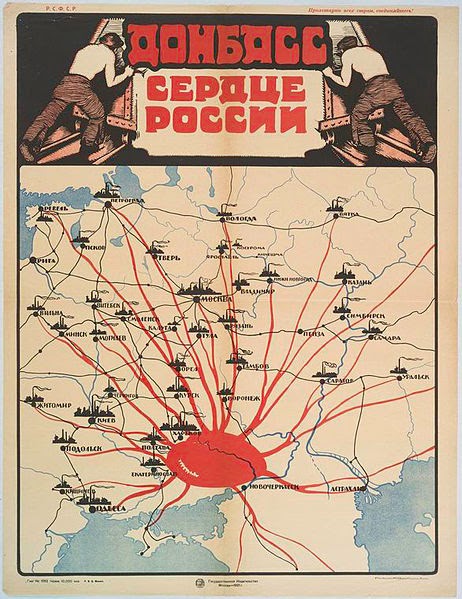 |
| 1921 Soviet propaganda poster praising Donets Basin as Heart of Russia; PD-1923 |
Sunday, November 9, 2014
Update On Troubles In Ukraine
Link: Russian Army Tank Column Crosses Border Into Ukraine
Its been a while since we visited Ukraine. Syria, Iraq and West Africa have been a bit distracting as of late. In all honesty, I was beginning to hope that cooler heads had prevailed in Moscow. Putin had the opportunity to "magnanimously" withdraw all Russian units from eastern Ukraine, and invite the Ukrainians (alone) to join him at the negotiating table. You know and I know that Russia will not be returning Crimea to Ukraine, and Putin's influence and reputation have suffered because of this unilateral annexation. So a peace offensive on the part of Putin would provide a way out for those Europeans who have been looking for a way to forgive Russia, and to do so without losing face. While theoretically this could begin with a sign of good faith in form of the departure of Russian military units from eastern Ukraine, it isn't going to happen. We now have clear and dangerous indications that Russian armor is on the move in eastern Ukraine. Friday's actions remind me of the Russian invasion of Georgia in 2008 and I fully expect to see a mobilization of sorts from the Russian Army (In the long run, Russia's less-than prepared Army and Airborne units invading Georgia resembled Mussolini's forces invading Greece in 1940). Putin knows he doesn't need to play "peacemaker," and negotiate to keep Crimea. He recognizes that Russia can tear off just as much of Ukraine as she pleases. Merkel, Cameron and Hollande (is this little pipsqueak still around?) will go to lunch and toss a few more sanctions at Russia. Putin is well aware that this is the only recourse for the European
 Union. Since I don't see much anti-Putin agitation in Moscow these days, we can assume that the sanctions haven't been much of a deterrent.
Last month, I hypothesized that Putin was really only interested in Crimea, because of its strategic location on the Black Sea. I believe he stirred up the shit pot among the substantial Russian minority in Donetsk, Luhansk, Kharkiv, and Dnipropetrovsk (why do I like saying "Dnipropetrovsk" so much?) in order to create a problem that only he could solve. I assumed that Putin was planning to offer peace and the departure of Russian forces from eastern Ukraine, in exchange for an acknowledgement of Russia's Crimean annexation. It's really simple, when you think about it. If you want something that belongs to someone else, you take it, along with something else of value. In order to return the second item of value, they must accept that you are keeping the first item. If not, they risk losing both. I believe that Putin's original intention was to maneuver his way into receiving European and Ukrainian acceptance of Russian Crimea. For the life of me I couldn't find a reason why Putin would want eastern Ukraine. Forgive the rudeness, but have you been to Donetsk? Its not Vienna or Paris, that's for sure. Hell, its not even Des Moines. But Putin did not need to find justification for invading eastern Ukraine. All Putin needed to do was CONVINCE THE WEST that he had reason for invading eastern Ukraine (all those poor, abused ethnic Russians). Then when the mercenary slugs hired by Putin in the Donetsk region accidentally shot down a civilian jet full of totally innocent folks, I imagine that Putin was obliged to review his escape strategy. But, as it is with most things, if you wait awhile, people will forget. I can't remember the last time I heard mention of the Malaysian Airlines jet that was shot down.
The truth is, Putin realizes that he doesn't have to order the departure of Russian forces from eastern Ukraine. The typically weak line of diplomacy offered up by Obama, Merkel, Hollande and Kirk Cameron has allowed Putin to annex Crimea and absorb the Ukrainian Navy. And to Putin's surprise, it looks like he gets to keep as much of the Ukraine as he chooses. It's no longer about Crimea. The presence of a column of what appears to be functioning (nothing is guaranteed) Russian armor tooling around in the Donbas region of eastern Ukraine is a clear indication to me that Putin has decided to "up the ante". It is in Putin's nature to take advantage of as many opportunities as possible, which includes the west being distracted by events on Syria, Iraq and Liberia. These distractions, and Obama's continued mantra about "no ground troops" (which is an example to be followed by everyone....except France), have given Putin the opportunity to decide just how much of
Ukraine to keep. Interestingly enough, while Putin dances diplomatic circles around Obama and the Europeans, he has had plenty of time to send equipment, supplies and possibly air units to his buddy Bashir al-Assad in Damascus. I'm guessing that Vlad is trying to get as much accomplished as possible before 2016, when its likely that the White House will be home to someone "with a pair". I can just imagine what the map of Ukraine will look like in 2016. Eastern Ukraine does have a number of lovely forested regions, perfect for a topless Putin to go on lots of horseback excursions. I only ask, for the sake of decency, Vlad: either find a training bra or put your shirt back on.
Its been a while since we visited Ukraine. Syria, Iraq and West Africa have been a bit distracting as of late. In all honesty, I was beginning to hope that cooler heads had prevailed in Moscow. Putin had the opportunity to "magnanimously" withdraw all Russian units from eastern Ukraine, and invite the Ukrainians (alone) to join him at the negotiating table. You know and I know that Russia will not be returning Crimea to Ukraine, and Putin's influence and reputation have suffered because of this unilateral annexation. So a peace offensive on the part of Putin would provide a way out for those Europeans who have been looking for a way to forgive Russia, and to do so without losing face. While theoretically this could begin with a sign of good faith in form of the departure of Russian military units from eastern Ukraine, it isn't going to happen. We now have clear and dangerous indications that Russian armor is on the move in eastern Ukraine. Friday's actions remind me of the Russian invasion of Georgia in 2008 and I fully expect to see a mobilization of sorts from the Russian Army (In the long run, Russia's less-than prepared Army and Airborne units invading Georgia resembled Mussolini's forces invading Greece in 1940). Putin knows he doesn't need to play "peacemaker," and negotiate to keep Crimea. He recognizes that Russia can tear off just as much of Ukraine as she pleases. Merkel, Cameron and Hollande (is this little pipsqueak still around?) will go to lunch and toss a few more sanctions at Russia. Putin is well aware that this is the only recourse for the European
Last month, I hypothesized that Putin was really only interested in Crimea, because of its strategic location on the Black Sea. I believe he stirred up the shit pot among the substantial Russian minority in Donetsk, Luhansk, Kharkiv, and Dnipropetrovsk (why do I like saying "Dnipropetrovsk" so much?) in order to create a problem that only he could solve. I assumed that Putin was planning to offer peace and the departure of Russian forces from eastern Ukraine, in exchange for an acknowledgement of Russia's Crimean annexation. It's really simple, when you think about it. If you want something that belongs to someone else, you take it, along with something else of value. In order to return the second item of value, they must accept that you are keeping the first item. If not, they risk losing both. I believe that Putin's original intention was to maneuver his way into receiving European and Ukrainian acceptance of Russian Crimea. For the life of me I couldn't find a reason why Putin would want eastern Ukraine. Forgive the rudeness, but have you been to Donetsk? Its not Vienna or Paris, that's for sure. Hell, its not even Des Moines. But Putin did not need to find justification for invading eastern Ukraine. All Putin needed to do was CONVINCE THE WEST that he had reason for invading eastern Ukraine (all those poor, abused ethnic Russians). Then when the mercenary slugs hired by Putin in the Donetsk region accidentally shot down a civilian jet full of totally innocent folks, I imagine that Putin was obliged to review his escape strategy. But, as it is with most things, if you wait awhile, people will forget. I can't remember the last time I heard mention of the Malaysian Airlines jet that was shot down.
The truth is, Putin realizes that he doesn't have to order the departure of Russian forces from eastern Ukraine. The typically weak line of diplomacy offered up by Obama, Merkel, Hollande and Kirk Cameron has allowed Putin to annex Crimea and absorb the Ukrainian Navy. And to Putin's surprise, it looks like he gets to keep as much of the Ukraine as he chooses. It's no longer about Crimea. The presence of a column of what appears to be functioning (nothing is guaranteed) Russian armor tooling around in the Donbas region of eastern Ukraine is a clear indication to me that Putin has decided to "up the ante". It is in Putin's nature to take advantage of as many opportunities as possible, which includes the west being distracted by events on Syria, Iraq and Liberia. These distractions, and Obama's continued mantra about "no ground troops" (which is an example to be followed by everyone....except France), have given Putin the opportunity to decide just how much of
 |
| A horse with two asses . . . |
Friday, August 29, 2014
What game is Putin playing?
Link: What is Putin trying to accomplish by invading the Ukraine?
In case you haven't noticed, I'm a bit of a fan of "vox.com". They don't hesitate to offer possibilities that more mainstream news sources shy away from. As for the issue addressed in this posting (Putin, Russia and this mini-invasion of Eastern Ukraine), I wish I had some clue what Vlad is planning, or if he has script at all. My first thought was that Russia was stepping up military activity vis-à-vis Eastern Ukraine for two reasons: first, the attention of NATO and the United Nations has been drawn back to the Near East (I chose to say Near East instead of Middle East; its how I was raised from an infant Case Officer) and this Caliphate bunch of beasties. Second, with the eyes of the West elsewhere, an opportunity arises to bolster the battered pro-Russian guerillas around Luhansk and Donetsk.
To be honest, I've been a bit confused by the part being played by the Ukrainian military. I realize that the Ukrainian Army and Air Force (the Navy ceased to exist a few months back) cannot stand up to a full mobilization by Russia. But we have yet to see anything close to a full Russian mobilization. I would love to see it, though. Vlad would be exposing the weaknesses of his planning and organizational capabilities to the very interested eyes of NATO. Back to the Ukrainian Army. The Ukrainians have been very active in every peace keeping operation in recent memory. They have troops (not a whole lot, granted) who have seen action and also worked side-by-side with Western forces. Ukraine recently reduced the size of its army by leaps and bounds, but this was more of an effort to modernize and streamline than anything else. As of today, the majority of Ukraine's fighting potential is still sitting around Kiev and to the West. Why haven't they charged into Eastern Ukraine, full force, and wiped out this bunch of ass holes that take hostages and shoot down civilian jet liners? Obviously the new administration in Kiev does not want to act rashly and encourage Russia to raise the stakes as well. But aggressive action is the only action Putin respects. Taking small steps only will allow Putin to completely step over the Ukrainians. I have been encouraged by the Ukrainian Army's recent successes, but I can't help wonder if a full assault against these thugs would not have ended this issue altogether.
I have a brilliant friend who is convinced that Putin is trying to occupy a bit of land and strengthen the guerillas to improve his bargaining position. My buddy believes that the Russian people will not give Putin an unending vote of confidence as sanctions start to really bite the Russian middle class. The sanctions are hurting, but mostly in the pocketbook of the richest of Russians. But these guys are the ones who seem to be backing Putin lately (the ones who farted without his permission ended up in jail or in exile in the UK). My friend believes that Putin will use Eastern Ukraine as a bargaining chip to permanently attach the Crimean Republic (just in name only, folks) to Mother Russia. Crimea does appear to be the most valuable piece of this puzzle from a strategic perspective. Putin has already reunited the Russian Navy and if he can gain some legitimacy for his military conquest of Crimea, then the Black Sea again becomes a Russian lake (no offense to the Bulgarians, Romanians, Moldovans, Turks, etc.). The Black Sea is more than just important from a military viewpoint. The issue of oil and its transport (pipelines, drilling, refining, shipping, all that good stuff) are unavoidably connected to the Black Sea. Maybe Putin believes he can trade stability in Eastern Ukraine (and friendly relations with Russia) with the acceptance of a fait d-accompli in Crimea.
The Obama Administration has a very painful headache to deal with. Instead of the proverbial two-front war (that doomed Hitler and Napoleon), Obama is faced with a two-front diplomatic crisis. Both might one day involve the U.S. military, so forward-thinking (not this Administration's strong suit..) is a must. I would argue that the day has come and gone for giving the Ukrainian Army and Air Force whatever they want. The Ukrainian people are majorly pissed off at Putin and the Russians, and the regular Ukrainian Army echoes those feelings. I say give them what they need to free their homeland, and call Putin's bluff. As for the Near East, you will have to tune in tomorrow for that commentary. Much obliged, folks.....
In case you haven't noticed, I'm a bit of a fan of "vox.com". They don't hesitate to offer possibilities that more mainstream news sources shy away from. As for the issue addressed in this posting (Putin, Russia and this mini-invasion of Eastern Ukraine), I wish I had some clue what Vlad is planning, or if he has script at all. My first thought was that Russia was stepping up military activity vis-à-vis Eastern Ukraine for two reasons: first, the attention of NATO and the United Nations has been drawn back to the Near East (I chose to say Near East instead of Middle East; its how I was raised from an infant Case Officer) and this Caliphate bunch of beasties. Second, with the eyes of the West elsewhere, an opportunity arises to bolster the battered pro-Russian guerillas around Luhansk and Donetsk.
To be honest, I've been a bit confused by the part being played by the Ukrainian military. I realize that the Ukrainian Army and Air Force (the Navy ceased to exist a few months back) cannot stand up to a full mobilization by Russia. But we have yet to see anything close to a full Russian mobilization. I would love to see it, though. Vlad would be exposing the weaknesses of his planning and organizational capabilities to the very interested eyes of NATO. Back to the Ukrainian Army. The Ukrainians have been very active in every peace keeping operation in recent memory. They have troops (not a whole lot, granted) who have seen action and also worked side-by-side with Western forces. Ukraine recently reduced the size of its army by leaps and bounds, but this was more of an effort to modernize and streamline than anything else. As of today, the majority of Ukraine's fighting potential is still sitting around Kiev and to the West. Why haven't they charged into Eastern Ukraine, full force, and wiped out this bunch of ass holes that take hostages and shoot down civilian jet liners? Obviously the new administration in Kiev does not want to act rashly and encourage Russia to raise the stakes as well. But aggressive action is the only action Putin respects. Taking small steps only will allow Putin to completely step over the Ukrainians. I have been encouraged by the Ukrainian Army's recent successes, but I can't help wonder if a full assault against these thugs would not have ended this issue altogether.
I have a brilliant friend who is convinced that Putin is trying to occupy a bit of land and strengthen the guerillas to improve his bargaining position. My buddy believes that the Russian people will not give Putin an unending vote of confidence as sanctions start to really bite the Russian middle class. The sanctions are hurting, but mostly in the pocketbook of the richest of Russians. But these guys are the ones who seem to be backing Putin lately (the ones who farted without his permission ended up in jail or in exile in the UK). My friend believes that Putin will use Eastern Ukraine as a bargaining chip to permanently attach the Crimean Republic (just in name only, folks) to Mother Russia. Crimea does appear to be the most valuable piece of this puzzle from a strategic perspective. Putin has already reunited the Russian Navy and if he can gain some legitimacy for his military conquest of Crimea, then the Black Sea again becomes a Russian lake (no offense to the Bulgarians, Romanians, Moldovans, Turks, etc.). The Black Sea is more than just important from a military viewpoint. The issue of oil and its transport (pipelines, drilling, refining, shipping, all that good stuff) are unavoidably connected to the Black Sea. Maybe Putin believes he can trade stability in Eastern Ukraine (and friendly relations with Russia) with the acceptance of a fait d-accompli in Crimea.
The Obama Administration has a very painful headache to deal with. Instead of the proverbial two-front war (that doomed Hitler and Napoleon), Obama is faced with a two-front diplomatic crisis. Both might one day involve the U.S. military, so forward-thinking (not this Administration's strong suit..) is a must. I would argue that the day has come and gone for giving the Ukrainian Army and Air Force whatever they want. The Ukrainian people are majorly pissed off at Putin and the Russians, and the regular Ukrainian Army echoes those feelings. I say give them what they need to free their homeland, and call Putin's bluff. As for the Near East, you will have to tune in tomorrow for that commentary. Much obliged, folks.....
Subscribe to:
Posts (Atom)