Link: Putin using media and military to make headlines in Syria.
Over the last two years, the world has become a much more dangerous place. Russia seems intent on presiding over the dismemberment of Ukraine, Libya has become a magnet for jihadist groups, Iran, arguably the world's foremost exporter of terrorism, has been given open access to purchase modern military equipment, and ISIS seems unstoppable as it racks up battlefield victories in Iraq and Syria. What the international situation calls for is the arrival on the scene of a true leader. Barack Obama does not have the courage or the conviction to be that leader, and the various European Heads of State are permanently frozen in "surrender" mode. Whose left? What about Vladimir Putin? Sure, I'm disturbed by Russian aggression in Ukraine, but the situation in Donbas and Crimea does not present a current threat to world peace. Let's take a serious look at the danger posed by the continued existence of the Islamic State for Iraq and al-Sham, or the Islamic State for a Caliphate in the Levant, or ISIS/ISIL, or whatever name suits you. Simply put, this Islamic Extremist Organization is about Death.
ISIS claims to be singularly focused on the creation of a new Islamic Caliphate. The most recent Caliph was embodied in the form of the last Sultan of the Ottoman Empire. What is a Caliph? A Caliph is the spiritual leader of the Islamic World, and the Caliphate is intended to be whatever geographical area that accepts his total authority. At times, ISIS has claimed to be only interested in Syria, but that interest was expanded to include Iraq, upon the ill-timed withdrawal of U.S. troops. Now we here the area of interest has expanded to include "The Levant" which is a colonial term used to describe Syria, Lebanon, Israel/Palestine, and Jordan. The reality is, ISIS is a plague with world domination goals. The organization has spread to Africa, South America, Southeast Asia, Europe and the United States. Quite a reach for a group only interested in The Levant. As for its Modus Operandi, ISIS flourishes through the spread of tyranny, domination and mass murder. The tools most frequently utilized are terror and fear. Its ability to spread to so many disparate communities, including the Philippines and Kenya, allows ISIS to spread its message like a virus. How are they able to convince so many young people to join? ISIS provides the one thing missing in the lives of young people from the poorest corners of the earth: hope. For the individual, ISIS provides sustenance, and in many instances, a little money to send home. And at the end of the day, anyone who dies in pursuit of the Caliphate, will most certainly qualify as a martyr. For the hundreds of thousands of unemployed, hungry young men in places like Cairo, Nairobi, Damascus, Sana'a, the Balkans, Chechnya, Tajikistan, Somalia, and Libya, ISIS puts a gun in their hands and gives them not only something to do, but something powerful to belong to.
Again, anyone one of a dozen nations, if properly motivated and mobilized, could defeat ISIS on the present battlefields of Iraq and Syria. Even with their F5s and stolen Iraqi Migs, I believe the Iranians could vanquish ISIS. In fact, a coalition of Saudi Arabia, the U.A.E. and Kuwait could probably get the job done as well. Ideally, the United Nations would sponsor the creation of an international military coalition to destroy ISIS. There was a day when the President of United States would ideally fit into the role of political leader of this coalition, given the amount of diplomatic relationships and influence the United States enjoys. But it doesn't appear that our current President is up for the job. Just when it appeared that no one was willing to take the job, Vladimir Putin announces that Russia has decided to aggressively re-engage in Syria, in opposition to ISIS. Vlad puts his money where his mouth is; Russian heavy tanks, artillery, and necessary troop-support equipment has started to arrive in Latakia, on Syria's northwestern coast. If the Russians so chose, a dedicated offensive campaign against ISIS, that utilizes whatever resources are necessary (and with the "no troops on the ground" assistance from the U.S. and Europe), would eventually crush ISIS. But the elephant-sized question in the room, is can we allow Putin to become that leader of an international coalition to defeat the worst of the bad guys, when in the first paragraph, we identified Putin as one of the (lesser) bad guys?
In every post on this blog that focuses on Ukraine, I have made my pro-Ukrainian stance obvious. I'm not Ukrainian, nor do I have any close Ukrainian friends. I support Ukraine simply because they are a nation attempting to become more free and democratic, that has been invaded by its more powerful neighbor. I will continue to support Ukraine, but I'm willing to avert my gaze for a period of time, if it will encourage Putin to dive head-first into the battle to defeat ISIS. I recognize this evil organization for what it is, and what it has the potential to accomplish. The time to smash ISIS is now, when it is still basically in its infant state. Can you imagine the kind of conflicts that are raging in Iraq and Syria, also happening in South Africa, Argentina, and Thailand? Unfortunately, its not as far-fetched as it was a year ago. Someone with international influence has to stand up and build a coalition to destroy ISIS, and it needs to happen now. Since no one else wants it, as far as I'm concerned, Putin has my total support to assume the job.

Showing posts with label Donbas. Show all posts
Showing posts with label Donbas. Show all posts
Friday, September 18, 2015

Thursday, September 3, 2015
Conservative factions in Ukraine increasing pressure on Poroshenko.
Link: Violence between right-wing protesters and police outside Kiev Parliament.
The announcement by Ukrainian officials of a ceasefire with separatists has resulted in angry demonstrations from conservative and right-wing protesters outside of Parliament in the capital city of Kiev. The conservative political groups in Ukraine have traditionally been strong, and the crisis in the east of the country has only added to their influence. Ukrainians living in the west of the country are particularly incensed with the lack of progress in combatting the separatists, and the shaky coalition that President Petro Poroshenko requires to stay in power is under great pressure. Conservative Ukrainians were not satisfied with the provisions of the "Minsk II" agreement, which really never got off the ground, because the separatists began violating the agreement almost as soon as it was announced. Some of the more controversial provisions of "Minsk II" never saw the light if day, until now, when they were repeated as part of the new ceasefire agreement, scheduled to begin on Tuesday, September 1. The Ukrainian right-wing objects to the agreement for declaring a "special status" for the disputed areas, and also for introducing the idea of autonomy to the negotiations. On the other hand, the government claims that the ceasefire agreement only calls for the decentralization of authority, designed to give more power to local government. In reality, the demonstrations in Kiev were coming, sooner or later, as Conservative Ukrainians grow more dissatisfied everyday with the current situation in the east. The number of Ukrainian troops in the east is almost matched by the number of volunteers, who have picked up weapons and transported themselves to the front line, "to fight for the freedom and integrity of Ukraine", as one protester explained. Poroshenko and his EU puppet masters must understand that this outpouring of rejection is not only in response to this latest ceasefire agreement, but also a message that the people of Ukraine do not believe in any more treaties with the separatists.
Since the genesis of this crisis, every agreement with the Russian-backed separatists has been violated by the rebels. Actually, the modus operandi of this movement mirrors typical fascist behavior. Violate every agreement, but continue to sign them, as long as the enemy is stupid enough to continue negotiating under the pretense of "good faith". While the separatists continually violate agreements, the Russians keep lying about the involvement of the Russian military and use of Russian equipment. The obscene fact that even after the overwhelming amount of evidence, the Russian government and the separatists still refuse to admit that a Russian "Buk" missile destroyed Malaysian Airlines flight 17 (MH17), killing all 298 on board. in July 2015, a draft resolution to set up an international tribunal into the MH17 air disaster was put before the United Nations Security Council. Malaysia had requested a tribunal to take place, but the proposal was blocked by a Russian veto. It was the only nation on the 15-member UN Security Council to oppose the request. There can be only one reason why the Russian government would oppose an investigation by the world's leading experts on the subject: to hide its complicity. We don't believe the Russians themselves fired at the airliner. We are convinced that the basically untrained separatist volunteers who were manning the Buk missile launcher, mistook the airliner for a large Ukrainian Air Force cargo plane, a hypothesis which is supported by evidence, including recorded cell phone conversations from one separatist unit to another.
The citizens of Ukraine who are opposed to the current agreement stood by Poroshenko for some time. He was a sympathetic figure, attempting to do his best to appease the European and U.S. governments, and also continuing to look strong in the face of Russian aggression first in Crimea, and then in Donbas. Poroshenko was forced to walk a tricky tight rope. From his perspective, Ukraine would be lost without the steadfast support of Europe and the United States; therefore, if France, Germany and the Obama Administration advised compromise, then Poroshenko would compromise. Hollande, Merkel and Obama told Poroshenko that the Russians would eventually be obliged to back down, because the sanctions regime was going to cripple the Russian economy. As we predicted last year on this blog, Putin never had any intention of backing down because of the sanctions. He understood as we did; that the Russian people take particular offense at that type of punishment. The Russians are made of tougher stuff than that. They won't be made to compromise because a few items disappear off the shelves and everyone has to tighten their belt a bit. So the sanctions have failed, and Poroshenko has authorized negotiators in Minsk to compromise with the separatists and Russians, as directed by the Europeans and Americans. What was the result? Two agreements that were violated by the separatists before the paint was dry. In the last year, the separatists have expanded the territory under their control, to include the strategic town of Debaltseve. There has been no offensive activity on the part of the Ukrainian Army, not really.
So its clear why most Ukrainians have lost faith in Poroshenko and why demonstrators were protesting in Kiev. Its not just for this terrible agreement, but for the previous two which were violated, and for the failed sanctions regime, which was supposed to force Russia to compromise. Putin is winning this chess game hands down, because Europe and the United States are too frightened to allow Ukraine to take any Russian pieces. Earlier this year, we called for the United States to begin providing weapons to the Ukrainian Army, including F16s and Abrams tanks if necessary. The Ukrainian people have no love-lost for the Russians, and they have already watched Putin steal the Crimea right from under their nose. They are anxious to settle this issue on the battlefield, but the Obama Administration has hamstrung the Ukrainian Armed Forces by refusing to sell them weapons and equipment. Why don't the Ukrainians just go to someone else to get weapons? Because everyone else who is not in Russia's orbit, is following the lead of the United States. Its a tremendously depressing situation. Poroshenko would probably like to be more militarily aggressive, but to be so would probably cost him the support of France, Germany and the United States. We expect the Ukrainian people to bring about another change in government, which may result in full deployment of the Ukrainian military to eastern Ukraine for the purpose of ending the illegal separatist movement. But if the Russian military becomes directly involved, the Ukrainians will be hard-pressed to keep up, without an influx of new equipment and supplies. The end of this drama will probably result in a new Ukraine, minus the industrial southwest. And Putin will be man of the year in Sevastopol and Donetsk.
The announcement by Ukrainian officials of a ceasefire with separatists has resulted in angry demonstrations from conservative and right-wing protesters outside of Parliament in the capital city of Kiev. The conservative political groups in Ukraine have traditionally been strong, and the crisis in the east of the country has only added to their influence. Ukrainians living in the west of the country are particularly incensed with the lack of progress in combatting the separatists, and the shaky coalition that President Petro Poroshenko requires to stay in power is under great pressure. Conservative Ukrainians were not satisfied with the provisions of the "Minsk II" agreement, which really never got off the ground, because the separatists began violating the agreement almost as soon as it was announced. Some of the more controversial provisions of "Minsk II" never saw the light if day, until now, when they were repeated as part of the new ceasefire agreement, scheduled to begin on Tuesday, September 1. The Ukrainian right-wing objects to the agreement for declaring a "special status" for the disputed areas, and also for introducing the idea of autonomy to the negotiations. On the other hand, the government claims that the ceasefire agreement only calls for the decentralization of authority, designed to give more power to local government. In reality, the demonstrations in Kiev were coming, sooner or later, as Conservative Ukrainians grow more dissatisfied everyday with the current situation in the east. The number of Ukrainian troops in the east is almost matched by the number of volunteers, who have picked up weapons and transported themselves to the front line, "to fight for the freedom and integrity of Ukraine", as one protester explained. Poroshenko and his EU puppet masters must understand that this outpouring of rejection is not only in response to this latest ceasefire agreement, but also a message that the people of Ukraine do not believe in any more treaties with the separatists.
Since the genesis of this crisis, every agreement with the Russian-backed separatists has been violated by the rebels. Actually, the modus operandi of this movement mirrors typical fascist behavior. Violate every agreement, but continue to sign them, as long as the enemy is stupid enough to continue negotiating under the pretense of "good faith". While the separatists continually violate agreements, the Russians keep lying about the involvement of the Russian military and use of Russian equipment. The obscene fact that even after the overwhelming amount of evidence, the Russian government and the separatists still refuse to admit that a Russian "Buk" missile destroyed Malaysian Airlines flight 17 (MH17), killing all 298 on board. in July 2015, a draft resolution to set up an international tribunal into the MH17 air disaster was put before the United Nations Security Council. Malaysia had requested a tribunal to take place, but the proposal was blocked by a Russian veto. It was the only nation on the 15-member UN Security Council to oppose the request. There can be only one reason why the Russian government would oppose an investigation by the world's leading experts on the subject: to hide its complicity. We don't believe the Russians themselves fired at the airliner. We are convinced that the basically untrained separatist volunteers who were manning the Buk missile launcher, mistook the airliner for a large Ukrainian Air Force cargo plane, a hypothesis which is supported by evidence, including recorded cell phone conversations from one separatist unit to another.
The citizens of Ukraine who are opposed to the current agreement stood by Poroshenko for some time. He was a sympathetic figure, attempting to do his best to appease the European and U.S. governments, and also continuing to look strong in the face of Russian aggression first in Crimea, and then in Donbas. Poroshenko was forced to walk a tricky tight rope. From his perspective, Ukraine would be lost without the steadfast support of Europe and the United States; therefore, if France, Germany and the Obama Administration advised compromise, then Poroshenko would compromise. Hollande, Merkel and Obama told Poroshenko that the Russians would eventually be obliged to back down, because the sanctions regime was going to cripple the Russian economy. As we predicted last year on this blog, Putin never had any intention of backing down because of the sanctions. He understood as we did; that the Russian people take particular offense at that type of punishment. The Russians are made of tougher stuff than that. They won't be made to compromise because a few items disappear off the shelves and everyone has to tighten their belt a bit. So the sanctions have failed, and Poroshenko has authorized negotiators in Minsk to compromise with the separatists and Russians, as directed by the Europeans and Americans. What was the result? Two agreements that were violated by the separatists before the paint was dry. In the last year, the separatists have expanded the territory under their control, to include the strategic town of Debaltseve. There has been no offensive activity on the part of the Ukrainian Army, not really.
So its clear why most Ukrainians have lost faith in Poroshenko and why demonstrators were protesting in Kiev. Its not just for this terrible agreement, but for the previous two which were violated, and for the failed sanctions regime, which was supposed to force Russia to compromise. Putin is winning this chess game hands down, because Europe and the United States are too frightened to allow Ukraine to take any Russian pieces. Earlier this year, we called for the United States to begin providing weapons to the Ukrainian Army, including F16s and Abrams tanks if necessary. The Ukrainian people have no love-lost for the Russians, and they have already watched Putin steal the Crimea right from under their nose. They are anxious to settle this issue on the battlefield, but the Obama Administration has hamstrung the Ukrainian Armed Forces by refusing to sell them weapons and equipment. Why don't the Ukrainians just go to someone else to get weapons? Because everyone else who is not in Russia's orbit, is following the lead of the United States. Its a tremendously depressing situation. Poroshenko would probably like to be more militarily aggressive, but to be so would probably cost him the support of France, Germany and the United States. We expect the Ukrainian people to bring about another change in government, which may result in full deployment of the Ukrainian military to eastern Ukraine for the purpose of ending the illegal separatist movement. But if the Russian military becomes directly involved, the Ukrainians will be hard-pressed to keep up, without an influx of new equipment and supplies. The end of this drama will probably result in a new Ukraine, minus the industrial southwest. And Putin will be man of the year in Sevastopol and Donetsk.
Saturday, August 22, 2015
France, Germany pressure Kiev to grant autonomy to separatists, as conflict escalates.
Link: Poroshenko meets with Hollande, Merkel in Berlin.
Today, Ukrainian President Poroshenko traveled to Berlin for consultations with German Chancellor Merkel and French President Hollande to discuss the rapidly unravelling "Minsk II" accord. As anticipated, in recent days, separatist forces have launched numerous attacks against Ukrainian positions. On August 10, separatists used tanks and heavy artillery in an attack on Ukrainian forces 20 kilometers east of the Donetsk-Mariupol Highway, and the Organization for Security and Cooperation in Europe (OSCE) monitoring installations continue to track "Grad" multiple launch rocket system (MLRS) strikes along much of the frontline in Donetsk Oblast. On August 16, separatists launched an artillery barrage on the northeastern outskirts of Mariupol. It is widely suspected that the upturn in violence is an effort on the part of the separatists to influence Kiev, as negotiations continue in Minsk and now also in Berlin. The Russian-backed separatists hope that the more pessimistic the current military situation appears, the more likely that Kiev will be more flexible when it comes to negotiating the issue of autonomy for Donbas.
It is also widely accepted that both Hollande and Merkel will pressure Poroshenko to yield on the issue of autonomy for Donbas. Again, just another example of the complete lack of conviction and courage on the part of European leaders when faced with military aggression. If history has taught us anything, it is that a bully, regardless of the size of the playground, will continue to terrorize until he is confronted by a united opposition. Poroshenko has no choice but to follow the advice of his benefactors (I would include President Obama on this list, but I'm not really sure where he has been lately...probably putting the final touches on his Amnesty Executive Order Action); without the continued support of Europe and the United States, Ukraine would be totally occupied by the Russian Army by the end of next week. Back to the present: if Poroshenko grants autonomy to Donbas (without a plebiscite, mind you....shades of Austria, 1938), no doubt the separatists and Russia will control whatever elections come next, and those "elected" will uniformly support the annexation of Donbas by Russia. Remember this blog post from August 21, 2015: if Poroshenko approves any form of autonomy for sections of Eastern Ukraine, those areas will eventually be swallowed up by Russia, a la Crimea.
Why are the European leaders so reticent to militarily confront Putin? They must realize that this is a problem they will be forced to deal with sooner or later, and later will always be more difficult. If the EU decided to support Ukraine militarily, and German, Polish, French and Italian Air Forces enforced a no-fly zone over Ukraine, Putin would be obliged to either back off, or actually go to war. I don't believe the Russian Air Force is in any state of readiness to confront the combined Air resources of Europe and the United States. Also, why not "loan" Ukraine a few hundred LeClerc Heavy Battle Tanks, and maybe a few Leopard as well. This will be akin to the leaders of free and democratic Europe drawing a line in the dirt, and telling Putin, "you've gone far enough; don't cross this line". If I were Poroshenko, I would ask Hollande to imagine what it must have been like for France when Germany "stole" Alsace-Lorraine in 1871? Or remind Chancellor Merkel of Russia's stranglehold on East Germany. Allowing a foreign country to invade and occupy Ukrainian territory should be unacceptable not only to Poroshenko, but to the EU as well. Our position on this issue is not unique; many other blogs and learned analysts are warning that Russia will not stop its efforts at expansion with the annexation of Donbas, anymore than Putin quit with Crimea (which, considering how little it is mentioned by Hollande and Merkel, is obviously a Fait Accompli). When will they learn?
Today, Ukrainian President Poroshenko traveled to Berlin for consultations with German Chancellor Merkel and French President Hollande to discuss the rapidly unravelling "Minsk II" accord. As anticipated, in recent days, separatist forces have launched numerous attacks against Ukrainian positions. On August 10, separatists used tanks and heavy artillery in an attack on Ukrainian forces 20 kilometers east of the Donetsk-Mariupol Highway, and the Organization for Security and Cooperation in Europe (OSCE) monitoring installations continue to track "Grad" multiple launch rocket system (MLRS) strikes along much of the frontline in Donetsk Oblast. On August 16, separatists launched an artillery barrage on the northeastern outskirts of Mariupol. It is widely suspected that the upturn in violence is an effort on the part of the separatists to influence Kiev, as negotiations continue in Minsk and now also in Berlin. The Russian-backed separatists hope that the more pessimistic the current military situation appears, the more likely that Kiev will be more flexible when it comes to negotiating the issue of autonomy for Donbas.
It is also widely accepted that both Hollande and Merkel will pressure Poroshenko to yield on the issue of autonomy for Donbas. Again, just another example of the complete lack of conviction and courage on the part of European leaders when faced with military aggression. If history has taught us anything, it is that a bully, regardless of the size of the playground, will continue to terrorize until he is confronted by a united opposition. Poroshenko has no choice but to follow the advice of his benefactors (I would include President Obama on this list, but I'm not really sure where he has been lately...probably putting the final touches on his Amnesty Executive Order Action); without the continued support of Europe and the United States, Ukraine would be totally occupied by the Russian Army by the end of next week. Back to the present: if Poroshenko grants autonomy to Donbas (without a plebiscite, mind you....shades of Austria, 1938), no doubt the separatists and Russia will control whatever elections come next, and those "elected" will uniformly support the annexation of Donbas by Russia. Remember this blog post from August 21, 2015: if Poroshenko approves any form of autonomy for sections of Eastern Ukraine, those areas will eventually be swallowed up by Russia, a la Crimea.
Why are the European leaders so reticent to militarily confront Putin? They must realize that this is a problem they will be forced to deal with sooner or later, and later will always be more difficult. If the EU decided to support Ukraine militarily, and German, Polish, French and Italian Air Forces enforced a no-fly zone over Ukraine, Putin would be obliged to either back off, or actually go to war. I don't believe the Russian Air Force is in any state of readiness to confront the combined Air resources of Europe and the United States. Also, why not "loan" Ukraine a few hundred LeClerc Heavy Battle Tanks, and maybe a few Leopard as well. This will be akin to the leaders of free and democratic Europe drawing a line in the dirt, and telling Putin, "you've gone far enough; don't cross this line". If I were Poroshenko, I would ask Hollande to imagine what it must have been like for France when Germany "stole" Alsace-Lorraine in 1871? Or remind Chancellor Merkel of Russia's stranglehold on East Germany. Allowing a foreign country to invade and occupy Ukrainian territory should be unacceptable not only to Poroshenko, but to the EU as well. Our position on this issue is not unique; many other blogs and learned analysts are warning that Russia will not stop its efforts at expansion with the annexation of Donbas, anymore than Putin quit with Crimea (which, considering how little it is mentioned by Hollande and Merkel, is obviously a Fait Accompli). When will they learn?
Thursday, August 6, 2015
Ukraine separatists take full advantage of Minsk negotiations; France cancels Russian warship purchase.
Link: France cancels Russian warship order.
While pro-Ukrainian demonstrators in Mariupol argue against making concessions during the latest round of negotiations in Minsk, separatists continue to accuse the Ukrainian military of double-dealing. The issue at hand deals with the withdrawal of heavy weapons and tanks from sensitive areas. The negotiations have reached the point at which anything that the Ukraine agrees to will be manipulated for press consumption; how the participants on the Kiev side can continue to negotiate in good faith is a mystery to us. The separatists regularly violated the Minsk II agreement to withdraw heavy weapons from contested areas, but for some reason current negotiators are discussing the same issue, with the idea that the separatists will, for some reason, decide to abide by the agreement this time. Every effort on behalf of both the separatists and the Russian government is intended to further the determination to dismember the Ukrainian state as we know it. The frustration expressed by the numerous nationalist groups in Kiev, Mariupol, Odessa, Lvov, and other Ukrainian cities, is beginning to put tremendous pressure on the government of President Petro Poroshenko. The current government in Kiev has shown incredible restraint, taking great care to not upset its European and U.S. allies. Unfortunately for Poroshenko, his popularity is in free-fall as the Ukrainian public grows increasingly frustrated at the lack of direct military support from Europe and the Obama Administration. The crisis in Donbas is no closer to being resolved than it was at the commencement of the original Minsk negotiations. No doubt the separatists consider the subject of national boundaries to be an issue of occupation. At this stage, its hard to imagine Ukraine returning to its pre-conflict borders.
In 2011, Russia and France negotiated the purchase by Russia of two French Mistral-class amphibious assault ships. The delivery of the ships was on schedule, when the Ukrainian conflict intervened. The French government decided to review its decision to sell the modern warships, following Russia's obvious military support for the Donbas separatists. The decision to reconsider the sale was controversial for both the French and the Russians. The French weapons industry was anxious for the positive press that would accompany the on-schedule delivery of the warships, not to mention the financial windfall. And the Russian military is determined to upgrade and modernize its amphibious capabilities. Regardless, on Wednesday the French government, after lengthly deliberation, decided to cancel the contract and all payments to Russia. The Russian foreign ministry has responded as anticipated, accusing the French of illegally breaking the contract. This development will probably negatively impact the French arms industry temporarily, but the French are always in the forefront of developing new military hardware, and in the end, Paris will have its usual backlog of defense industry orders from international customers.
While pro-Ukrainian demonstrators in Mariupol argue against making concessions during the latest round of negotiations in Minsk, separatists continue to accuse the Ukrainian military of double-dealing. The issue at hand deals with the withdrawal of heavy weapons and tanks from sensitive areas. The negotiations have reached the point at which anything that the Ukraine agrees to will be manipulated for press consumption; how the participants on the Kiev side can continue to negotiate in good faith is a mystery to us. The separatists regularly violated the Minsk II agreement to withdraw heavy weapons from contested areas, but for some reason current negotiators are discussing the same issue, with the idea that the separatists will, for some reason, decide to abide by the agreement this time. Every effort on behalf of both the separatists and the Russian government is intended to further the determination to dismember the Ukrainian state as we know it. The frustration expressed by the numerous nationalist groups in Kiev, Mariupol, Odessa, Lvov, and other Ukrainian cities, is beginning to put tremendous pressure on the government of President Petro Poroshenko. The current government in Kiev has shown incredible restraint, taking great care to not upset its European and U.S. allies. Unfortunately for Poroshenko, his popularity is in free-fall as the Ukrainian public grows increasingly frustrated at the lack of direct military support from Europe and the Obama Administration. The crisis in Donbas is no closer to being resolved than it was at the commencement of the original Minsk negotiations. No doubt the separatists consider the subject of national boundaries to be an issue of occupation. At this stage, its hard to imagine Ukraine returning to its pre-conflict borders.
In 2011, Russia and France negotiated the purchase by Russia of two French Mistral-class amphibious assault ships. The delivery of the ships was on schedule, when the Ukrainian conflict intervened. The French government decided to review its decision to sell the modern warships, following Russia's obvious military support for the Donbas separatists. The decision to reconsider the sale was controversial for both the French and the Russians. The French weapons industry was anxious for the positive press that would accompany the on-schedule delivery of the warships, not to mention the financial windfall. And the Russian military is determined to upgrade and modernize its amphibious capabilities. Regardless, on Wednesday the French government, after lengthly deliberation, decided to cancel the contract and all payments to Russia. The Russian foreign ministry has responded as anticipated, accusing the French of illegally breaking the contract. This development will probably negatively impact the French arms industry temporarily, but the French are always in the forefront of developing new military hardware, and in the end, Paris will have its usual backlog of defense industry orders from international customers.
Thursday, July 23, 2015
Ukrainian separatists pretend to abide by the Minsk Agreement by re-deploying certain forces.
Links: A. Calls for the implementation of the Minsk Agreement.
B. Right wing protests Poroshenko in Kiev.
Both Kiev and Moscow are very interested in giving the impression of support for the Minsk negotiations. The discussions, which include the Ukraine, France, Germany and Russia, evolved after the failure of the Minsk Protocol, a 5 September 2014 agreement to halt the war in the Donbas Region. The Minsk Protocol included twelve main points, but within the first few weeks, both sides had violated the agreement. By January 2015, it was acknowledged by all parties concerned that the Minsk Protocol was a failure, and that negotiators had to return to Minsk and begin again. On 11 February 2015, the leaders of Ukraine, Germany, France, and Russia agreed to a new package of measures which for all practical purposes, revived the Minsk Protocol. As opposed to the first agreement, it appears at this early stage that both parties are interested in at least giving the appearance of compliance. As an addendum to the Minsk II agreement, both parties (Ukraine and the Donbas separatists) agreed to a heavy weapons withdrawal that includes tanks and certain "previously excluded" lighter weapons. On June 21, monitors for the Organization for the Security and Co-operation in Europe (OSCE) reported that both Ukrainian and separatist forces had begun removing the proscribed weapons from the front lines, even though the addendum had yet to be actually signed. Although the intention of the addendum was to reduce the intensity of the fighting in southeast Ukraine, the separatist almost immediately issued a declaration that they will retain armor around the key cities of Donetsk and Debaltseve. It is apparent that the separatist will utilize a well-worn strategy of continually moving heavy weapons and firepower from one location to the next, to give the impression that they are abiding by the agreement. In reality, as long as the armor and heavy firepower are present in Donbas, they can be maneuvered into position to fire on Ukrainian targets within a day's notice (and in most instances, less).
Not surprisingly, the separatists will agree to whatever particular parts of the agreement that suits their military and political objectives. While Ukrainian President Petro Poroschenko bends over backwards to demonstrate to his European supporters that he is willing to negotiate with the separatists (and the Russians), regardless of the continual violation of previous agreements and the brutal destruction of a civilian passenger airliner by an SA-11 missile fired by Russian Buk missile launcher, he faces mounting disapproval in his own capital. The Right Sector Movement (RSM), the political movement which led the demonstrations that eventually removed Poroschenko's successor, has become increasingly more active and vocal in their opposition to the manner in which Poroschenko is handling this crisis. Poroschenko must be very careful how he maneuvers around this pot-hole, because the RSM, which contributes volunteers to actively fight alongside the Ukrainian Army, is very popular in western Ukraine. One issue that receives a great deal of attention in Ukraine, is the fact that Poroschenko continues to refer to the crisis as an anti-terrorist action (!) as opposed to an actual war. Poroschenko has also been opposed to calls in Parliament (supported by RSM and the majority of Ukrainians) to institute and economic blockade of Donbas, and he does not support the various volunteer military units that have sprung up in support of the Ukrainian Army. All of these measures would be seen by the European "friends of Ukraine", as being inflammatory and not in the spirit of de-escalation, so its obvious from where Poroschenko is currently receiving his marching orders. And you can't blame Poroschenko for taking direction from the leaders of nations that haven't been to war in over five decades, at least not declared. He is being advised by honor graduates of the Neville Chamberlain "sacrifice anything and everyone for peace in our time" school of diplomacy. It should come as no surprise; this is how Europeans think in 2015. Considering the devastation of two World Wars, I certainly understand their wish to avoid aggravating the situation. But dangerous times call for courageous leadership. This is the time and place for the United States to act as the leader of the European delegation, and start dealing with Putin directly. Since the entire planet recognizes that he is calling the shots for the separatists, why to we continue to avoid dealing with him directly?
At present, we in the United States are without a President who is willing to utilize both our diplomatic and military resources appropriately and aggressively, in defense of international freedom and security. Since 2008, the United States has basically been adrift internationally, occasionally reacting to important events, but always the last one to show up at the party. The establishment of ISIS in Iraq is a direct result of the rash removal of U.S. forces in contrast to the phased-out, long-term withdrawal schedule preferred by the Pentagon. And Ukraine is obliged to cling to the coat tails of Angela Merkel and Francois Hollande because our government is preaching the same, defeatist diatribe as they are (and they're closer). If I could only remember the number of Democrats who have argued against long-term sanctions at one time or another (Cuba comes to mind); and now these same Democrats watch Vladimir Putin and the Russian people totally ignore the sanctions regime in-place against Russia, and call for.....continued sanctions! Putin will eventually swallow Ukraine piece-by piece. Why? Because its in his nature; he is a megalomaniac, and like true megalomaniacs, he won't stop until HE IS STOPPED. When we made the point in favor of aggressive and appropriate diplomatic and military action, we were recognizing that the United States and our European partners have the opportunity to persuade Putin to climb back into his box. We must show that we are determined to protect the independence and sovereignty of Ukraine, and this can be accomplished by providing all supplies and military equipment that the Ukrainian military requests. Would you like a chuckle? If the Iranian nuke treaty is approved, we will then be able to sell F16s and Abrams tanks to Iran, but no to Ukraine! We can also influence Putin's decision-making by returning U.S. military forces to Europe, but in new locations, possibly, Poland, Latvia, Estonia, and Romania? The threat of a missile-defense shield for eastern Europe is another issue that annoys Putin (and that we have sacrificed for absolutely no political gain). We have military options in dealing with both Putin and ISIS; now all we need is the motivation and the backbone.
2016 can't come fast enough.
B. Right wing protests Poroshenko in Kiev.
Both Kiev and Moscow are very interested in giving the impression of support for the Minsk negotiations. The discussions, which include the Ukraine, France, Germany and Russia, evolved after the failure of the Minsk Protocol, a 5 September 2014 agreement to halt the war in the Donbas Region. The Minsk Protocol included twelve main points, but within the first few weeks, both sides had violated the agreement. By January 2015, it was acknowledged by all parties concerned that the Minsk Protocol was a failure, and that negotiators had to return to Minsk and begin again. On 11 February 2015, the leaders of Ukraine, Germany, France, and Russia agreed to a new package of measures which for all practical purposes, revived the Minsk Protocol. As opposed to the first agreement, it appears at this early stage that both parties are interested in at least giving the appearance of compliance. As an addendum to the Minsk II agreement, both parties (Ukraine and the Donbas separatists) agreed to a heavy weapons withdrawal that includes tanks and certain "previously excluded" lighter weapons. On June 21, monitors for the Organization for the Security and Co-operation in Europe (OSCE) reported that both Ukrainian and separatist forces had begun removing the proscribed weapons from the front lines, even though the addendum had yet to be actually signed. Although the intention of the addendum was to reduce the intensity of the fighting in southeast Ukraine, the separatist almost immediately issued a declaration that they will retain armor around the key cities of Donetsk and Debaltseve. It is apparent that the separatist will utilize a well-worn strategy of continually moving heavy weapons and firepower from one location to the next, to give the impression that they are abiding by the agreement. In reality, as long as the armor and heavy firepower are present in Donbas, they can be maneuvered into position to fire on Ukrainian targets within a day's notice (and in most instances, less).
Not surprisingly, the separatists will agree to whatever particular parts of the agreement that suits their military and political objectives. While Ukrainian President Petro Poroschenko bends over backwards to demonstrate to his European supporters that he is willing to negotiate with the separatists (and the Russians), regardless of the continual violation of previous agreements and the brutal destruction of a civilian passenger airliner by an SA-11 missile fired by Russian Buk missile launcher, he faces mounting disapproval in his own capital. The Right Sector Movement (RSM), the political movement which led the demonstrations that eventually removed Poroschenko's successor, has become increasingly more active and vocal in their opposition to the manner in which Poroschenko is handling this crisis. Poroschenko must be very careful how he maneuvers around this pot-hole, because the RSM, which contributes volunteers to actively fight alongside the Ukrainian Army, is very popular in western Ukraine. One issue that receives a great deal of attention in Ukraine, is the fact that Poroschenko continues to refer to the crisis as an anti-terrorist action (!) as opposed to an actual war. Poroschenko has also been opposed to calls in Parliament (supported by RSM and the majority of Ukrainians) to institute and economic blockade of Donbas, and he does not support the various volunteer military units that have sprung up in support of the Ukrainian Army. All of these measures would be seen by the European "friends of Ukraine", as being inflammatory and not in the spirit of de-escalation, so its obvious from where Poroschenko is currently receiving his marching orders. And you can't blame Poroschenko for taking direction from the leaders of nations that haven't been to war in over five decades, at least not declared. He is being advised by honor graduates of the Neville Chamberlain "sacrifice anything and everyone for peace in our time" school of diplomacy. It should come as no surprise; this is how Europeans think in 2015. Considering the devastation of two World Wars, I certainly understand their wish to avoid aggravating the situation. But dangerous times call for courageous leadership. This is the time and place for the United States to act as the leader of the European delegation, and start dealing with Putin directly. Since the entire planet recognizes that he is calling the shots for the separatists, why to we continue to avoid dealing with him directly?
At present, we in the United States are without a President who is willing to utilize both our diplomatic and military resources appropriately and aggressively, in defense of international freedom and security. Since 2008, the United States has basically been adrift internationally, occasionally reacting to important events, but always the last one to show up at the party. The establishment of ISIS in Iraq is a direct result of the rash removal of U.S. forces in contrast to the phased-out, long-term withdrawal schedule preferred by the Pentagon. And Ukraine is obliged to cling to the coat tails of Angela Merkel and Francois Hollande because our government is preaching the same, defeatist diatribe as they are (and they're closer). If I could only remember the number of Democrats who have argued against long-term sanctions at one time or another (Cuba comes to mind); and now these same Democrats watch Vladimir Putin and the Russian people totally ignore the sanctions regime in-place against Russia, and call for.....continued sanctions! Putin will eventually swallow Ukraine piece-by piece. Why? Because its in his nature; he is a megalomaniac, and like true megalomaniacs, he won't stop until HE IS STOPPED. When we made the point in favor of aggressive and appropriate diplomatic and military action, we were recognizing that the United States and our European partners have the opportunity to persuade Putin to climb back into his box. We must show that we are determined to protect the independence and sovereignty of Ukraine, and this can be accomplished by providing all supplies and military equipment that the Ukrainian military requests. Would you like a chuckle? If the Iranian nuke treaty is approved, we will then be able to sell F16s and Abrams tanks to Iran, but no to Ukraine! We can also influence Putin's decision-making by returning U.S. military forces to Europe, but in new locations, possibly, Poland, Latvia, Estonia, and Romania? The threat of a missile-defense shield for eastern Europe is another issue that annoys Putin (and that we have sacrificed for absolutely no political gain). We have military options in dealing with both Putin and ISIS; now all we need is the motivation and the backbone.
2016 can't come fast enough.
Saturday, July 4, 2015
Separatist (read Russian) offensive about ready to kick off in Ukraine.
Link: Indications point to a Russian-backed offensive in the Ukraine.
We've had so much news coming out of Iraq and Syria, not to mention to deterioration of Constitutional authority in the United States lately, that we haven't had much to say about events in Ukraine. Fortunately, while we were away, most of the action was taking place in planning rooms and in front of the press. Both the Ukrainian government and the Russian-backed separatists continue to make a show out of adhering to the cease-fire conditions of the "Minsk 2" agreement. The Ukrainians probably felt as if they had no choice, but everything that comes from the other side is complete crap. I have always been amazed at watching diplomats negotiate with people who can't be trusted. Hillary Clinton is a classic example. She would sign a treaty with Hitler if it might win her an election. We can't pretend to be "just discovering" what a snake Putin is; we've known for decades, even before he took the throne. But we signed a treaty with him, one that eliminates any strategic edge we might have in ballistic missiles. Believe me, when these Republican egoists go at each other in the upcoming debates, I will be listening to someone talking about REAL issues: drastic reduction in government spending and the abolition of the New Start Treaty. But I digress. I believe we were talking about Ukraine . . .
Recently the Pentagon released an annual threat assessment, which highlighted Russia more than any terrorist group. The brief correctly concluded that Russia has no respect for any international borders, as they prove time and time again. Pretending that the Donbas Separatist Groups are really behind the insurrection in Ukraine is like trying to hide an amputation with a Band-Aid. It just doesn't fly, especially in light of intelligence collected by drones that illustrate a continued Russian military build-up. Kiev claims that there are at least 7,000 Russian soldiers in Ukraine, under the authority of five Generals. That's a bit much. I think we could handle 7,000 U.S. Army troops with a Lt. Colonel . . . but you know how those Russians like to show off their rank, with the giant medals
and hilariously oversized hats. A friend of mine suspects that the Russian military noticed that our officer's uniform hats were a bit more attractive than theirs. So, in typical Russian fashion (bigger is better), they just increased the circumference of their officer hats, which leave them looking like a combination of a hubcap and a sombrero. But again I digress. I believe we were talking about Ukraine . . .
I understand that the Ukrainian military is still hesitant to fully deploy their armed forces in the Donbas region, for security fears regarding Kiev. The way I see it, if they don't deploy sometime soon, we will be at the gates of Kiev soon regardless. The truth is, Poroshenko would have been wiser to have called out a full-mobilization and an offensive by now. He might have had hope of recovering Crimea, given the difficulty the Russians would have initially had resupplying their forces. But the entire province has been militarized and Russianized by now, and the defensive positions taken by the separatists are going to be a hard nut to crack. Poroshenko had to attempt a diplomatic solution first, though, he knows as well as us that Russia and Putin weren't interested in any political solution. In the beginning of the conflict, Putin would have withdrawn support for the separatists if Kiev and the West had acknowledged the annexation of Crimea. But our weakness and unwillingness to supply the Ukrainian military with weapons and equipment have far surpassed Putin's wildest hopes. Now he is in a position to dismember Ukraine for good.
The upcoming offensive that is being discussed in the halls of the Pentagon, in Kiev, and in the living rooms of Mariupol, no doubt, are intended to widen the territory over which the separatist political arm can claim authority. The more territory you occupy, the better your bargaining position. President Obama, who should be leading on this issue, has only introduced sanctions to ward off Russian aggression. We knew how far that would go. We need to arm the Ukrainians to the hilt, and start deploying (or at least pretend to) some sort of missile shield system in Poland, Hungary and the Czech Republic. What I would give to see someone call Putin's bluff. The missile defense is key. . . he will abandon Ukraine if it's used as a threat. But we don't do those sorts of things. This administration went to the Neville Chamberlain school of diplomacy: give everything away, and then bend over. Yes, I know Europe has been just as prostrate, but most of the NATO countries committed self-emasculation some time ago. Outside of the UK and France, who won't hesitate to throw troops into Africa on a moment's notice, no European country has been engaged militarily since the first Gulf War (I don't count Kosovo or U.N. peacekeeping duty, OK?). But I believe that the Europeans are scared, and are willing to follow our lead. Now to find a leader . . .
We've had so much news coming out of Iraq and Syria, not to mention to deterioration of Constitutional authority in the United States lately, that we haven't had much to say about events in Ukraine. Fortunately, while we were away, most of the action was taking place in planning rooms and in front of the press. Both the Ukrainian government and the Russian-backed separatists continue to make a show out of adhering to the cease-fire conditions of the "Minsk 2" agreement. The Ukrainians probably felt as if they had no choice, but everything that comes from the other side is complete crap. I have always been amazed at watching diplomats negotiate with people who can't be trusted. Hillary Clinton is a classic example. She would sign a treaty with Hitler if it might win her an election. We can't pretend to be "just discovering" what a snake Putin is; we've known for decades, even before he took the throne. But we signed a treaty with him, one that eliminates any strategic edge we might have in ballistic missiles. Believe me, when these Republican egoists go at each other in the upcoming debates, I will be listening to someone talking about REAL issues: drastic reduction in government spending and the abolition of the New Start Treaty. But I digress. I believe we were talking about Ukraine . . .
Recently the Pentagon released an annual threat assessment, which highlighted Russia more than any terrorist group. The brief correctly concluded that Russia has no respect for any international borders, as they prove time and time again. Pretending that the Donbas Separatist Groups are really behind the insurrection in Ukraine is like trying to hide an amputation with a Band-Aid. It just doesn't fly, especially in light of intelligence collected by drones that illustrate a continued Russian military build-up. Kiev claims that there are at least 7,000 Russian soldiers in Ukraine, under the authority of five Generals. That's a bit much. I think we could handle 7,000 U.S. Army troops with a Lt. Colonel . . . but you know how those Russians like to show off their rank, with the giant medals
 |
| Source: russiandefpolicy.wordpress |
I understand that the Ukrainian military is still hesitant to fully deploy their armed forces in the Donbas region, for security fears regarding Kiev. The way I see it, if they don't deploy sometime soon, we will be at the gates of Kiev soon regardless. The truth is, Poroshenko would have been wiser to have called out a full-mobilization and an offensive by now. He might have had hope of recovering Crimea, given the difficulty the Russians would have initially had resupplying their forces. But the entire province has been militarized and Russianized by now, and the defensive positions taken by the separatists are going to be a hard nut to crack. Poroshenko had to attempt a diplomatic solution first, though, he knows as well as us that Russia and Putin weren't interested in any political solution. In the beginning of the conflict, Putin would have withdrawn support for the separatists if Kiev and the West had acknowledged the annexation of Crimea. But our weakness and unwillingness to supply the Ukrainian military with weapons and equipment have far surpassed Putin's wildest hopes. Now he is in a position to dismember Ukraine for good.
The upcoming offensive that is being discussed in the halls of the Pentagon, in Kiev, and in the living rooms of Mariupol, no doubt, are intended to widen the territory over which the separatist political arm can claim authority. The more territory you occupy, the better your bargaining position. President Obama, who should be leading on this issue, has only introduced sanctions to ward off Russian aggression. We knew how far that would go. We need to arm the Ukrainians to the hilt, and start deploying (or at least pretend to) some sort of missile shield system in Poland, Hungary and the Czech Republic. What I would give to see someone call Putin's bluff. The missile defense is key. . . he will abandon Ukraine if it's used as a threat. But we don't do those sorts of things. This administration went to the Neville Chamberlain school of diplomacy: give everything away, and then bend over. Yes, I know Europe has been just as prostrate, but most of the NATO countries committed self-emasculation some time ago. Outside of the UK and France, who won't hesitate to throw troops into Africa on a moment's notice, no European country has been engaged militarily since the first Gulf War (I don't count Kosovo or U.N. peacekeeping duty, OK?). But I believe that the Europeans are scared, and are willing to follow our lead. Now to find a leader . . .
Sunday, May 24, 2015
How do we fix this mess that we are in overseas?
Presently, the United States has involved itself in three conflicts raging overseas. I'm sure some folks actually believed President Obama when he paid lip service to the Elizabeth Warren click within the Democratic Party and promised to end foreign U.S. military involvement. I can't really pin the blame for the crisis in the Ukraine on Obama, because Russian President Vladimir Putin has obviously been the one calling all the shots. I can, however, call into question his strategy of implementing sanctions on Russia, and keeping the sanctions in place long after it has become apparent that Russians don't give a shit about sanctions. But Putin's ballsy decision to scoop up the Crimea practically overnight was a surprise to just about everyone. When the move in Crimea coincided with an outbreak in separatist activity in Donbas (ESE Ukraine), it was apparent to us that Putin was looking for a bargaining chip, something he could trade in exchange for recognition of Russia's claim to Crimean sovereignty. But Putin was taken as much by surprise as we were by the weak and limp-wristed response by the European Powers, NATO, and the United States. Putin annexed territory belonging to a foreign state and began fomenting rebellion elsewhere, and the response from the free world is little more than a 5-minute stay in time out. Don't agree? Well, explain it to me then. I am in serious need of educating. How has the sanctions regime impacted the Russian decision to invalidate the territorial integrity of a UN and NATO member state? It appears to me, that as of May 22, 2015, the Russians/Separatists (it will continue to get more and more difficult to tell them apart, as Russia decides to end the charade) are again on the offensive, moving further west into Ukraine, consolidating their hold on Luhansk and Donetsk, and preparing to lay siege to Mariupol. What can be done? Europe and the United States seem content to talk about more sanctions (you would think that they would be a bit embarrassed by now, talking about additional sanctions when the ones in place have had no impact on Russian policy whatsoever), so its up to us to talk about solutions.
First and foremost, when dealing with Putin, a foreign leader with any hope of success must call Putin's bluff. Inform Putin that if Russia does not evacuate Crimea and Donbas within a week, that the U.S. and NATO will begin full military deployment in the Baltic Republics, Poland, and Ukraine. By deployment, I don't mean actual U.S. Marines, I'm talking about full military support, in equipment, tanks, planes, anti-aircraft batteries, surface to air missiles, and, if possible, implementation of the defensive, anti-ballistic missile "Dome" that everyone nicknamed "Star Wars". Putin cannot accuse the west of militarizing Russia's borders, not when Putin is in the middle of doing it himself. The only language Putin understands is the language of force. His only choice for diplomacy is diplomatic aggression. On the other hand, if he makes a move in the right direction, and starts to de-militarize eastern Ukraine, then the United States and NATO should take appropriate, similar action. Dealing with Putin is like trying to stop a flood. The only way to be successful is by building a dam, and saying, "no further".
The situation in Iraq and Syria is more complicated. Formerly we would evaluate the scenarios as separate battlefields. We have abandoned that perspective. The Islamic Front (IS) continues to surprise analysts and military leaders alike in its ability to rebound from defeats and its ability to transport men and equipment so quickly and effectively. Granted, the IS has become masterful at taking full advantage of sandstorms and other weather anomalies, but recent events in Anbar and also Syria have made it apparent that the IS views the conflict as one battlefield, and regroups, resupplies and conducts offensives accordingly. Today, the Iraqi military is taking drastic measures to present an all-out disaster with the loss of the Baiji refinery. There has been some discussion of an offensive to retake Ramadi, but if resources are allocated for just such an operation, don't be surprised to see Tikrit again fall to the IS. It has become apparent to us that the Iraqi military has a limited number of effective, reliable troops, and they are shuttled from one crisis area to the next. No doubt the 1500 U.S. instructors are tasked with increasing that number, but so far they haven't had much peace, with al-Asad Airbase under constant threat. We are most concerned, as we have always been, with the security of U.S. personnel, and the possible occupation of Baghdad by the IS. We would like to take the opportunity to repeat our warning to either move all non-essential U.S. personnel out of Iraq, or, evacuate it completely, hook, line, and sinker. As it is, with State Dept., Intel folks, USAID, multiple private security contractors, etc., all over the place, from Mosul to Basra, I am petrified that the IS is going to get its hands on any number of U.S. persons. We all can only imagine what would happen.
Syria is a bit different. We don't have the same concerns regarding U.S. personnel, although given the nebulous nature of the Free Syrian Army, we may be mistaken. We have been convinced for a few months now that Assad and the Ba'ath regime is living on borrowed time. We cannot envision a scenario in which Assad can pull defeat from the jaws of victory. It does appear as if Assad has been forsaken by his Russian friends, as the influx of weapons and equipment we anticipated never materialized. Is it possible that Putin's addition of one naval port (Crimea) allowed him to shelve his designs for a Mediterranean naval base, at least for the time being? The IS and its surrogates, including the burgeoning Jabhat al-Nusrah, are sitting in the catbird seat, with regime forces only in control of areas west of the Anti-Lebanon Mountains. Sure there are outposts and isolated units in the east, but lets be realistic: Assad needs to decide if he is going to go down with the ship, a la Gadhafi, or when its best to vacate Damascus for friendlier environs (a Black Sea Dacha, maybe?). It appears as if the IS is in no hurry to settle things in Syria, probably because it currently has the full military initiative in Iraq.
How can something positive be delivered of this difficult predicament? Firstly, the decision must be made in the capitals of Europe and Washington DC, that there will be no negotiating with the Islamic State. If the member States of the EU and the United States were to sign such a pledge, it would send the right kind of message to the IS, and be a move in the right direction. The battlefield in Iraq is the key to the conflict with the IS. They have proven to be much more strategic and adept at military planning than expected, but it shouldn't be difficult to take advantage of their limited military experience. What the IS can ill-afford to lose is fighters. Make the IS bleed in Iraq; make every inch, every foot, every mile carry a tremendous price tag. This can't be achieved by the Iraqi Security Forces (ISF) alone, although if the Iranians were keen on a full engagement against the IS, we believe that they would win the day handily, as would the Marines that we believe should be deployed in Iraq in targeted operations, with the sole purpose being to kill as many IS fighters as possible. Sure, we could give the Iraqis the equipment that our Marines would use, but I don't trust them. In a week, there would be another evacuation, and all that equipment would end up in IS hands...again. The Marines know the job, and they will clean up. Within a month of targeted operations involving the U.S. Marines, with heavy Air Support, the IS will be on the run from Baiji and from Anbar itself. More importantly, they will be suffering a manpower issue, which can only assist whatever policy is formulated in Syria. We can't hypothesize about possible U.S. action in Syria because we still have no clue who or what the Free Syrian Army is, and where they are. Its possible that the IS could be bled enough in Iraq to allow a large-enough neutral army like the Free Syrian Army, to pacify the countryside for possible elections and the arrival of UN Peacekeepers. At this stage, in Iraq, we believe that the time has come to remind the Iraqi people that we do believe in their future, and we are willing to fight alongside them against the IS. This effort should be worth at least two permanent Air Bases and at least one, huge Army facility.
First and foremost, when dealing with Putin, a foreign leader with any hope of success must call Putin's bluff. Inform Putin that if Russia does not evacuate Crimea and Donbas within a week, that the U.S. and NATO will begin full military deployment in the Baltic Republics, Poland, and Ukraine. By deployment, I don't mean actual U.S. Marines, I'm talking about full military support, in equipment, tanks, planes, anti-aircraft batteries, surface to air missiles, and, if possible, implementation of the defensive, anti-ballistic missile "Dome" that everyone nicknamed "Star Wars". Putin cannot accuse the west of militarizing Russia's borders, not when Putin is in the middle of doing it himself. The only language Putin understands is the language of force. His only choice for diplomacy is diplomatic aggression. On the other hand, if he makes a move in the right direction, and starts to de-militarize eastern Ukraine, then the United States and NATO should take appropriate, similar action. Dealing with Putin is like trying to stop a flood. The only way to be successful is by building a dam, and saying, "no further".
The situation in Iraq and Syria is more complicated. Formerly we would evaluate the scenarios as separate battlefields. We have abandoned that perspective. The Islamic Front (IS) continues to surprise analysts and military leaders alike in its ability to rebound from defeats and its ability to transport men and equipment so quickly and effectively. Granted, the IS has become masterful at taking full advantage of sandstorms and other weather anomalies, but recent events in Anbar and also Syria have made it apparent that the IS views the conflict as one battlefield, and regroups, resupplies and conducts offensives accordingly. Today, the Iraqi military is taking drastic measures to present an all-out disaster with the loss of the Baiji refinery. There has been some discussion of an offensive to retake Ramadi, but if resources are allocated for just such an operation, don't be surprised to see Tikrit again fall to the IS. It has become apparent to us that the Iraqi military has a limited number of effective, reliable troops, and they are shuttled from one crisis area to the next. No doubt the 1500 U.S. instructors are tasked with increasing that number, but so far they haven't had much peace, with al-Asad Airbase under constant threat. We are most concerned, as we have always been, with the security of U.S. personnel, and the possible occupation of Baghdad by the IS. We would like to take the opportunity to repeat our warning to either move all non-essential U.S. personnel out of Iraq, or, evacuate it completely, hook, line, and sinker. As it is, with State Dept., Intel folks, USAID, multiple private security contractors, etc., all over the place, from Mosul to Basra, I am petrified that the IS is going to get its hands on any number of U.S. persons. We all can only imagine what would happen.
Syria is a bit different. We don't have the same concerns regarding U.S. personnel, although given the nebulous nature of the Free Syrian Army, we may be mistaken. We have been convinced for a few months now that Assad and the Ba'ath regime is living on borrowed time. We cannot envision a scenario in which Assad can pull defeat from the jaws of victory. It does appear as if Assad has been forsaken by his Russian friends, as the influx of weapons and equipment we anticipated never materialized. Is it possible that Putin's addition of one naval port (Crimea) allowed him to shelve his designs for a Mediterranean naval base, at least for the time being? The IS and its surrogates, including the burgeoning Jabhat al-Nusrah, are sitting in the catbird seat, with regime forces only in control of areas west of the Anti-Lebanon Mountains. Sure there are outposts and isolated units in the east, but lets be realistic: Assad needs to decide if he is going to go down with the ship, a la Gadhafi, or when its best to vacate Damascus for friendlier environs (a Black Sea Dacha, maybe?). It appears as if the IS is in no hurry to settle things in Syria, probably because it currently has the full military initiative in Iraq.
How can something positive be delivered of this difficult predicament? Firstly, the decision must be made in the capitals of Europe and Washington DC, that there will be no negotiating with the Islamic State. If the member States of the EU and the United States were to sign such a pledge, it would send the right kind of message to the IS, and be a move in the right direction. The battlefield in Iraq is the key to the conflict with the IS. They have proven to be much more strategic and adept at military planning than expected, but it shouldn't be difficult to take advantage of their limited military experience. What the IS can ill-afford to lose is fighters. Make the IS bleed in Iraq; make every inch, every foot, every mile carry a tremendous price tag. This can't be achieved by the Iraqi Security Forces (ISF) alone, although if the Iranians were keen on a full engagement against the IS, we believe that they would win the day handily, as would the Marines that we believe should be deployed in Iraq in targeted operations, with the sole purpose being to kill as many IS fighters as possible. Sure, we could give the Iraqis the equipment that our Marines would use, but I don't trust them. In a week, there would be another evacuation, and all that equipment would end up in IS hands...again. The Marines know the job, and they will clean up. Within a month of targeted operations involving the U.S. Marines, with heavy Air Support, the IS will be on the run from Baiji and from Anbar itself. More importantly, they will be suffering a manpower issue, which can only assist whatever policy is formulated in Syria. We can't hypothesize about possible U.S. action in Syria because we still have no clue who or what the Free Syrian Army is, and where they are. Its possible that the IS could be bled enough in Iraq to allow a large-enough neutral army like the Free Syrian Army, to pacify the countryside for possible elections and the arrival of UN Peacekeepers. At this stage, in Iraq, we believe that the time has come to remind the Iraqi people that we do believe in their future, and we are willing to fight alongside them against the IS. This effort should be worth at least two permanent Air Bases and at least one, huge Army facility.
Wednesday, May 20, 2015
The Shit is About to Hit The Fan, Folks.
Links: A. Real-time situation report from the battlefields of Iraq.
B. Real-time situation report from the battlefields of Syria.
C. Real-time situation report from the battlefields of Ukraine.
Before we take a graceful swan-dive into the subject of today's post, I want to bring attention to the three links that I have provided. All three links are generated from the same blog, "The Institute for the Study of War" (ISW). At times I have praised certain websites and blogs, especially if I find myself becoming a regular visitor. But I must truly take my hat off to the people behind this blog. I am repeatedly amazed by the detail, accuracy, and familiarity with ground truth, that is so evident in ISW updates. I am most impressed with ISW's ability to provide the same high-caliber reporting from three separate battlefields. Personally, I'm already combining the Syrian and Iraqi zone of conflict, but Ukraine is entirely different nut altogether. Everyday I wait for my email from ISW; kudos to whoever runs the show for turning me into and out-and-out ISW junkie!
After taking a few minutes to praise another blog, allow me to take a few more to praise my own. We have been raising the warning flag regarding the Islamic State's (IS) ability to threaten Baghdad for some months now. Yesterday, the IS launched a furious assault on Ramadi and also NW of Ramadi in the direction of al-Asad Air Base, a location that had received a great deal of attention from just about everyone. It is likely that the IS will occupy Ramadi, at least most of it, and also probable that the ISF, and or a Shi'a militia, will snatch it back. But this game of give-and-take is accomplishing something strategic and tremendously valuable to IS. You see, the continued battles for the Sunni communities on the road to Jordan provide the IS with the opportunity to seed the bedroom communities of Baghdad with sympathizers, and eventually operatives. The style of semi-urban warfare takes a page out of Vietnam. One of the many reasons that the North Vietnamese and the Viet Cong were initially so successful in the Tet Offensive of 1968 was the pre-positioning of sympathizers and irregular forces in the close suburb communities outside Saigon, DaNang, and Hue. We are convinced that the IS has been seeding various Sunni residential areas outside the capital with supporters and operatives, waiting for the order to become operational. The IS also seeded the Yarmouk Refugee Camp just outside of Damascus, and they were so successful that analysts are already conceding that territory to the IS. Its not rocket science.
We at Mukhabarat, Baby! are growing more concerned every day for the still-substantial number of American and European non-combatants in Baghdad. Its my understanding that certain agencies have re-deployed officers back to Iraq after the Obama drawdown. Here is a very important question: if the U.S. has non-combatants (intelligence officers, engineers, instructors, linguists, support staff, etc.) widely dispersed in places such as Basra, Erbil, Mosul, and Baghdad, who do these people look to for protection? I'm not exactly sure how many U.S. troops are in Iraq and what their designation happens to be, by last November President Obama was given approval to send 1,500 troops (specifically in a training posture) to Iraq. So whatever civilians the U.S. government and its contractors have in Iraq are relying upon the lightly-trained Iraqi Security Forces and possibly the odd Shi'a militia for protection. Forgive me, but we find this arrangement unacceptable, given the IS' track record in dealing with prisoners. We must be proactive, and either move our people out, or take steps to ensure their safety by the U.S. military.
Syria also appears to be nearing the finishing line, but we've been beating this horse to death lately. Because of the myriad of equities involved, the IS may not go in for the "coup de grace" for some time yet. If Russia had given the slightest inclination of providing Assad the military support he needs, then possibly it would be best for the IS to strike while the iron's hot. But Russia seems solely interested in dumping its excess weaponry and equipment in eastern Ukraine, where it is greedily gobbled up by the various separatists groups. I saw a video clip last week that I haven't been able to relocate, otherwise I would have included it on my links. It was a clip of a group of separatists trying to make heads or tails out of a relatively small missile or grenade launcher of some sort. To cut to the chase, the evil guerilla driving accidentally ran over one of his guerilla buddies. I haven't laughed so much since the photo of the Pakistani guy catching his arm on fire as he tries to ignite a U.S. flag. Priceless. Back to Syria.....certainly it appears that the IS is in position to pick off regime-held towns along the Anti-Lebanon mountain chain, until reaching Damascus. If Assad were still in town, then the IS could seal up the place and starve him out. But by then, Assad will have vacated the premises for more pleasant digs. But the IS must eventually address a few political issues regarding the various factions that have been opposing Assad as well, some of them for a much longer period of time. We have argued that the numerous groups, including Jabhat al-Nusrah, Khorasan, and the IS, are, at the end of the day, loyal to the Sunni cause and the leadership of Osama bin-Laden. Would the IS share authority with the others? And what of the Free Syrian Army? Obviously they can't be abandoned after volunteering to fight as a proxy ground force for the Pentagon. Something tells me that the lot of 'em, families in tow, will be receiving Resident Alien status. And who am I to complain? At least its something that this administration does well.
Of the three trouble spots that we've been examining (with the expert guidance of the ISW), Ukraine appears to be the one with the most staying power. I can't imagine that the Russian Army will roll across the Ukrainian border, make short work of the Ukrainian Army, and then occupy the entire country. This festering boil will continue to fester for some time to come. Putin is obviously committed at some level. Russian troops and tanks are in Ukraine, and Russian Migs and Sukhois are patrolling the skies in the east. At one point, it appeared that Putin was attempting to use the Donbas region as a bargaining chip, to ensure that Kiev and the west recognize the Russian occupation of Crimea. As Putin, who still thinks like an intelligence officer, sees it, a simple trade would have been sufficient. We stop destabilizing Donbas, you forget about Crimea. But we've moved quite a bit down the road since then. The Ukrainian Army has shown itself to be far less effective than originally thought. In fact, in many instances, it has been the separatists who have won the day in direct clashes with the Ukrainian Army. Its possible that the government of Ukraine is holding back its major military resources in case a defense of Kiev of the heartland is necessary. We can't say. One thing is for sure...the Ukrainian Army currently in the field in the southeast, will be chewed up quickly if the anticipated offensive takes place as expected. Its true that members of the U.S. military are currently in Ukraine, assisting in the training of the many new recruits that have poured into the recruitment offices in the west of the country. But what the Ukrainian military needs more than anything else (short of western military intervention), is a dump of military weapons and equipment. If the G.I. from Savannah, Georgia is going to tech the young Ukrainian private how to shoot an M16, it would be nice if an M16 were available for the private to use. Back to the bigger picture....we still aren't convinced that Putin has in interest in swallowing up the entire Ukraine. It would be more trouble than its worth. A struggling economy, reliance on Russia for energy, a vocal, agitated youth movement, and issues with NATO would be waiting for Vladimir if he managed to occupy the entire country. Its possible that he simply wants to bring Ukraine back into the fold, and at the same time, annex both Donbas and Crimea. Crimea is worth the hassle....but Donbas?
B. Real-time situation report from the battlefields of Syria.
C. Real-time situation report from the battlefields of Ukraine.
Before we take a graceful swan-dive into the subject of today's post, I want to bring attention to the three links that I have provided. All three links are generated from the same blog, "The Institute for the Study of War" (ISW). At times I have praised certain websites and blogs, especially if I find myself becoming a regular visitor. But I must truly take my hat off to the people behind this blog. I am repeatedly amazed by the detail, accuracy, and familiarity with ground truth, that is so evident in ISW updates. I am most impressed with ISW's ability to provide the same high-caliber reporting from three separate battlefields. Personally, I'm already combining the Syrian and Iraqi zone of conflict, but Ukraine is entirely different nut altogether. Everyday I wait for my email from ISW; kudos to whoever runs the show for turning me into and out-and-out ISW junkie!
After taking a few minutes to praise another blog, allow me to take a few more to praise my own. We have been raising the warning flag regarding the Islamic State's (IS) ability to threaten Baghdad for some months now. Yesterday, the IS launched a furious assault on Ramadi and also NW of Ramadi in the direction of al-Asad Air Base, a location that had received a great deal of attention from just about everyone. It is likely that the IS will occupy Ramadi, at least most of it, and also probable that the ISF, and or a Shi'a militia, will snatch it back. But this game of give-and-take is accomplishing something strategic and tremendously valuable to IS. You see, the continued battles for the Sunni communities on the road to Jordan provide the IS with the opportunity to seed the bedroom communities of Baghdad with sympathizers, and eventually operatives. The style of semi-urban warfare takes a page out of Vietnam. One of the many reasons that the North Vietnamese and the Viet Cong were initially so successful in the Tet Offensive of 1968 was the pre-positioning of sympathizers and irregular forces in the close suburb communities outside Saigon, DaNang, and Hue. We are convinced that the IS has been seeding various Sunni residential areas outside the capital with supporters and operatives, waiting for the order to become operational. The IS also seeded the Yarmouk Refugee Camp just outside of Damascus, and they were so successful that analysts are already conceding that territory to the IS. Its not rocket science.
We at Mukhabarat, Baby! are growing more concerned every day for the still-substantial number of American and European non-combatants in Baghdad. Its my understanding that certain agencies have re-deployed officers back to Iraq after the Obama drawdown. Here is a very important question: if the U.S. has non-combatants (intelligence officers, engineers, instructors, linguists, support staff, etc.) widely dispersed in places such as Basra, Erbil, Mosul, and Baghdad, who do these people look to for protection? I'm not exactly sure how many U.S. troops are in Iraq and what their designation happens to be, by last November President Obama was given approval to send 1,500 troops (specifically in a training posture) to Iraq. So whatever civilians the U.S. government and its contractors have in Iraq are relying upon the lightly-trained Iraqi Security Forces and possibly the odd Shi'a militia for protection. Forgive me, but we find this arrangement unacceptable, given the IS' track record in dealing with prisoners. We must be proactive, and either move our people out, or take steps to ensure their safety by the U.S. military.
Syria also appears to be nearing the finishing line, but we've been beating this horse to death lately. Because of the myriad of equities involved, the IS may not go in for the "coup de grace" for some time yet. If Russia had given the slightest inclination of providing Assad the military support he needs, then possibly it would be best for the IS to strike while the iron's hot. But Russia seems solely interested in dumping its excess weaponry and equipment in eastern Ukraine, where it is greedily gobbled up by the various separatists groups. I saw a video clip last week that I haven't been able to relocate, otherwise I would have included it on my links. It was a clip of a group of separatists trying to make heads or tails out of a relatively small missile or grenade launcher of some sort. To cut to the chase, the evil guerilla driving accidentally ran over one of his guerilla buddies. I haven't laughed so much since the photo of the Pakistani guy catching his arm on fire as he tries to ignite a U.S. flag. Priceless. Back to Syria.....certainly it appears that the IS is in position to pick off regime-held towns along the Anti-Lebanon mountain chain, until reaching Damascus. If Assad were still in town, then the IS could seal up the place and starve him out. But by then, Assad will have vacated the premises for more pleasant digs. But the IS must eventually address a few political issues regarding the various factions that have been opposing Assad as well, some of them for a much longer period of time. We have argued that the numerous groups, including Jabhat al-Nusrah, Khorasan, and the IS, are, at the end of the day, loyal to the Sunni cause and the leadership of Osama bin-Laden. Would the IS share authority with the others? And what of the Free Syrian Army? Obviously they can't be abandoned after volunteering to fight as a proxy ground force for the Pentagon. Something tells me that the lot of 'em, families in tow, will be receiving Resident Alien status. And who am I to complain? At least its something that this administration does well.
Of the three trouble spots that we've been examining (with the expert guidance of the ISW), Ukraine appears to be the one with the most staying power. I can't imagine that the Russian Army will roll across the Ukrainian border, make short work of the Ukrainian Army, and then occupy the entire country. This festering boil will continue to fester for some time to come. Putin is obviously committed at some level. Russian troops and tanks are in Ukraine, and Russian Migs and Sukhois are patrolling the skies in the east. At one point, it appeared that Putin was attempting to use the Donbas region as a bargaining chip, to ensure that Kiev and the west recognize the Russian occupation of Crimea. As Putin, who still thinks like an intelligence officer, sees it, a simple trade would have been sufficient. We stop destabilizing Donbas, you forget about Crimea. But we've moved quite a bit down the road since then. The Ukrainian Army has shown itself to be far less effective than originally thought. In fact, in many instances, it has been the separatists who have won the day in direct clashes with the Ukrainian Army. Its possible that the government of Ukraine is holding back its major military resources in case a defense of Kiev of the heartland is necessary. We can't say. One thing is for sure...the Ukrainian Army currently in the field in the southeast, will be chewed up quickly if the anticipated offensive takes place as expected. Its true that members of the U.S. military are currently in Ukraine, assisting in the training of the many new recruits that have poured into the recruitment offices in the west of the country. But what the Ukrainian military needs more than anything else (short of western military intervention), is a dump of military weapons and equipment. If the G.I. from Savannah, Georgia is going to tech the young Ukrainian private how to shoot an M16, it would be nice if an M16 were available for the private to use. Back to the bigger picture....we still aren't convinced that Putin has in interest in swallowing up the entire Ukraine. It would be more trouble than its worth. A struggling economy, reliance on Russia for energy, a vocal, agitated youth movement, and issues with NATO would be waiting for Vladimir if he managed to occupy the entire country. Its possible that he simply wants to bring Ukraine back into the fold, and at the same time, annex both Donbas and Crimea. Crimea is worth the hassle....but Donbas?
Wednesday, February 4, 2015
How Similar is the New Russia To The USSR? (Part II)
Links: A. Russia Wikipedia
B. Description of Organized Crime in Russia
C. Useful Background on Russian Political Structure
D. Putin Wikipedia
I've finally been able to shelve my disappointment at the direction Russia is moving in the twenty-first century. In the last decade, Putin has repeatedly demonstrated his disdain for NATO and the international rule of law. What amazes me is the European willingness to cling to the idea of international law, even while the Russians, Chinese, Iranians and Islamic terrorists are giving Den Haag the finger. We live in a time during which an illness that I like to call the "Chamberlain Syndrome" seems to be infecting the leaders of Europe. It coincides with another malady I have named, the "America has been naughty and we are so sorry" Syndrome, which has taken root in the present U.S. Administration. It should come as no surprise that the bad guys aren't moved by "national moments of reflection". They will take advantage of every inch and every ounce that they are given. The Chinese, Russians and Iranians are a perfect example of how the rest of the world thinks and behaves. They follow military and diplomatic initiatives that have one purpose only: to further what they see as their own best interests, to the detriment of whomever it is that they consider to be their prime enemy. In all four cases (throw in the Islamic extremists as well), the number one enemy is the United States.
In the case of Putin, his ability to build such a formidable base and consolidate his personal power has been phenomenal. History demonstrates that while Yeltsin spent most of his
time in office drunk out of his gourd, the Russian Mafia and related organized crime interests practically took over Russia. The networks which now call the shots in Moscow are not nearly as numerous as they once were. This is a direct result of one criminal enterprise swallowing up the smaller, less powerful guppies. What we see in Russia today are a handful of criminal organizations, usually headed by one individual, who methodically and without conscience demand a cut of just about every piece of the Russian economy. Who says criminals can't appreciate organization? In the United States we have observed a number of law-abiding Wall Street firms go bad, and transpose all of their assets and training to almost 'legitimize" their corrupt activities. Who is more powerful, the crime lords of Russia or Vladimir Putin? Its basically a moot point at this juncture, since they continue to drink at the same trough. But my suspicion is that Putin has the upper hand. Why? Because he never hesitates. If one of the oligarchs pisses him off, they end up in jail. It's that simple. I don't know of a Russian, crime lord or not, who can give orders to Putin. He singularly controls the Duma, the Press, the Military and the Police. The criminal elements understand that they need to play nice with Vlad, and then everyone goes home happy. The recent problems with the Russian economy will no doubt cut into the profits of these various enterprises, and it will be interesting to see how things shake out if the price of oil doesn't rebound soon.
Continued crippling economic contraction is the one development which can damage Putin. But in order for this to continue, the price of oil must stay low or go lower. This will not happen, because the Arabs need a return to payday just as much as the Russians do. Once the price moves back in the other direction, Russia will again have its battering ram against Europe. If only the countries who are dependent upon Russia for oil and natural gas were in a position to buy it from the United States instead, then Russia would lose most of its clout.
Why do Russia and Putin insist on being so contrary? I'm no psychologist, but I believe Putin is a bit of a sociopath. He craves power, and conveniently for him, he has no conscience. Putin doesn't want to share power with the United States. As a former KGB man, he has nothing but disdain for the American people and all those values we constantly lecture others about. Putin wants to win, and he will do what it takes to end up on top. The Chinese are a bit more pragmatic. They don't take their endemic distrust of the United States personally. Its about the glory of China, and the spread of Chinese power and influence around the globe. I think Putin sees the world through a special pair of glasses, that allow him to always gauge his decisions vis-à-vis the United States. Putin doesn't fear China because he considers the Chinese military to be a bit of a paper tiger — and he should know, given the volume of military trade that has taken place between China and Russia. The American people had better give serious and full consideration on who they choose to elect in 2016, because the four main antagonists (not to mention the rise in anti-U.S. politics in Latin America and Africa) all see the U.S. as their principle adversary. Its a very dangerous time to be an American, with so many enemies about. Thankfully, we can rely on diplomacy and allies to deal with most of our troubles. Islamic extremists are a whole different matter. They must be dealt with as a priority, and with military determination and strength. We may be saying the same thing about Russia one day.
B. Description of Organized Crime in Russia
C. Useful Background on Russian Political Structure
D. Putin Wikipedia
In the case of Putin, his ability to build such a formidable base and consolidate his personal power has been phenomenal. History demonstrates that while Yeltsin spent most of his
 |
| 1999 Putin and Yeltsin with Patriarch Alexy II Source: Kremlin.ru |
 |
| Putin with Chairman of Gazprom’s Mgmt Committee and the Vice Premier of China, Zhang Gaoli; Source: Kremlin.ru |
Why do Russia and Putin insist on being so contrary? I'm no psychologist, but I believe Putin is a bit of a sociopath. He craves power, and conveniently for him, he has no conscience. Putin doesn't want to share power with the United States. As a former KGB man, he has nothing but disdain for the American people and all those values we constantly lecture others about. Putin wants to win, and he will do what it takes to end up on top. The Chinese are a bit more pragmatic. They don't take their endemic distrust of the United States personally. Its about the glory of China, and the spread of Chinese power and influence around the globe. I think Putin sees the world through a special pair of glasses, that allow him to always gauge his decisions vis-à-vis the United States. Putin doesn't fear China because he considers the Chinese military to be a bit of a paper tiger — and he should know, given the volume of military trade that has taken place between China and Russia. The American people had better give serious and full consideration on who they choose to elect in 2016, because the four main antagonists (not to mention the rise in anti-U.S. politics in Latin America and Africa) all see the U.S. as their principle adversary. Its a very dangerous time to be an American, with so many enemies about. Thankfully, we can rely on diplomacy and allies to deal with most of our troubles. Islamic extremists are a whole different matter. They must be dealt with as a priority, and with military determination and strength. We may be saying the same thing about Russia one day.
Monday, February 2, 2015
How Similar is the New Russia To The USSR? (Part I)
Links: A. Russia Wikipedia
B. Description of Organized Crime in Russia
C. Useful Background on Russian Political Structure
D. Putin Wikipedia
Of all the posts I've written for the blog, this one has been the most difficult to put together. When the Cold War ended and Boris Yeltsin was singing the praises of capitalism, I was truly optimistic about Russia's future. There can be no doubt that the Russian people work hard and take pride in their country. In July 1998, when the bodies of the former ruling Romanov family were interred in St. Petersburg, and the streets were lined with people showing their respect as the coffins made their way to the St. Peter and Paul Cathedral, I thought to myself that Russia had come to terms with its past and was ready to embrace the future. I had this crazy notion that the United States and Russia would lead the world on a crusade for peace, economic freedom for all, and ecological responsibility. It was a serious dose of wishful thinking. Since that time, I have been reminded that the Russian people are obsessed with the need for a strong leader, regardless of the freedoms they must relinquish. The everyday, on the street Russian is fairly well-read and educated. They watch the news, read the paper and listen to the radio. Granted, it's mostly propaganda bullshit, but they know how to read between the lines. They just chose not to. The average Russian is well aware of President Vladimir Putin's ties to organized crime and his manipulation of the political system to allow for his permanence in power. They are not blind to the fact that Putin cut every state budget, while increasing defense spending by twenty percent. Does anyone see a threat to Russia? Is there a need for the Russians to be stocking up on equipment and weapons to defend the Motherland? Of course not; and the increase in defense spending was for offensive intentions, vice defense. The next reasonable question to ask is, "if Russia doesn't have an outside threat, then what offensive operations are being considered?"
Obviously Putin is not satisfied with the situation in Ukraine. I imagine that he expected the Ukrainians to have folded by now, and accepted the loss of the Crimea in order to secure the integrity of Eastern Ukraine. Putin keeps up the charade of a Donbas indigenous
movement to be annexed by Russia, in order to keep his military active in the region. His military and the equipping of the guerilla forces around Donets'k, Luhans'k and Mariupol' is singularly intended to create a bargaining chip. Putin will pull out of Eastern Ukraine, if Ukraine and the west will recognize the annexation of Crimea to Russia. I believe that Putin expected the Ukrainian government to fold, given their dependence on Russian oil and natural gas, and the apparent sorry state of affairs in the Ukrainian military. But the people of Kiev and Western Ukraine have had just about enough of Russian military bullying. The people of Ukraine have suffered heavily from Russian intervention over the years, and, particularly in western Ukraine, they want nothing to do with old school "business-as -usual". They want a Ukraine as part of Europe, a member of NATO and hopefully one day a member of the EU. Ukrainian military officials were not prepared for the number of volunteers from western Ukraine who have flooded recruitment centers, and the new government has been given a free-reign to conduct the war as it sees fit, as long as no concessions are made to Russia. If the current government gave any indication that it was considering a swap of Crimea for peace in Donbas, they would be under siege from protesters in Kiev. The unexpected success of sanctions imposed by the United States and Europe has steeled the nerve of the government in Kiev, but for how long is anybody's guess. The reality is, if it weren't for certain decisions being made in Saudi Arabia, then the price of oil would not have fallen dramatically and the EU and U.S. sanctions would have been basically harmless. Make no mistake, the real impact of sanctions on Russia are only causing hardship because of the combined impact of the fall of the price of crude.
 Contrary to what many in the west want to believe, Putin is not losing any sleep. If he were, then he wouldn't have initiated a costly, aggressive move into the Arctic region. Putin knows that the low price of a barrel of crude is a temporary factor, and that the Ruble will rebound sooner rather than later. Putin's actions in the Arctic are not a short-term strategy. He realizes that taking control of the desolate islands in the Arctic (by right of simple possession) won't give him overnight access to thirty percent of the world's natural gas reserves and thirteen percent of it's oil reserves. This move, to rebuild airbases, relocate naval squadrons, position troops and begin a diplomatic offensive, will take time. Putin is counting on a Hillary Clinton presidency, as he sees her as little more than a shorter, fatter version of Barrack Obama (have a look at the provisions of the "New Start" Treaty that Hillary negotiated with Putin in 2010; believe me, Vlad is salivating at the thought of another President Clinton). He knows that he can threaten and bluff all the way to Spitsbergen/Svalbard and back, if necessary. Norway has a huge stake in the future debate over the Arctic, as does Canada and the United States. Heck, even Denmark (Greenland) should be part of the discussion. Even if the U.S. elects a Republican as president in 2016, it will be hard to displace Russia once she has militarized Novaya Zemlya and Franz Josef Land. The real issue of contention will be the area of the Berents Sea and anything close to Norway. Frankly, the majority of the deposits sit well within Russian territory as it is. I can only assume that the military build-up in the region is to ensure that any contentious strikes, or new discoveries, will go Russia's way as well.
B. Description of Organized Crime in Russia
C. Useful Background on Russian Political Structure
D. Putin Wikipedia
Of all the posts I've written for the blog, this one has been the most difficult to put together. When the Cold War ended and Boris Yeltsin was singing the praises of capitalism, I was truly optimistic about Russia's future. There can be no doubt that the Russian people work hard and take pride in their country. In July 1998, when the bodies of the former ruling Romanov family were interred in St. Petersburg, and the streets were lined with people showing their respect as the coffins made their way to the St. Peter and Paul Cathedral, I thought to myself that Russia had come to terms with its past and was ready to embrace the future. I had this crazy notion that the United States and Russia would lead the world on a crusade for peace, economic freedom for all, and ecological responsibility. It was a serious dose of wishful thinking. Since that time, I have been reminded that the Russian people are obsessed with the need for a strong leader, regardless of the freedoms they must relinquish. The everyday, on the street Russian is fairly well-read and educated. They watch the news, read the paper and listen to the radio. Granted, it's mostly propaganda bullshit, but they know how to read between the lines. They just chose not to. The average Russian is well aware of President Vladimir Putin's ties to organized crime and his manipulation of the political system to allow for his permanence in power. They are not blind to the fact that Putin cut every state budget, while increasing defense spending by twenty percent. Does anyone see a threat to Russia? Is there a need for the Russians to be stocking up on equipment and weapons to defend the Motherland? Of course not; and the increase in defense spending was for offensive intentions, vice defense. The next reasonable question to ask is, "if Russia doesn't have an outside threat, then what offensive operations are being considered?"
Obviously Putin is not satisfied with the situation in Ukraine. I imagine that he expected the Ukrainians to have folded by now, and accepted the loss of the Crimea in order to secure the integrity of Eastern Ukraine. Putin keeps up the charade of a Donbas indigenous
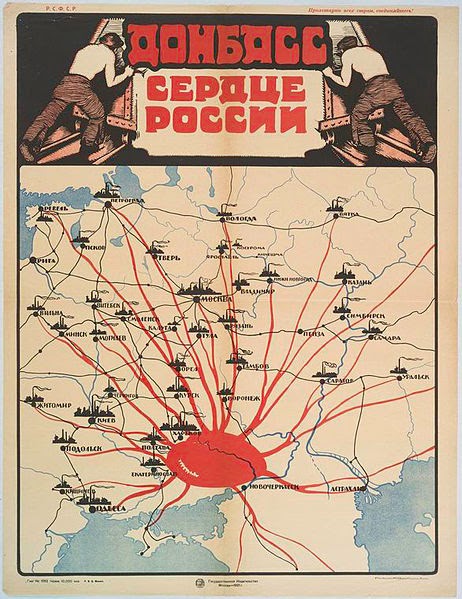 |
| 1921 Soviet propaganda poster praising Donets Basin as Heart of Russia; PD-1923 |
Subscribe to:
Posts (Atom)