Link: Russian airstrikes in Syria continue to target anti-Assad forces, not ISIS.
Everyday we get a better idea exactly what Vladimir Putin intends to do in Syria. Normally, the Russians would attempt to be a bit discreet, but Putin realizes that he is experiencing a rare moment of complete freedom to do as he pleases. The Russians are moving quickly, before someone in the international community decides to object and attempt to slow things down. One would have thought that Putin would have been a bit more subtle with his intention to destroy the anti-Assad indigenous movement first, but he has decided it is more prudent to act quickly, before any real opposition can manifest itself. During three days of bombing sorties, the Russians exclusively targeted anti-Assad forces, as the disinformation campaign went into gear, identifying the locations bombed as the "ISIS command center at Raqqah City". Satellite imagery identifies the town of Al Latamneh in Hama Province as being the actual target. The Russians will continue to spin a web of disinformation at every opportunity, as they have learned from the Ukraine crisis that disseminating false information is effective. The worst tragedy is that it appears the majority of the casualties in three days of Russian airstrikes haven't even been anti-Assad combatants, but civilians. Not that the Russians mind. Killing civilians is a very useful motivational tool. And to think just a few weeks ago, Europe and the United States were up in arms over the photograph of one drowned Syrian child.
For years, we have wondered what location on the relatively meager Syrian coastline would the Russians chose for their Mediterranean Naval Base. I thought that Putin would want to build a shiny, new base in Latakia, but it appears from construction that has already started, that the base will be at Tartus instead. Tartus, which is south of Latakia and a few kilometers north of the Lebanese border, has some existing port facilities, which are proving useful to the Russians, who are conducting naval and amphibious exercises just offshore. It is believed that Putin will soon grant "combatant status" to the Russian troops already in Syria, and evidence strongly suggests that Russia is preparing for a broader military intervention than repeatedly claimed by Moscow. With the announcement of the Iran/Iraq/Russia joint combat coordination center in Baghdad, we considered the possibility that the Iranian government would order full military intervention in Iraq, on the grounds of self defense, as ISIS attacks in Diyala Province are having an impact on neighboring Iran. The persistent presence of ISIS in Diyala gives the Iranians the justification for greater involvement. It seemed the ideal scenario for Iran, fighting alongside the militias and the Iraqi Security Forces, to pressure ISIS from the east, while Russian forces attacked from the west in Syria. At this point, Putin no longer sees the battlefield as being separated by national boundaries, and he is prudent in his assessment. ISIS must be dealt with on all available fronts, with as much pressure as can be applied. Since Iranian troops, along with some militia units, have arrived in Syria, the fear that Iran will directly intervene in Iraq, although still a likely possibility, has lessened somewhat.
At the moment, the goal for Russia is to successfully re-introduce Bashar al-Assad to the international community as the legitimate president of Syria. It is believed that the Russians are planning an operation to retake the ancient city of Palmyra, which will provide Assad with a tremendous publicity opportunity. Ideally, the recapture of Palmyra (by Syrian regime forces, no doubt) will remind the Syrian people that Assad is a great warrior who will eventually outlast his enemies. Why Putin insists on propping up Assad is still a bit of a mystery. He could remove Assad, which would please the Turks and the Gulf Arabs immensely, and install another pro-Russian government. But for the moment, Assad is experiencing a rejuvenation, as his forces are re-equipped and greatly assisted by the Russian air campaign. The West must be very careful, that the anti-Assad groups that we have been supporting, don't turn to Al-Qaeda surrogate Jabhat al-Nusra for assistance. Its a real possibility, as all they have seen since Russia's arrival on the scene, is typical diplomatic hyperbole. U.S. Secretary of State has threatened that the U.S.-led air coalition might very well increase its anti-ISIS bombing sorties in Syria, as opposed to ending them altogether, as Russia has demanded. If it is possible to increase the bombing sorties against ISIS, why weren't we doing so before the Russians arrived?

Showing posts with label Putin. Show all posts
Showing posts with label Putin. Show all posts
Monday, October 5, 2015

Friday, August 28, 2015
Ukraine and Russian- backed Donbas separatists are negotiating a complete ceasefire to begin on September 1.
Link: Cease fire in Ukraine planned for 1 September.
Here we go again. For the third time in the past two years, France and Germany have assisted in the crafting of a ceasefire agreement between Ukraine and Russian-backed Donbas separatists. According to negotiators, the ceasefire is a blanket agreement in which both sides unilaterally agree to end the discharge of weapons in eastern Ukraine on September 1, 2015. Up until the very minute of the announcement of the intended ceasefire, separatist forces had escalated attacks against Ukrainian troops, killing two soldiers less than ten miles outside of the strategic port city of Mariupol. This attack comes one week after a separatist artillery barrage killed three civilians in a suburb of Mariupol. On August 10, a separatist combined arms assault east of the Donetsk-Mariupol highway, in conjunction with an increase in separatist shelling of Ukrainian-held areas outside Mariupol, indicate that the Russian-backed separatists have set the table nicely for this most recent negotiated ceasefire. You see, each time the negotiators reach the more difficult issues at hand, the separatists increase offensive activity, as a means of influencing the diplomatic proceedings. By raising the level of military activity, the separatists are sending the clear message that they are nowhere near backing down, and it would be in Kiev's best interest to compromise. You would think that after two ceasefires that were violated by the separatists almost immediately, that the Ukrainians and their European allies would be reticent to enter into another agreement. But Poroshenko has absolutely no wiggle room. Basically, he has to do what is told. Without the support of France, Germany, and the United States, Poroshenko knows that Ukraine would be invaded by Russia in the blink of an eye. The real question, which has been asked so many time over the past few decades and has never received an adequate explanation, is why the leaders of Europe are so intent on placating aggressive dictators who are fully intent on expansionist enterprises?
On September 1, the latest ceasefire (Minsk III?) will be implemented. Because the provisions contained within are so favorable to the separatists, it is likely that we won't see a violation for some time. You see, the new agreement calls for elections, and also mandates the establishment of a special self-management status for separatist-minded regions. What is so fascinating is that until Russia started expressing real annoyance at Ukraine's insistence on being an independent nation, there was no "eastern Ukraine separatist movement". For the past decade, Ukraine has tweaked Moscow's nose on a number of occasions, and the cozying up to NATO and the United States was probably the last straw (or was it the popular removal of a president who was acting as a Russian puppet?). Putin didn't try and create a nationalist, pro-Russian movement in Crimea; he just gauged the complete lack of spine amongst the European leaders and the United States. The annexation of Crimea was a marvelously orchestrated "fait d'accompli" on the part of Putin; but it did get the attention of the international community, so justification had to be created for the biting off of eastern Ukraine.
I'm sure the OSCE will deploy observers whenever elections take place in the disputed regions, and no doubt the separatists will hound and harass them so that it is impossible to validate the electoral process. Why will the separatists do this? Because they can. Even if the election observers were able to verify extensive electoral fraud, what would be the end result? Nothing. Probably within six months after the elections occur, the separatists will kick the military campaign back into gear, to swallow up the next piece of free Ukraine, which more than likely will include the city of Mariupol. We will repeat the same process, with Merkel and Hollande pressuring Poroshenko to agree to more demands. The only hope for a free and democratic Ukraine will be if the Ukrainian people rise up and remove Poroshenko, and replace him with someone who is willing to tell the west to go suck an egg. Unfortunately, this will create the military environment that Putin is waiting for: an under-equipped Ukrainian military facing off against the Russian Armed Forces. And the EU and the United States will stand back and say, "we tried to get the Ukrainians to negotiate, but they were determined to follow another course". My prognostication is probably way off base, but it doesn't take Henry Kissinger to see that Putin has manipulated this crisis in a manner that guarantees some level of success. God forbid that the European nations are ever faced with the decision to fight for their freedom, or become the slaves of a group like ISIS. I fear for the decision that will be made.
Here we go again. For the third time in the past two years, France and Germany have assisted in the crafting of a ceasefire agreement between Ukraine and Russian-backed Donbas separatists. According to negotiators, the ceasefire is a blanket agreement in which both sides unilaterally agree to end the discharge of weapons in eastern Ukraine on September 1, 2015. Up until the very minute of the announcement of the intended ceasefire, separatist forces had escalated attacks against Ukrainian troops, killing two soldiers less than ten miles outside of the strategic port city of Mariupol. This attack comes one week after a separatist artillery barrage killed three civilians in a suburb of Mariupol. On August 10, a separatist combined arms assault east of the Donetsk-Mariupol highway, in conjunction with an increase in separatist shelling of Ukrainian-held areas outside Mariupol, indicate that the Russian-backed separatists have set the table nicely for this most recent negotiated ceasefire. You see, each time the negotiators reach the more difficult issues at hand, the separatists increase offensive activity, as a means of influencing the diplomatic proceedings. By raising the level of military activity, the separatists are sending the clear message that they are nowhere near backing down, and it would be in Kiev's best interest to compromise. You would think that after two ceasefires that were violated by the separatists almost immediately, that the Ukrainians and their European allies would be reticent to enter into another agreement. But Poroshenko has absolutely no wiggle room. Basically, he has to do what is told. Without the support of France, Germany, and the United States, Poroshenko knows that Ukraine would be invaded by Russia in the blink of an eye. The real question, which has been asked so many time over the past few decades and has never received an adequate explanation, is why the leaders of Europe are so intent on placating aggressive dictators who are fully intent on expansionist enterprises?
On September 1, the latest ceasefire (Minsk III?) will be implemented. Because the provisions contained within are so favorable to the separatists, it is likely that we won't see a violation for some time. You see, the new agreement calls for elections, and also mandates the establishment of a special self-management status for separatist-minded regions. What is so fascinating is that until Russia started expressing real annoyance at Ukraine's insistence on being an independent nation, there was no "eastern Ukraine separatist movement". For the past decade, Ukraine has tweaked Moscow's nose on a number of occasions, and the cozying up to NATO and the United States was probably the last straw (or was it the popular removal of a president who was acting as a Russian puppet?). Putin didn't try and create a nationalist, pro-Russian movement in Crimea; he just gauged the complete lack of spine amongst the European leaders and the United States. The annexation of Crimea was a marvelously orchestrated "fait d'accompli" on the part of Putin; but it did get the attention of the international community, so justification had to be created for the biting off of eastern Ukraine.
I'm sure the OSCE will deploy observers whenever elections take place in the disputed regions, and no doubt the separatists will hound and harass them so that it is impossible to validate the electoral process. Why will the separatists do this? Because they can. Even if the election observers were able to verify extensive electoral fraud, what would be the end result? Nothing. Probably within six months after the elections occur, the separatists will kick the military campaign back into gear, to swallow up the next piece of free Ukraine, which more than likely will include the city of Mariupol. We will repeat the same process, with Merkel and Hollande pressuring Poroshenko to agree to more demands. The only hope for a free and democratic Ukraine will be if the Ukrainian people rise up and remove Poroshenko, and replace him with someone who is willing to tell the west to go suck an egg. Unfortunately, this will create the military environment that Putin is waiting for: an under-equipped Ukrainian military facing off against the Russian Armed Forces. And the EU and the United States will stand back and say, "we tried to get the Ukrainians to negotiate, but they were determined to follow another course". My prognostication is probably way off base, but it doesn't take Henry Kissinger to see that Putin has manipulated this crisis in a manner that guarantees some level of success. God forbid that the European nations are ever faced with the decision to fight for their freedom, or become the slaves of a group like ISIS. I fear for the decision that will be made.
Saturday, August 22, 2015
France, Germany pressure Kiev to grant autonomy to separatists, as conflict escalates.
Link: Poroshenko meets with Hollande, Merkel in Berlin.
Today, Ukrainian President Poroshenko traveled to Berlin for consultations with German Chancellor Merkel and French President Hollande to discuss the rapidly unravelling "Minsk II" accord. As anticipated, in recent days, separatist forces have launched numerous attacks against Ukrainian positions. On August 10, separatists used tanks and heavy artillery in an attack on Ukrainian forces 20 kilometers east of the Donetsk-Mariupol Highway, and the Organization for Security and Cooperation in Europe (OSCE) monitoring installations continue to track "Grad" multiple launch rocket system (MLRS) strikes along much of the frontline in Donetsk Oblast. On August 16, separatists launched an artillery barrage on the northeastern outskirts of Mariupol. It is widely suspected that the upturn in violence is an effort on the part of the separatists to influence Kiev, as negotiations continue in Minsk and now also in Berlin. The Russian-backed separatists hope that the more pessimistic the current military situation appears, the more likely that Kiev will be more flexible when it comes to negotiating the issue of autonomy for Donbas.
It is also widely accepted that both Hollande and Merkel will pressure Poroshenko to yield on the issue of autonomy for Donbas. Again, just another example of the complete lack of conviction and courage on the part of European leaders when faced with military aggression. If history has taught us anything, it is that a bully, regardless of the size of the playground, will continue to terrorize until he is confronted by a united opposition. Poroshenko has no choice but to follow the advice of his benefactors (I would include President Obama on this list, but I'm not really sure where he has been lately...probably putting the final touches on his Amnesty Executive Order Action); without the continued support of Europe and the United States, Ukraine would be totally occupied by the Russian Army by the end of next week. Back to the present: if Poroshenko grants autonomy to Donbas (without a plebiscite, mind you....shades of Austria, 1938), no doubt the separatists and Russia will control whatever elections come next, and those "elected" will uniformly support the annexation of Donbas by Russia. Remember this blog post from August 21, 2015: if Poroshenko approves any form of autonomy for sections of Eastern Ukraine, those areas will eventually be swallowed up by Russia, a la Crimea.
Why are the European leaders so reticent to militarily confront Putin? They must realize that this is a problem they will be forced to deal with sooner or later, and later will always be more difficult. If the EU decided to support Ukraine militarily, and German, Polish, French and Italian Air Forces enforced a no-fly zone over Ukraine, Putin would be obliged to either back off, or actually go to war. I don't believe the Russian Air Force is in any state of readiness to confront the combined Air resources of Europe and the United States. Also, why not "loan" Ukraine a few hundred LeClerc Heavy Battle Tanks, and maybe a few Leopard as well. This will be akin to the leaders of free and democratic Europe drawing a line in the dirt, and telling Putin, "you've gone far enough; don't cross this line". If I were Poroshenko, I would ask Hollande to imagine what it must have been like for France when Germany "stole" Alsace-Lorraine in 1871? Or remind Chancellor Merkel of Russia's stranglehold on East Germany. Allowing a foreign country to invade and occupy Ukrainian territory should be unacceptable not only to Poroshenko, but to the EU as well. Our position on this issue is not unique; many other blogs and learned analysts are warning that Russia will not stop its efforts at expansion with the annexation of Donbas, anymore than Putin quit with Crimea (which, considering how little it is mentioned by Hollande and Merkel, is obviously a Fait Accompli). When will they learn?
Today, Ukrainian President Poroshenko traveled to Berlin for consultations with German Chancellor Merkel and French President Hollande to discuss the rapidly unravelling "Minsk II" accord. As anticipated, in recent days, separatist forces have launched numerous attacks against Ukrainian positions. On August 10, separatists used tanks and heavy artillery in an attack on Ukrainian forces 20 kilometers east of the Donetsk-Mariupol Highway, and the Organization for Security and Cooperation in Europe (OSCE) monitoring installations continue to track "Grad" multiple launch rocket system (MLRS) strikes along much of the frontline in Donetsk Oblast. On August 16, separatists launched an artillery barrage on the northeastern outskirts of Mariupol. It is widely suspected that the upturn in violence is an effort on the part of the separatists to influence Kiev, as negotiations continue in Minsk and now also in Berlin. The Russian-backed separatists hope that the more pessimistic the current military situation appears, the more likely that Kiev will be more flexible when it comes to negotiating the issue of autonomy for Donbas.
It is also widely accepted that both Hollande and Merkel will pressure Poroshenko to yield on the issue of autonomy for Donbas. Again, just another example of the complete lack of conviction and courage on the part of European leaders when faced with military aggression. If history has taught us anything, it is that a bully, regardless of the size of the playground, will continue to terrorize until he is confronted by a united opposition. Poroshenko has no choice but to follow the advice of his benefactors (I would include President Obama on this list, but I'm not really sure where he has been lately...probably putting the final touches on his Amnesty Executive Order Action); without the continued support of Europe and the United States, Ukraine would be totally occupied by the Russian Army by the end of next week. Back to the present: if Poroshenko grants autonomy to Donbas (without a plebiscite, mind you....shades of Austria, 1938), no doubt the separatists and Russia will control whatever elections come next, and those "elected" will uniformly support the annexation of Donbas by Russia. Remember this blog post from August 21, 2015: if Poroshenko approves any form of autonomy for sections of Eastern Ukraine, those areas will eventually be swallowed up by Russia, a la Crimea.
Why are the European leaders so reticent to militarily confront Putin? They must realize that this is a problem they will be forced to deal with sooner or later, and later will always be more difficult. If the EU decided to support Ukraine militarily, and German, Polish, French and Italian Air Forces enforced a no-fly zone over Ukraine, Putin would be obliged to either back off, or actually go to war. I don't believe the Russian Air Force is in any state of readiness to confront the combined Air resources of Europe and the United States. Also, why not "loan" Ukraine a few hundred LeClerc Heavy Battle Tanks, and maybe a few Leopard as well. This will be akin to the leaders of free and democratic Europe drawing a line in the dirt, and telling Putin, "you've gone far enough; don't cross this line". If I were Poroshenko, I would ask Hollande to imagine what it must have been like for France when Germany "stole" Alsace-Lorraine in 1871? Or remind Chancellor Merkel of Russia's stranglehold on East Germany. Allowing a foreign country to invade and occupy Ukrainian territory should be unacceptable not only to Poroshenko, but to the EU as well. Our position on this issue is not unique; many other blogs and learned analysts are warning that Russia will not stop its efforts at expansion with the annexation of Donbas, anymore than Putin quit with Crimea (which, considering how little it is mentioned by Hollande and Merkel, is obviously a Fait Accompli). When will they learn?
Thursday, July 23, 2015
Ukrainian separatists pretend to abide by the Minsk Agreement by re-deploying certain forces.
Links: A. Calls for the implementation of the Minsk Agreement.
B. Right wing protests Poroshenko in Kiev.
Both Kiev and Moscow are very interested in giving the impression of support for the Minsk negotiations. The discussions, which include the Ukraine, France, Germany and Russia, evolved after the failure of the Minsk Protocol, a 5 September 2014 agreement to halt the war in the Donbas Region. The Minsk Protocol included twelve main points, but within the first few weeks, both sides had violated the agreement. By January 2015, it was acknowledged by all parties concerned that the Minsk Protocol was a failure, and that negotiators had to return to Minsk and begin again. On 11 February 2015, the leaders of Ukraine, Germany, France, and Russia agreed to a new package of measures which for all practical purposes, revived the Minsk Protocol. As opposed to the first agreement, it appears at this early stage that both parties are interested in at least giving the appearance of compliance. As an addendum to the Minsk II agreement, both parties (Ukraine and the Donbas separatists) agreed to a heavy weapons withdrawal that includes tanks and certain "previously excluded" lighter weapons. On June 21, monitors for the Organization for the Security and Co-operation in Europe (OSCE) reported that both Ukrainian and separatist forces had begun removing the proscribed weapons from the front lines, even though the addendum had yet to be actually signed. Although the intention of the addendum was to reduce the intensity of the fighting in southeast Ukraine, the separatist almost immediately issued a declaration that they will retain armor around the key cities of Donetsk and Debaltseve. It is apparent that the separatist will utilize a well-worn strategy of continually moving heavy weapons and firepower from one location to the next, to give the impression that they are abiding by the agreement. In reality, as long as the armor and heavy firepower are present in Donbas, they can be maneuvered into position to fire on Ukrainian targets within a day's notice (and in most instances, less).
Not surprisingly, the separatists will agree to whatever particular parts of the agreement that suits their military and political objectives. While Ukrainian President Petro Poroschenko bends over backwards to demonstrate to his European supporters that he is willing to negotiate with the separatists (and the Russians), regardless of the continual violation of previous agreements and the brutal destruction of a civilian passenger airliner by an SA-11 missile fired by Russian Buk missile launcher, he faces mounting disapproval in his own capital. The Right Sector Movement (RSM), the political movement which led the demonstrations that eventually removed Poroschenko's successor, has become increasingly more active and vocal in their opposition to the manner in which Poroschenko is handling this crisis. Poroschenko must be very careful how he maneuvers around this pot-hole, because the RSM, which contributes volunteers to actively fight alongside the Ukrainian Army, is very popular in western Ukraine. One issue that receives a great deal of attention in Ukraine, is the fact that Poroschenko continues to refer to the crisis as an anti-terrorist action (!) as opposed to an actual war. Poroschenko has also been opposed to calls in Parliament (supported by RSM and the majority of Ukrainians) to institute and economic blockade of Donbas, and he does not support the various volunteer military units that have sprung up in support of the Ukrainian Army. All of these measures would be seen by the European "friends of Ukraine", as being inflammatory and not in the spirit of de-escalation, so its obvious from where Poroschenko is currently receiving his marching orders. And you can't blame Poroschenko for taking direction from the leaders of nations that haven't been to war in over five decades, at least not declared. He is being advised by honor graduates of the Neville Chamberlain "sacrifice anything and everyone for peace in our time" school of diplomacy. It should come as no surprise; this is how Europeans think in 2015. Considering the devastation of two World Wars, I certainly understand their wish to avoid aggravating the situation. But dangerous times call for courageous leadership. This is the time and place for the United States to act as the leader of the European delegation, and start dealing with Putin directly. Since the entire planet recognizes that he is calling the shots for the separatists, why to we continue to avoid dealing with him directly?
At present, we in the United States are without a President who is willing to utilize both our diplomatic and military resources appropriately and aggressively, in defense of international freedom and security. Since 2008, the United States has basically been adrift internationally, occasionally reacting to important events, but always the last one to show up at the party. The establishment of ISIS in Iraq is a direct result of the rash removal of U.S. forces in contrast to the phased-out, long-term withdrawal schedule preferred by the Pentagon. And Ukraine is obliged to cling to the coat tails of Angela Merkel and Francois Hollande because our government is preaching the same, defeatist diatribe as they are (and they're closer). If I could only remember the number of Democrats who have argued against long-term sanctions at one time or another (Cuba comes to mind); and now these same Democrats watch Vladimir Putin and the Russian people totally ignore the sanctions regime in-place against Russia, and call for.....continued sanctions! Putin will eventually swallow Ukraine piece-by piece. Why? Because its in his nature; he is a megalomaniac, and like true megalomaniacs, he won't stop until HE IS STOPPED. When we made the point in favor of aggressive and appropriate diplomatic and military action, we were recognizing that the United States and our European partners have the opportunity to persuade Putin to climb back into his box. We must show that we are determined to protect the independence and sovereignty of Ukraine, and this can be accomplished by providing all supplies and military equipment that the Ukrainian military requests. Would you like a chuckle? If the Iranian nuke treaty is approved, we will then be able to sell F16s and Abrams tanks to Iran, but no to Ukraine! We can also influence Putin's decision-making by returning U.S. military forces to Europe, but in new locations, possibly, Poland, Latvia, Estonia, and Romania? The threat of a missile-defense shield for eastern Europe is another issue that annoys Putin (and that we have sacrificed for absolutely no political gain). We have military options in dealing with both Putin and ISIS; now all we need is the motivation and the backbone.
2016 can't come fast enough.
B. Right wing protests Poroshenko in Kiev.
Both Kiev and Moscow are very interested in giving the impression of support for the Minsk negotiations. The discussions, which include the Ukraine, France, Germany and Russia, evolved after the failure of the Minsk Protocol, a 5 September 2014 agreement to halt the war in the Donbas Region. The Minsk Protocol included twelve main points, but within the first few weeks, both sides had violated the agreement. By January 2015, it was acknowledged by all parties concerned that the Minsk Protocol was a failure, and that negotiators had to return to Minsk and begin again. On 11 February 2015, the leaders of Ukraine, Germany, France, and Russia agreed to a new package of measures which for all practical purposes, revived the Minsk Protocol. As opposed to the first agreement, it appears at this early stage that both parties are interested in at least giving the appearance of compliance. As an addendum to the Minsk II agreement, both parties (Ukraine and the Donbas separatists) agreed to a heavy weapons withdrawal that includes tanks and certain "previously excluded" lighter weapons. On June 21, monitors for the Organization for the Security and Co-operation in Europe (OSCE) reported that both Ukrainian and separatist forces had begun removing the proscribed weapons from the front lines, even though the addendum had yet to be actually signed. Although the intention of the addendum was to reduce the intensity of the fighting in southeast Ukraine, the separatist almost immediately issued a declaration that they will retain armor around the key cities of Donetsk and Debaltseve. It is apparent that the separatist will utilize a well-worn strategy of continually moving heavy weapons and firepower from one location to the next, to give the impression that they are abiding by the agreement. In reality, as long as the armor and heavy firepower are present in Donbas, they can be maneuvered into position to fire on Ukrainian targets within a day's notice (and in most instances, less).
Not surprisingly, the separatists will agree to whatever particular parts of the agreement that suits their military and political objectives. While Ukrainian President Petro Poroschenko bends over backwards to demonstrate to his European supporters that he is willing to negotiate with the separatists (and the Russians), regardless of the continual violation of previous agreements and the brutal destruction of a civilian passenger airliner by an SA-11 missile fired by Russian Buk missile launcher, he faces mounting disapproval in his own capital. The Right Sector Movement (RSM), the political movement which led the demonstrations that eventually removed Poroschenko's successor, has become increasingly more active and vocal in their opposition to the manner in which Poroschenko is handling this crisis. Poroschenko must be very careful how he maneuvers around this pot-hole, because the RSM, which contributes volunteers to actively fight alongside the Ukrainian Army, is very popular in western Ukraine. One issue that receives a great deal of attention in Ukraine, is the fact that Poroschenko continues to refer to the crisis as an anti-terrorist action (!) as opposed to an actual war. Poroschenko has also been opposed to calls in Parliament (supported by RSM and the majority of Ukrainians) to institute and economic blockade of Donbas, and he does not support the various volunteer military units that have sprung up in support of the Ukrainian Army. All of these measures would be seen by the European "friends of Ukraine", as being inflammatory and not in the spirit of de-escalation, so its obvious from where Poroschenko is currently receiving his marching orders. And you can't blame Poroschenko for taking direction from the leaders of nations that haven't been to war in over five decades, at least not declared. He is being advised by honor graduates of the Neville Chamberlain "sacrifice anything and everyone for peace in our time" school of diplomacy. It should come as no surprise; this is how Europeans think in 2015. Considering the devastation of two World Wars, I certainly understand their wish to avoid aggravating the situation. But dangerous times call for courageous leadership. This is the time and place for the United States to act as the leader of the European delegation, and start dealing with Putin directly. Since the entire planet recognizes that he is calling the shots for the separatists, why to we continue to avoid dealing with him directly?
At present, we in the United States are without a President who is willing to utilize both our diplomatic and military resources appropriately and aggressively, in defense of international freedom and security. Since 2008, the United States has basically been adrift internationally, occasionally reacting to important events, but always the last one to show up at the party. The establishment of ISIS in Iraq is a direct result of the rash removal of U.S. forces in contrast to the phased-out, long-term withdrawal schedule preferred by the Pentagon. And Ukraine is obliged to cling to the coat tails of Angela Merkel and Francois Hollande because our government is preaching the same, defeatist diatribe as they are (and they're closer). If I could only remember the number of Democrats who have argued against long-term sanctions at one time or another (Cuba comes to mind); and now these same Democrats watch Vladimir Putin and the Russian people totally ignore the sanctions regime in-place against Russia, and call for.....continued sanctions! Putin will eventually swallow Ukraine piece-by piece. Why? Because its in his nature; he is a megalomaniac, and like true megalomaniacs, he won't stop until HE IS STOPPED. When we made the point in favor of aggressive and appropriate diplomatic and military action, we were recognizing that the United States and our European partners have the opportunity to persuade Putin to climb back into his box. We must show that we are determined to protect the independence and sovereignty of Ukraine, and this can be accomplished by providing all supplies and military equipment that the Ukrainian military requests. Would you like a chuckle? If the Iranian nuke treaty is approved, we will then be able to sell F16s and Abrams tanks to Iran, but no to Ukraine! We can also influence Putin's decision-making by returning U.S. military forces to Europe, but in new locations, possibly, Poland, Latvia, Estonia, and Romania? The threat of a missile-defense shield for eastern Europe is another issue that annoys Putin (and that we have sacrificed for absolutely no political gain). We have military options in dealing with both Putin and ISIS; now all we need is the motivation and the backbone.
2016 can't come fast enough.
Saturday, July 4, 2015
Separatist (read Russian) offensive about ready to kick off in Ukraine.
Link: Indications point to a Russian-backed offensive in the Ukraine.
We've had so much news coming out of Iraq and Syria, not to mention to deterioration of Constitutional authority in the United States lately, that we haven't had much to say about events in Ukraine. Fortunately, while we were away, most of the action was taking place in planning rooms and in front of the press. Both the Ukrainian government and the Russian-backed separatists continue to make a show out of adhering to the cease-fire conditions of the "Minsk 2" agreement. The Ukrainians probably felt as if they had no choice, but everything that comes from the other side is complete crap. I have always been amazed at watching diplomats negotiate with people who can't be trusted. Hillary Clinton is a classic example. She would sign a treaty with Hitler if it might win her an election. We can't pretend to be "just discovering" what a snake Putin is; we've known for decades, even before he took the throne. But we signed a treaty with him, one that eliminates any strategic edge we might have in ballistic missiles. Believe me, when these Republican egoists go at each other in the upcoming debates, I will be listening to someone talking about REAL issues: drastic reduction in government spending and the abolition of the New Start Treaty. But I digress. I believe we were talking about Ukraine . . .
Recently the Pentagon released an annual threat assessment, which highlighted Russia more than any terrorist group. The brief correctly concluded that Russia has no respect for any international borders, as they prove time and time again. Pretending that the Donbas Separatist Groups are really behind the insurrection in Ukraine is like trying to hide an amputation with a Band-Aid. It just doesn't fly, especially in light of intelligence collected by drones that illustrate a continued Russian military build-up. Kiev claims that there are at least 7,000 Russian soldiers in Ukraine, under the authority of five Generals. That's a bit much. I think we could handle 7,000 U.S. Army troops with a Lt. Colonel . . . but you know how those Russians like to show off their rank, with the giant medals
and hilariously oversized hats. A friend of mine suspects that the Russian military noticed that our officer's uniform hats were a bit more attractive than theirs. So, in typical Russian fashion (bigger is better), they just increased the circumference of their officer hats, which leave them looking like a combination of a hubcap and a sombrero. But again I digress. I believe we were talking about Ukraine . . .
I understand that the Ukrainian military is still hesitant to fully deploy their armed forces in the Donbas region, for security fears regarding Kiev. The way I see it, if they don't deploy sometime soon, we will be at the gates of Kiev soon regardless. The truth is, Poroshenko would have been wiser to have called out a full-mobilization and an offensive by now. He might have had hope of recovering Crimea, given the difficulty the Russians would have initially had resupplying their forces. But the entire province has been militarized and Russianized by now, and the defensive positions taken by the separatists are going to be a hard nut to crack. Poroshenko had to attempt a diplomatic solution first, though, he knows as well as us that Russia and Putin weren't interested in any political solution. In the beginning of the conflict, Putin would have withdrawn support for the separatists if Kiev and the West had acknowledged the annexation of Crimea. But our weakness and unwillingness to supply the Ukrainian military with weapons and equipment have far surpassed Putin's wildest hopes. Now he is in a position to dismember Ukraine for good.
The upcoming offensive that is being discussed in the halls of the Pentagon, in Kiev, and in the living rooms of Mariupol, no doubt, are intended to widen the territory over which the separatist political arm can claim authority. The more territory you occupy, the better your bargaining position. President Obama, who should be leading on this issue, has only introduced sanctions to ward off Russian aggression. We knew how far that would go. We need to arm the Ukrainians to the hilt, and start deploying (or at least pretend to) some sort of missile shield system in Poland, Hungary and the Czech Republic. What I would give to see someone call Putin's bluff. The missile defense is key. . . he will abandon Ukraine if it's used as a threat. But we don't do those sorts of things. This administration went to the Neville Chamberlain school of diplomacy: give everything away, and then bend over. Yes, I know Europe has been just as prostrate, but most of the NATO countries committed self-emasculation some time ago. Outside of the UK and France, who won't hesitate to throw troops into Africa on a moment's notice, no European country has been engaged militarily since the first Gulf War (I don't count Kosovo or U.N. peacekeeping duty, OK?). But I believe that the Europeans are scared, and are willing to follow our lead. Now to find a leader . . .
We've had so much news coming out of Iraq and Syria, not to mention to deterioration of Constitutional authority in the United States lately, that we haven't had much to say about events in Ukraine. Fortunately, while we were away, most of the action was taking place in planning rooms and in front of the press. Both the Ukrainian government and the Russian-backed separatists continue to make a show out of adhering to the cease-fire conditions of the "Minsk 2" agreement. The Ukrainians probably felt as if they had no choice, but everything that comes from the other side is complete crap. I have always been amazed at watching diplomats negotiate with people who can't be trusted. Hillary Clinton is a classic example. She would sign a treaty with Hitler if it might win her an election. We can't pretend to be "just discovering" what a snake Putin is; we've known for decades, even before he took the throne. But we signed a treaty with him, one that eliminates any strategic edge we might have in ballistic missiles. Believe me, when these Republican egoists go at each other in the upcoming debates, I will be listening to someone talking about REAL issues: drastic reduction in government spending and the abolition of the New Start Treaty. But I digress. I believe we were talking about Ukraine . . .
Recently the Pentagon released an annual threat assessment, which highlighted Russia more than any terrorist group. The brief correctly concluded that Russia has no respect for any international borders, as they prove time and time again. Pretending that the Donbas Separatist Groups are really behind the insurrection in Ukraine is like trying to hide an amputation with a Band-Aid. It just doesn't fly, especially in light of intelligence collected by drones that illustrate a continued Russian military build-up. Kiev claims that there are at least 7,000 Russian soldiers in Ukraine, under the authority of five Generals. That's a bit much. I think we could handle 7,000 U.S. Army troops with a Lt. Colonel . . . but you know how those Russians like to show off their rank, with the giant medals
 |
| Source: russiandefpolicy.wordpress |
I understand that the Ukrainian military is still hesitant to fully deploy their armed forces in the Donbas region, for security fears regarding Kiev. The way I see it, if they don't deploy sometime soon, we will be at the gates of Kiev soon regardless. The truth is, Poroshenko would have been wiser to have called out a full-mobilization and an offensive by now. He might have had hope of recovering Crimea, given the difficulty the Russians would have initially had resupplying their forces. But the entire province has been militarized and Russianized by now, and the defensive positions taken by the separatists are going to be a hard nut to crack. Poroshenko had to attempt a diplomatic solution first, though, he knows as well as us that Russia and Putin weren't interested in any political solution. In the beginning of the conflict, Putin would have withdrawn support for the separatists if Kiev and the West had acknowledged the annexation of Crimea. But our weakness and unwillingness to supply the Ukrainian military with weapons and equipment have far surpassed Putin's wildest hopes. Now he is in a position to dismember Ukraine for good.
The upcoming offensive that is being discussed in the halls of the Pentagon, in Kiev, and in the living rooms of Mariupol, no doubt, are intended to widen the territory over which the separatist political arm can claim authority. The more territory you occupy, the better your bargaining position. President Obama, who should be leading on this issue, has only introduced sanctions to ward off Russian aggression. We knew how far that would go. We need to arm the Ukrainians to the hilt, and start deploying (or at least pretend to) some sort of missile shield system in Poland, Hungary and the Czech Republic. What I would give to see someone call Putin's bluff. The missile defense is key. . . he will abandon Ukraine if it's used as a threat. But we don't do those sorts of things. This administration went to the Neville Chamberlain school of diplomacy: give everything away, and then bend over. Yes, I know Europe has been just as prostrate, but most of the NATO countries committed self-emasculation some time ago. Outside of the UK and France, who won't hesitate to throw troops into Africa on a moment's notice, no European country has been engaged militarily since the first Gulf War (I don't count Kosovo or U.N. peacekeeping duty, OK?). But I believe that the Europeans are scared, and are willing to follow our lead. Now to find a leader . . .
Sunday, May 24, 2015
How do we fix this mess that we are in overseas?
Presently, the United States has involved itself in three conflicts raging overseas. I'm sure some folks actually believed President Obama when he paid lip service to the Elizabeth Warren click within the Democratic Party and promised to end foreign U.S. military involvement. I can't really pin the blame for the crisis in the Ukraine on Obama, because Russian President Vladimir Putin has obviously been the one calling all the shots. I can, however, call into question his strategy of implementing sanctions on Russia, and keeping the sanctions in place long after it has become apparent that Russians don't give a shit about sanctions. But Putin's ballsy decision to scoop up the Crimea practically overnight was a surprise to just about everyone. When the move in Crimea coincided with an outbreak in separatist activity in Donbas (ESE Ukraine), it was apparent to us that Putin was looking for a bargaining chip, something he could trade in exchange for recognition of Russia's claim to Crimean sovereignty. But Putin was taken as much by surprise as we were by the weak and limp-wristed response by the European Powers, NATO, and the United States. Putin annexed territory belonging to a foreign state and began fomenting rebellion elsewhere, and the response from the free world is little more than a 5-minute stay in time out. Don't agree? Well, explain it to me then. I am in serious need of educating. How has the sanctions regime impacted the Russian decision to invalidate the territorial integrity of a UN and NATO member state? It appears to me, that as of May 22, 2015, the Russians/Separatists (it will continue to get more and more difficult to tell them apart, as Russia decides to end the charade) are again on the offensive, moving further west into Ukraine, consolidating their hold on Luhansk and Donetsk, and preparing to lay siege to Mariupol. What can be done? Europe and the United States seem content to talk about more sanctions (you would think that they would be a bit embarrassed by now, talking about additional sanctions when the ones in place have had no impact on Russian policy whatsoever), so its up to us to talk about solutions.
First and foremost, when dealing with Putin, a foreign leader with any hope of success must call Putin's bluff. Inform Putin that if Russia does not evacuate Crimea and Donbas within a week, that the U.S. and NATO will begin full military deployment in the Baltic Republics, Poland, and Ukraine. By deployment, I don't mean actual U.S. Marines, I'm talking about full military support, in equipment, tanks, planes, anti-aircraft batteries, surface to air missiles, and, if possible, implementation of the defensive, anti-ballistic missile "Dome" that everyone nicknamed "Star Wars". Putin cannot accuse the west of militarizing Russia's borders, not when Putin is in the middle of doing it himself. The only language Putin understands is the language of force. His only choice for diplomacy is diplomatic aggression. On the other hand, if he makes a move in the right direction, and starts to de-militarize eastern Ukraine, then the United States and NATO should take appropriate, similar action. Dealing with Putin is like trying to stop a flood. The only way to be successful is by building a dam, and saying, "no further".
The situation in Iraq and Syria is more complicated. Formerly we would evaluate the scenarios as separate battlefields. We have abandoned that perspective. The Islamic Front (IS) continues to surprise analysts and military leaders alike in its ability to rebound from defeats and its ability to transport men and equipment so quickly and effectively. Granted, the IS has become masterful at taking full advantage of sandstorms and other weather anomalies, but recent events in Anbar and also Syria have made it apparent that the IS views the conflict as one battlefield, and regroups, resupplies and conducts offensives accordingly. Today, the Iraqi military is taking drastic measures to present an all-out disaster with the loss of the Baiji refinery. There has been some discussion of an offensive to retake Ramadi, but if resources are allocated for just such an operation, don't be surprised to see Tikrit again fall to the IS. It has become apparent to us that the Iraqi military has a limited number of effective, reliable troops, and they are shuttled from one crisis area to the next. No doubt the 1500 U.S. instructors are tasked with increasing that number, but so far they haven't had much peace, with al-Asad Airbase under constant threat. We are most concerned, as we have always been, with the security of U.S. personnel, and the possible occupation of Baghdad by the IS. We would like to take the opportunity to repeat our warning to either move all non-essential U.S. personnel out of Iraq, or, evacuate it completely, hook, line, and sinker. As it is, with State Dept., Intel folks, USAID, multiple private security contractors, etc., all over the place, from Mosul to Basra, I am petrified that the IS is going to get its hands on any number of U.S. persons. We all can only imagine what would happen.
Syria is a bit different. We don't have the same concerns regarding U.S. personnel, although given the nebulous nature of the Free Syrian Army, we may be mistaken. We have been convinced for a few months now that Assad and the Ba'ath regime is living on borrowed time. We cannot envision a scenario in which Assad can pull defeat from the jaws of victory. It does appear as if Assad has been forsaken by his Russian friends, as the influx of weapons and equipment we anticipated never materialized. Is it possible that Putin's addition of one naval port (Crimea) allowed him to shelve his designs for a Mediterranean naval base, at least for the time being? The IS and its surrogates, including the burgeoning Jabhat al-Nusrah, are sitting in the catbird seat, with regime forces only in control of areas west of the Anti-Lebanon Mountains. Sure there are outposts and isolated units in the east, but lets be realistic: Assad needs to decide if he is going to go down with the ship, a la Gadhafi, or when its best to vacate Damascus for friendlier environs (a Black Sea Dacha, maybe?). It appears as if the IS is in no hurry to settle things in Syria, probably because it currently has the full military initiative in Iraq.
How can something positive be delivered of this difficult predicament? Firstly, the decision must be made in the capitals of Europe and Washington DC, that there will be no negotiating with the Islamic State. If the member States of the EU and the United States were to sign such a pledge, it would send the right kind of message to the IS, and be a move in the right direction. The battlefield in Iraq is the key to the conflict with the IS. They have proven to be much more strategic and adept at military planning than expected, but it shouldn't be difficult to take advantage of their limited military experience. What the IS can ill-afford to lose is fighters. Make the IS bleed in Iraq; make every inch, every foot, every mile carry a tremendous price tag. This can't be achieved by the Iraqi Security Forces (ISF) alone, although if the Iranians were keen on a full engagement against the IS, we believe that they would win the day handily, as would the Marines that we believe should be deployed in Iraq in targeted operations, with the sole purpose being to kill as many IS fighters as possible. Sure, we could give the Iraqis the equipment that our Marines would use, but I don't trust them. In a week, there would be another evacuation, and all that equipment would end up in IS hands...again. The Marines know the job, and they will clean up. Within a month of targeted operations involving the U.S. Marines, with heavy Air Support, the IS will be on the run from Baiji and from Anbar itself. More importantly, they will be suffering a manpower issue, which can only assist whatever policy is formulated in Syria. We can't hypothesize about possible U.S. action in Syria because we still have no clue who or what the Free Syrian Army is, and where they are. Its possible that the IS could be bled enough in Iraq to allow a large-enough neutral army like the Free Syrian Army, to pacify the countryside for possible elections and the arrival of UN Peacekeepers. At this stage, in Iraq, we believe that the time has come to remind the Iraqi people that we do believe in their future, and we are willing to fight alongside them against the IS. This effort should be worth at least two permanent Air Bases and at least one, huge Army facility.
First and foremost, when dealing with Putin, a foreign leader with any hope of success must call Putin's bluff. Inform Putin that if Russia does not evacuate Crimea and Donbas within a week, that the U.S. and NATO will begin full military deployment in the Baltic Republics, Poland, and Ukraine. By deployment, I don't mean actual U.S. Marines, I'm talking about full military support, in equipment, tanks, planes, anti-aircraft batteries, surface to air missiles, and, if possible, implementation of the defensive, anti-ballistic missile "Dome" that everyone nicknamed "Star Wars". Putin cannot accuse the west of militarizing Russia's borders, not when Putin is in the middle of doing it himself. The only language Putin understands is the language of force. His only choice for diplomacy is diplomatic aggression. On the other hand, if he makes a move in the right direction, and starts to de-militarize eastern Ukraine, then the United States and NATO should take appropriate, similar action. Dealing with Putin is like trying to stop a flood. The only way to be successful is by building a dam, and saying, "no further".
The situation in Iraq and Syria is more complicated. Formerly we would evaluate the scenarios as separate battlefields. We have abandoned that perspective. The Islamic Front (IS) continues to surprise analysts and military leaders alike in its ability to rebound from defeats and its ability to transport men and equipment so quickly and effectively. Granted, the IS has become masterful at taking full advantage of sandstorms and other weather anomalies, but recent events in Anbar and also Syria have made it apparent that the IS views the conflict as one battlefield, and regroups, resupplies and conducts offensives accordingly. Today, the Iraqi military is taking drastic measures to present an all-out disaster with the loss of the Baiji refinery. There has been some discussion of an offensive to retake Ramadi, but if resources are allocated for just such an operation, don't be surprised to see Tikrit again fall to the IS. It has become apparent to us that the Iraqi military has a limited number of effective, reliable troops, and they are shuttled from one crisis area to the next. No doubt the 1500 U.S. instructors are tasked with increasing that number, but so far they haven't had much peace, with al-Asad Airbase under constant threat. We are most concerned, as we have always been, with the security of U.S. personnel, and the possible occupation of Baghdad by the IS. We would like to take the opportunity to repeat our warning to either move all non-essential U.S. personnel out of Iraq, or, evacuate it completely, hook, line, and sinker. As it is, with State Dept., Intel folks, USAID, multiple private security contractors, etc., all over the place, from Mosul to Basra, I am petrified that the IS is going to get its hands on any number of U.S. persons. We all can only imagine what would happen.
Syria is a bit different. We don't have the same concerns regarding U.S. personnel, although given the nebulous nature of the Free Syrian Army, we may be mistaken. We have been convinced for a few months now that Assad and the Ba'ath regime is living on borrowed time. We cannot envision a scenario in which Assad can pull defeat from the jaws of victory. It does appear as if Assad has been forsaken by his Russian friends, as the influx of weapons and equipment we anticipated never materialized. Is it possible that Putin's addition of one naval port (Crimea) allowed him to shelve his designs for a Mediterranean naval base, at least for the time being? The IS and its surrogates, including the burgeoning Jabhat al-Nusrah, are sitting in the catbird seat, with regime forces only in control of areas west of the Anti-Lebanon Mountains. Sure there are outposts and isolated units in the east, but lets be realistic: Assad needs to decide if he is going to go down with the ship, a la Gadhafi, or when its best to vacate Damascus for friendlier environs (a Black Sea Dacha, maybe?). It appears as if the IS is in no hurry to settle things in Syria, probably because it currently has the full military initiative in Iraq.
How can something positive be delivered of this difficult predicament? Firstly, the decision must be made in the capitals of Europe and Washington DC, that there will be no negotiating with the Islamic State. If the member States of the EU and the United States were to sign such a pledge, it would send the right kind of message to the IS, and be a move in the right direction. The battlefield in Iraq is the key to the conflict with the IS. They have proven to be much more strategic and adept at military planning than expected, but it shouldn't be difficult to take advantage of their limited military experience. What the IS can ill-afford to lose is fighters. Make the IS bleed in Iraq; make every inch, every foot, every mile carry a tremendous price tag. This can't be achieved by the Iraqi Security Forces (ISF) alone, although if the Iranians were keen on a full engagement against the IS, we believe that they would win the day handily, as would the Marines that we believe should be deployed in Iraq in targeted operations, with the sole purpose being to kill as many IS fighters as possible. Sure, we could give the Iraqis the equipment that our Marines would use, but I don't trust them. In a week, there would be another evacuation, and all that equipment would end up in IS hands...again. The Marines know the job, and they will clean up. Within a month of targeted operations involving the U.S. Marines, with heavy Air Support, the IS will be on the run from Baiji and from Anbar itself. More importantly, they will be suffering a manpower issue, which can only assist whatever policy is formulated in Syria. We can't hypothesize about possible U.S. action in Syria because we still have no clue who or what the Free Syrian Army is, and where they are. Its possible that the IS could be bled enough in Iraq to allow a large-enough neutral army like the Free Syrian Army, to pacify the countryside for possible elections and the arrival of UN Peacekeepers. At this stage, in Iraq, we believe that the time has come to remind the Iraqi people that we do believe in their future, and we are willing to fight alongside them against the IS. This effort should be worth at least two permanent Air Bases and at least one, huge Army facility.
Tuesday, April 28, 2015
With the intensification of the conflict, what is Putin's goal in the Ukraine?
Links: A. Fears of New Separatist Offensive in Ukraine.
B. Concern over likely new Offensive.
The conflict in Ukraine shows no indications of de-escalation, as Russian-backed separatists continue to dictate the course of events. Since last September's "cease fire", the Separatists have conducted a number of important operations, including the seizure of the airport at Donetsk and the occupation of the strategic town of Debaltseve. So what, exactly was the purpose of the cease fire? A serious analysis of the conflict over the past year, with a focus on where both sides are today, makes it apparent that the Russians have had no trouble outmaneuvering, outgunning, and outthinking the Ukrainians. Yes, the sanctions are in place, and yes, they have damaged the Russian economy. But they have failed miserably in their intention, which was to encourage a cease fire and pressure Russia into de-militarizing eastern Ukraine. In fact, the opposite has occurred. No doubt we here at MB were not the only bloggers who predicted that Russia would thumb its nose at sanctions. The Russian people no do respond well to that type of pressure. Traditionally, they have shown much more understanding for conflicts that are settled on the battlefield. We predicted that the Russian people might become even more galvanized behind Putin if the west insisted on a sanctions regime. Evidence points to our correct interpretation of the circumstances. The Russian media is loath to print or air a story that is critical of the Separatists, and the concocted stories regarding the Ukrainian government and alleged "atrocities" against ethnic Russians take a page right from Nazi tactics on the German-Polish border, circa 1939. Someone needs to deliver a polite message to Angela Merkel, Francois Hollande and Barack Obama: Sanctions have failed. Please tell us you have a plan B. If not, Putin may be tempted to split Ukraine right in half.
The Ukrainian military has not shown the strength and decisiveness that MB had predicted. Outgunned and outflanked repeatedly, the Ukrainians have been obliged to evacuate a number of strategic towns and locations. Its possible that this is a direct result of the lack of military support from the west, in particular the United States. With Congressmen of both parties urging President Obama to start providing weapons and supplies to the Ukrainians, Obama did nothing, although U.S. military advisors are on the ground, as well as instructors, and the United States has been sharing sensitive imagery and intelligence with the Ukrainians from the beginning of the conflict. One disturbing trend has been the increasing number of foreign mercenaries that have been fighting on behalf of Ukraine. The rest of Ukraine continues to function normally, as Russia has not curtailed the supply of gas. It does appear that the port city of Mariupol is the next strategic target for the Separatists, which would make sense, given Putin's obsession with the turning the Black Sea into a Russian lake.
As of mid-April, 2015, the military situation is extremely delicate for the Ukrainian government. While its true that the majority of Ukraine's military has not been brought into the conflict, there are reasons for that decision. The government has the obligation of ensuring at least a modest defense of the capital city of Kiev, should the conflict escalate. If the actions of the present Ukrainian government are any indication, then the military decisions have been made conservatively and the bulk of Ukraine's armor and air resources have not been deployed (although a great deal of artillery seems to have made its way to the front). The Ukrainian military authorities are concerned that the regular army, with so many new conscripts, will get pulverized on the eastern front. So the arrival of U.S. advisors/instructors is welcome. But the United States must set an example and demonstrate that it can discern the difference between the "good guys and the bad guys". If we can arm Egypt, Saudi Arabia, Jordan, and Turkey, then we should be able to assist Ukraine in a battle for survival against a 21st century fascist state.
As for Putin's goal, your guess is as good as ours. It appears that possibly he has decided to emasculate Ukraine by splitting it in two and depriving Kiev of any port access to the Black Sea. I can understand why some analysts might hypothesize that Putin intends on destroying independent Ukraine. No matter how we size it up, we cannot imagine that Putin actually intends on occupying the entire Ukraine. Western Ukraine is very Nationalist and Russia in particular is despised (with good reason). Trying to occupy anything west of Kiev would be more trouble than its worth, not to mention the Ukrainian military, such as it is, would take a toll on the Russians before all was said and done. But Putin has become hard to predict. In fact, he new policy seems to be, "what can I do to surprise the west today", so truly, the only surprise would be if Putin reverted back to what we believe was the original strategy and offers to evacuate eastern Ukraine in exchange for official recognition of Russian suzerainty over the Donbas Basin.
B. Concern over likely new Offensive.
The conflict in Ukraine shows no indications of de-escalation, as Russian-backed separatists continue to dictate the course of events. Since last September's "cease fire", the Separatists have conducted a number of important operations, including the seizure of the airport at Donetsk and the occupation of the strategic town of Debaltseve. So what, exactly was the purpose of the cease fire? A serious analysis of the conflict over the past year, with a focus on where both sides are today, makes it apparent that the Russians have had no trouble outmaneuvering, outgunning, and outthinking the Ukrainians. Yes, the sanctions are in place, and yes, they have damaged the Russian economy. But they have failed miserably in their intention, which was to encourage a cease fire and pressure Russia into de-militarizing eastern Ukraine. In fact, the opposite has occurred. No doubt we here at MB were not the only bloggers who predicted that Russia would thumb its nose at sanctions. The Russian people no do respond well to that type of pressure. Traditionally, they have shown much more understanding for conflicts that are settled on the battlefield. We predicted that the Russian people might become even more galvanized behind Putin if the west insisted on a sanctions regime. Evidence points to our correct interpretation of the circumstances. The Russian media is loath to print or air a story that is critical of the Separatists, and the concocted stories regarding the Ukrainian government and alleged "atrocities" against ethnic Russians take a page right from Nazi tactics on the German-Polish border, circa 1939. Someone needs to deliver a polite message to Angela Merkel, Francois Hollande and Barack Obama: Sanctions have failed. Please tell us you have a plan B. If not, Putin may be tempted to split Ukraine right in half.
The Ukrainian military has not shown the strength and decisiveness that MB had predicted. Outgunned and outflanked repeatedly, the Ukrainians have been obliged to evacuate a number of strategic towns and locations. Its possible that this is a direct result of the lack of military support from the west, in particular the United States. With Congressmen of both parties urging President Obama to start providing weapons and supplies to the Ukrainians, Obama did nothing, although U.S. military advisors are on the ground, as well as instructors, and the United States has been sharing sensitive imagery and intelligence with the Ukrainians from the beginning of the conflict. One disturbing trend has been the increasing number of foreign mercenaries that have been fighting on behalf of Ukraine. The rest of Ukraine continues to function normally, as Russia has not curtailed the supply of gas. It does appear that the port city of Mariupol is the next strategic target for the Separatists, which would make sense, given Putin's obsession with the turning the Black Sea into a Russian lake.
As of mid-April, 2015, the military situation is extremely delicate for the Ukrainian government. While its true that the majority of Ukraine's military has not been brought into the conflict, there are reasons for that decision. The government has the obligation of ensuring at least a modest defense of the capital city of Kiev, should the conflict escalate. If the actions of the present Ukrainian government are any indication, then the military decisions have been made conservatively and the bulk of Ukraine's armor and air resources have not been deployed (although a great deal of artillery seems to have made its way to the front). The Ukrainian military authorities are concerned that the regular army, with so many new conscripts, will get pulverized on the eastern front. So the arrival of U.S. advisors/instructors is welcome. But the United States must set an example and demonstrate that it can discern the difference between the "good guys and the bad guys". If we can arm Egypt, Saudi Arabia, Jordan, and Turkey, then we should be able to assist Ukraine in a battle for survival against a 21st century fascist state.
As for Putin's goal, your guess is as good as ours. It appears that possibly he has decided to emasculate Ukraine by splitting it in two and depriving Kiev of any port access to the Black Sea. I can understand why some analysts might hypothesize that Putin intends on destroying independent Ukraine. No matter how we size it up, we cannot imagine that Putin actually intends on occupying the entire Ukraine. Western Ukraine is very Nationalist and Russia in particular is despised (with good reason). Trying to occupy anything west of Kiev would be more trouble than its worth, not to mention the Ukrainian military, such as it is, would take a toll on the Russians before all was said and done. But Putin has become hard to predict. In fact, he new policy seems to be, "what can I do to surprise the west today", so truly, the only surprise would be if Putin reverted back to what we believe was the original strategy and offers to evacuate eastern Ukraine in exchange for official recognition of Russian suzerainty over the Donbas Basin.
Wednesday, February 4, 2015
How Similar is the New Russia To The USSR? (Part II)
Links: A. Russia Wikipedia
B. Description of Organized Crime in Russia
C. Useful Background on Russian Political Structure
D. Putin Wikipedia
I've finally been able to shelve my disappointment at the direction Russia is moving in the twenty-first century. In the last decade, Putin has repeatedly demonstrated his disdain for NATO and the international rule of law. What amazes me is the European willingness to cling to the idea of international law, even while the Russians, Chinese, Iranians and Islamic terrorists are giving Den Haag the finger. We live in a time during which an illness that I like to call the "Chamberlain Syndrome" seems to be infecting the leaders of Europe. It coincides with another malady I have named, the "America has been naughty and we are so sorry" Syndrome, which has taken root in the present U.S. Administration. It should come as no surprise that the bad guys aren't moved by "national moments of reflection". They will take advantage of every inch and every ounce that they are given. The Chinese, Russians and Iranians are a perfect example of how the rest of the world thinks and behaves. They follow military and diplomatic initiatives that have one purpose only: to further what they see as their own best interests, to the detriment of whomever it is that they consider to be their prime enemy. In all four cases (throw in the Islamic extremists as well), the number one enemy is the United States.
In the case of Putin, his ability to build such a formidable base and consolidate his personal power has been phenomenal. History demonstrates that while Yeltsin spent most of his
time in office drunk out of his gourd, the Russian Mafia and related organized crime interests practically took over Russia. The networks which now call the shots in Moscow are not nearly as numerous as they once were. This is a direct result of one criminal enterprise swallowing up the smaller, less powerful guppies. What we see in Russia today are a handful of criminal organizations, usually headed by one individual, who methodically and without conscience demand a cut of just about every piece of the Russian economy. Who says criminals can't appreciate organization? In the United States we have observed a number of law-abiding Wall Street firms go bad, and transpose all of their assets and training to almost 'legitimize" their corrupt activities. Who is more powerful, the crime lords of Russia or Vladimir Putin? Its basically a moot point at this juncture, since they continue to drink at the same trough. But my suspicion is that Putin has the upper hand. Why? Because he never hesitates. If one of the oligarchs pisses him off, they end up in jail. It's that simple. I don't know of a Russian, crime lord or not, who can give orders to Putin. He singularly controls the Duma, the Press, the Military and the Police. The criminal elements understand that they need to play nice with Vlad, and then everyone goes home happy. The recent problems with the Russian economy will no doubt cut into the profits of these various enterprises, and it will be interesting to see how things shake out if the price of oil doesn't rebound soon.
Continued crippling economic contraction is the one development which can damage Putin. But in order for this to continue, the price of oil must stay low or go lower. This will not happen, because the Arabs need a return to payday just as much as the Russians do. Once the price moves back in the other direction, Russia will again have its battering ram against Europe. If only the countries who are dependent upon Russia for oil and natural gas were in a position to buy it from the United States instead, then Russia would lose most of its clout.
Why do Russia and Putin insist on being so contrary? I'm no psychologist, but I believe Putin is a bit of a sociopath. He craves power, and conveniently for him, he has no conscience. Putin doesn't want to share power with the United States. As a former KGB man, he has nothing but disdain for the American people and all those values we constantly lecture others about. Putin wants to win, and he will do what it takes to end up on top. The Chinese are a bit more pragmatic. They don't take their endemic distrust of the United States personally. Its about the glory of China, and the spread of Chinese power and influence around the globe. I think Putin sees the world through a special pair of glasses, that allow him to always gauge his decisions vis-à-vis the United States. Putin doesn't fear China because he considers the Chinese military to be a bit of a paper tiger — and he should know, given the volume of military trade that has taken place between China and Russia. The American people had better give serious and full consideration on who they choose to elect in 2016, because the four main antagonists (not to mention the rise in anti-U.S. politics in Latin America and Africa) all see the U.S. as their principle adversary. Its a very dangerous time to be an American, with so many enemies about. Thankfully, we can rely on diplomacy and allies to deal with most of our troubles. Islamic extremists are a whole different matter. They must be dealt with as a priority, and with military determination and strength. We may be saying the same thing about Russia one day.
B. Description of Organized Crime in Russia
C. Useful Background on Russian Political Structure
D. Putin Wikipedia
In the case of Putin, his ability to build such a formidable base and consolidate his personal power has been phenomenal. History demonstrates that while Yeltsin spent most of his
 |
| 1999 Putin and Yeltsin with Patriarch Alexy II Source: Kremlin.ru |
 |
| Putin with Chairman of Gazprom’s Mgmt Committee and the Vice Premier of China, Zhang Gaoli; Source: Kremlin.ru |
Why do Russia and Putin insist on being so contrary? I'm no psychologist, but I believe Putin is a bit of a sociopath. He craves power, and conveniently for him, he has no conscience. Putin doesn't want to share power with the United States. As a former KGB man, he has nothing but disdain for the American people and all those values we constantly lecture others about. Putin wants to win, and he will do what it takes to end up on top. The Chinese are a bit more pragmatic. They don't take their endemic distrust of the United States personally. Its about the glory of China, and the spread of Chinese power and influence around the globe. I think Putin sees the world through a special pair of glasses, that allow him to always gauge his decisions vis-à-vis the United States. Putin doesn't fear China because he considers the Chinese military to be a bit of a paper tiger — and he should know, given the volume of military trade that has taken place between China and Russia. The American people had better give serious and full consideration on who they choose to elect in 2016, because the four main antagonists (not to mention the rise in anti-U.S. politics in Latin America and Africa) all see the U.S. as their principle adversary. Its a very dangerous time to be an American, with so many enemies about. Thankfully, we can rely on diplomacy and allies to deal with most of our troubles. Islamic extremists are a whole different matter. They must be dealt with as a priority, and with military determination and strength. We may be saying the same thing about Russia one day.
Monday, February 2, 2015
How Similar is the New Russia To The USSR? (Part I)
Links: A. Russia Wikipedia
B. Description of Organized Crime in Russia
C. Useful Background on Russian Political Structure
D. Putin Wikipedia
Of all the posts I've written for the blog, this one has been the most difficult to put together. When the Cold War ended and Boris Yeltsin was singing the praises of capitalism, I was truly optimistic about Russia's future. There can be no doubt that the Russian people work hard and take pride in their country. In July 1998, when the bodies of the former ruling Romanov family were interred in St. Petersburg, and the streets were lined with people showing their respect as the coffins made their way to the St. Peter and Paul Cathedral, I thought to myself that Russia had come to terms with its past and was ready to embrace the future. I had this crazy notion that the United States and Russia would lead the world on a crusade for peace, economic freedom for all, and ecological responsibility. It was a serious dose of wishful thinking. Since that time, I have been reminded that the Russian people are obsessed with the need for a strong leader, regardless of the freedoms they must relinquish. The everyday, on the street Russian is fairly well-read and educated. They watch the news, read the paper and listen to the radio. Granted, it's mostly propaganda bullshit, but they know how to read between the lines. They just chose not to. The average Russian is well aware of President Vladimir Putin's ties to organized crime and his manipulation of the political system to allow for his permanence in power. They are not blind to the fact that Putin cut every state budget, while increasing defense spending by twenty percent. Does anyone see a threat to Russia? Is there a need for the Russians to be stocking up on equipment and weapons to defend the Motherland? Of course not; and the increase in defense spending was for offensive intentions, vice defense. The next reasonable question to ask is, "if Russia doesn't have an outside threat, then what offensive operations are being considered?"
Obviously Putin is not satisfied with the situation in Ukraine. I imagine that he expected the Ukrainians to have folded by now, and accepted the loss of the Crimea in order to secure the integrity of Eastern Ukraine. Putin keeps up the charade of a Donbas indigenous
movement to be annexed by Russia, in order to keep his military active in the region. His military and the equipping of the guerilla forces around Donets'k, Luhans'k and Mariupol' is singularly intended to create a bargaining chip. Putin will pull out of Eastern Ukraine, if Ukraine and the west will recognize the annexation of Crimea to Russia. I believe that Putin expected the Ukrainian government to fold, given their dependence on Russian oil and natural gas, and the apparent sorry state of affairs in the Ukrainian military. But the people of Kiev and Western Ukraine have had just about enough of Russian military bullying. The people of Ukraine have suffered heavily from Russian intervention over the years, and, particularly in western Ukraine, they want nothing to do with old school "business-as -usual". They want a Ukraine as part of Europe, a member of NATO and hopefully one day a member of the EU. Ukrainian military officials were not prepared for the number of volunteers from western Ukraine who have flooded recruitment centers, and the new government has been given a free-reign to conduct the war as it sees fit, as long as no concessions are made to Russia. If the current government gave any indication that it was considering a swap of Crimea for peace in Donbas, they would be under siege from protesters in Kiev. The unexpected success of sanctions imposed by the United States and Europe has steeled the nerve of the government in Kiev, but for how long is anybody's guess. The reality is, if it weren't for certain decisions being made in Saudi Arabia, then the price of oil would not have fallen dramatically and the EU and U.S. sanctions would have been basically harmless. Make no mistake, the real impact of sanctions on Russia are only causing hardship because of the combined impact of the fall of the price of crude.
 Contrary to what many in the west want to believe, Putin is not losing any sleep. If he were, then he wouldn't have initiated a costly, aggressive move into the Arctic region. Putin knows that the low price of a barrel of crude is a temporary factor, and that the Ruble will rebound sooner rather than later. Putin's actions in the Arctic are not a short-term strategy. He realizes that taking control of the desolate islands in the Arctic (by right of simple possession) won't give him overnight access to thirty percent of the world's natural gas reserves and thirteen percent of it's oil reserves. This move, to rebuild airbases, relocate naval squadrons, position troops and begin a diplomatic offensive, will take time. Putin is counting on a Hillary Clinton presidency, as he sees her as little more than a shorter, fatter version of Barrack Obama (have a look at the provisions of the "New Start" Treaty that Hillary negotiated with Putin in 2010; believe me, Vlad is salivating at the thought of another President Clinton). He knows that he can threaten and bluff all the way to Spitsbergen/Svalbard and back, if necessary. Norway has a huge stake in the future debate over the Arctic, as does Canada and the United States. Heck, even Denmark (Greenland) should be part of the discussion. Even if the U.S. elects a Republican as president in 2016, it will be hard to displace Russia once she has militarized Novaya Zemlya and Franz Josef Land. The real issue of contention will be the area of the Berents Sea and anything close to Norway. Frankly, the majority of the deposits sit well within Russian territory as it is. I can only assume that the military build-up in the region is to ensure that any contentious strikes, or new discoveries, will go Russia's way as well.
B. Description of Organized Crime in Russia
C. Useful Background on Russian Political Structure
D. Putin Wikipedia
Of all the posts I've written for the blog, this one has been the most difficult to put together. When the Cold War ended and Boris Yeltsin was singing the praises of capitalism, I was truly optimistic about Russia's future. There can be no doubt that the Russian people work hard and take pride in their country. In July 1998, when the bodies of the former ruling Romanov family were interred in St. Petersburg, and the streets were lined with people showing their respect as the coffins made their way to the St. Peter and Paul Cathedral, I thought to myself that Russia had come to terms with its past and was ready to embrace the future. I had this crazy notion that the United States and Russia would lead the world on a crusade for peace, economic freedom for all, and ecological responsibility. It was a serious dose of wishful thinking. Since that time, I have been reminded that the Russian people are obsessed with the need for a strong leader, regardless of the freedoms they must relinquish. The everyday, on the street Russian is fairly well-read and educated. They watch the news, read the paper and listen to the radio. Granted, it's mostly propaganda bullshit, but they know how to read between the lines. They just chose not to. The average Russian is well aware of President Vladimir Putin's ties to organized crime and his manipulation of the political system to allow for his permanence in power. They are not blind to the fact that Putin cut every state budget, while increasing defense spending by twenty percent. Does anyone see a threat to Russia? Is there a need for the Russians to be stocking up on equipment and weapons to defend the Motherland? Of course not; and the increase in defense spending was for offensive intentions, vice defense. The next reasonable question to ask is, "if Russia doesn't have an outside threat, then what offensive operations are being considered?"
Obviously Putin is not satisfied with the situation in Ukraine. I imagine that he expected the Ukrainians to have folded by now, and accepted the loss of the Crimea in order to secure the integrity of Eastern Ukraine. Putin keeps up the charade of a Donbas indigenous
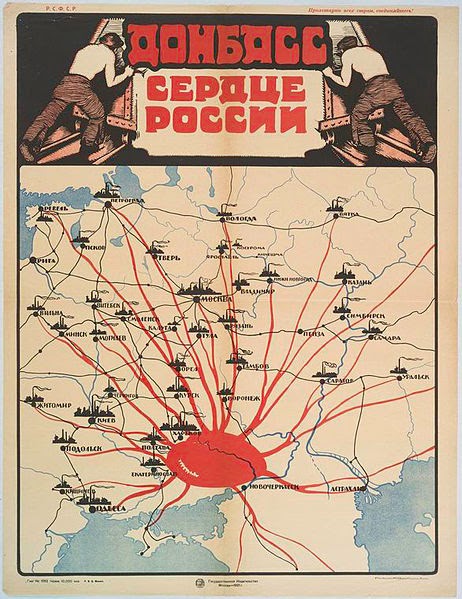 |
| 1921 Soviet propaganda poster praising Donets Basin as Heart of Russia; PD-1923 |
Wednesday, December 24, 2014
The War Against ISIL Is Being Lost While Obama Vacations...Again
Links: A. Iranian Militia-Leader Killed In Iraq
B. ISIL Retakes Baiji In Iraq
C. Russia Steps Up Involvement In Syria
I read in today's Washington Post that President Barrack Obama's favorability rating had improved up to 47 percent. I guess we should infer that the American people approve of the President acting unilaterally for the sole purpose of creating voters to support his political ideology. And, if the Amnesty issue wasn't irksome enough, Obama has decided (again, UNILATERALLY), to start the process of normalizing relations with Cuba. Obama announced this effort in his usual fashion. By declaring that the United States would be making all of the compromises and that in order to gain our friendship, Cuba would have to do....nothing. No, they were not required to release political prisoners, or legalize opposition parties, or end detention without trail. They weren't even asked to end their campaign of terror against U.S. citizens living in Florida who happen to oppose the Castro dictatorship. Obama makes two huge unilateral decisions and goes on vacation, and his approval jumps to 47 percent. Obviously he has this country figured out and I'm living in the past.
Lets cool off a bit by discussing the Islamic State (ISIL) and its offensives in both Syria and Iraq. Link C details very recent Russian efforts to get diplomatic traction in Syria. Not surprisingly, the EU bent over and greased up for Putin, I guess to reward him for not snatching another piece of Ukraine this week (I shouldn't complain....and least it was the EU and not Uncle Sam taking it south-ways this week). Putin's recent interest in Syria comes on the heels of recent unexpected military disasters for the regular Syrian Army in battles with ISIL. Remember, you heard it hear first (at least two months ago); Putin will not forsake Bashir al-Assad, at least not until he can replace him with another sycophant who will provide the Russian navy with a full-size (read: ballistic submarines) naval facility on Syria's Mediterranean Coast. What were John Kerry and the U.S. State Department doing while Putin was snuggling up to the EU? Probably smoking celebratory cigars with the Castro brothers. Since Obama enjoys adulation so much, I predict a trip to Havana is in the planning stages (again, remember you heard it here!). I wonder if he will think twice about the hundreds, maybe thousands of political prisoners that are rotting in Cuban jails without any kind of due process, some as young as thirteen years old. While Putin was re-establishing his Bona Fides vis-a-vis the Syrian conflict, the United States was continuing its illustrious Air Campaign against ISIL. In all honestly, the ineffectiveness of this military initiative has been a shock. Knowing the capabilities of the U.S. Air Force, I fully expected that ISIL would be suffering by now from supply problems. Our Air Force in Iraq and Afghanistan, using drones and ground troops to locate and verify targets, made it impossible for the enemy to move, let alone refuel, rearm and resupply. As I woke up this Sunday morning and read the news before Mass, I was reminded that ISIL has devastated regular Syrian Army positions in Eastern and Western Syria, and also retaken the town of Baiji, which was surrendered by the Iraqi Army without so much as fart in the direction of the enemy. But the Oil Refinery was heavily defended, which illustrates the priority of the Iraqi government. Let the people in Baiji get abused and in some cases, murdered by ISIL, as long as the money-maker keeps pumping.
Lately I've been very impressed with the willingness of the Iranians to take on ISIL in Iraq. The truth is, they recognize the threat that this group represents. Link A details the assassination of an important Iranian militia leader, who was active in Iraq's Diyala Province. Well, Diyala is in Eastern Iraq, just outside of Baghdad, and could not be more strategic. I was a bit perplexed by the number of individual Iranian-backed Shiite militias that were active in Iraq. These include, but are not limited to, the Mukhtar Army, Hezbollah Brigades (Hezbollah in Iraq, not Lebanon), Badr Brigades, Asaib al Haq, and something called the Peace Brigade. C'mon, Ayatollah whoever you are, don't you realize how much more effective to would be if you just merged these groups together? Each militia, fighting separately, with its own politically-focused leader, will have a miniscule impact on the conflict as opposed to what could be accomplished with one, well-equipped and properly led militia. At least the Iranians are recognizing the seriousness of the situation. The Iraqi Army cannot gain any traction. After publicizing the recapture of one or two towns, they pray that the local press won't also announced that four towns were occupied by ISIL during the same time period. Something tells me that the Iranians will be forced to launch a full-scale military intervention in Iraq. Its obviously something they would like to avoid, or at least delay until Obama finds a way to diplomatically allow them to enrich as much uranium as they want. Since Obama has been in office, the Iranians have moved closer and closer to complete independence for their nuclear program.
ISIL is on the offensive in Syria, and giving the Iraqi Army and the Iranian militias fits in Iraq. What about our bombing campaign? Where are the figures? I want to know how much ordinance has been expended and what the enemy has lost. You know the military has those figures at their fingertips. Normally I wouldn't care, but I'm trying to understand how a ragtag group of terrorists, totally without air support (except for a few drones, we're told), is moving around Iraq and Syria with impunity? How was ISIL able to reoccupy a town as large and strategic as Baiji, under the nose of the air coalition led by the United States Air Force, and including elements from France, Qatar, Kuwait and the UAE? Anyone? I don't see any slowdown in ISIL, so how about we save the U.S. taxpayer billions of dollars and just pull out? John Kerry should understand the policy. Its what he advocated for when he returned from Vietnam, remember?
On a separate note, I want to acknowledge all the media reports of Fidel Castro announcing Cuba's refusal to move one inch away from its Communist principles. I'm shocked that anyone would be surprised. Cuba isn't going to change, folks. What will happen, is a bunch of rich businessmen who donated money to Obama (and possibly Rand Paul as well), will build new, flashy resorts around the island, and make a ton of money. The Cuban elite will get their cut, the black market that runs the Cuban economy will get its due, and Obama's base will hail their icon as the man who saved the Cuban people (from the mean, ol' USA). Folks, the reality is, no one gives a shit about Cuba or the Cuban people. If Obama thought about Cuba even once while trotting from the sixth hole to the seventh, I will eat my hat. The goal isn't to change Cuba. ITS TO CHANGE THE UNITED STATES. More damage has been done to our Constitution in the last six years than has been done in the previous two hundred. This Imperial Administration is allowed to ignore an obvious electoral mandate, and just sideswipe Congress to enact monumental legislation. And the nut-less wonders Boehner and McConnell got over on us again, as nothing as yet to be even suggested in opposition to Obama's actions. Well, the GOP will have a nice surprise come 2016. I'm not sure about the Presidential Election, but conservative and moderate independent voters will either split the primary or not vote. The GOP rhinos have called the bluff of their own voters one too many times.
B. ISIL Retakes Baiji In Iraq
C. Russia Steps Up Involvement In Syria
I read in today's Washington Post that President Barrack Obama's favorability rating had improved up to 47 percent. I guess we should infer that the American people approve of the President acting unilaterally for the sole purpose of creating voters to support his political ideology. And, if the Amnesty issue wasn't irksome enough, Obama has decided (again, UNILATERALLY), to start the process of normalizing relations with Cuba. Obama announced this effort in his usual fashion. By declaring that the United States would be making all of the compromises and that in order to gain our friendship, Cuba would have to do....nothing. No, they were not required to release political prisoners, or legalize opposition parties, or end detention without trail. They weren't even asked to end their campaign of terror against U.S. citizens living in Florida who happen to oppose the Castro dictatorship. Obama makes two huge unilateral decisions and goes on vacation, and his approval jumps to 47 percent. Obviously he has this country figured out and I'm living in the past.
Lets cool off a bit by discussing the Islamic State (ISIL) and its offensives in both Syria and Iraq. Link C details very recent Russian efforts to get diplomatic traction in Syria. Not surprisingly, the EU bent over and greased up for Putin, I guess to reward him for not snatching another piece of Ukraine this week (I shouldn't complain....and least it was the EU and not Uncle Sam taking it south-ways this week). Putin's recent interest in Syria comes on the heels of recent unexpected military disasters for the regular Syrian Army in battles with ISIL. Remember, you heard it hear first (at least two months ago); Putin will not forsake Bashir al-Assad, at least not until he can replace him with another sycophant who will provide the Russian navy with a full-size (read: ballistic submarines) naval facility on Syria's Mediterranean Coast. What were John Kerry and the U.S. State Department doing while Putin was snuggling up to the EU? Probably smoking celebratory cigars with the Castro brothers. Since Obama enjoys adulation so much, I predict a trip to Havana is in the planning stages (again, remember you heard it here!). I wonder if he will think twice about the hundreds, maybe thousands of political prisoners that are rotting in Cuban jails without any kind of due process, some as young as thirteen years old. While Putin was re-establishing his Bona Fides vis-a-vis the Syrian conflict, the United States was continuing its illustrious Air Campaign against ISIL. In all honestly, the ineffectiveness of this military initiative has been a shock. Knowing the capabilities of the U.S. Air Force, I fully expected that ISIL would be suffering by now from supply problems. Our Air Force in Iraq and Afghanistan, using drones and ground troops to locate and verify targets, made it impossible for the enemy to move, let alone refuel, rearm and resupply. As I woke up this Sunday morning and read the news before Mass, I was reminded that ISIL has devastated regular Syrian Army positions in Eastern and Western Syria, and also retaken the town of Baiji, which was surrendered by the Iraqi Army without so much as fart in the direction of the enemy. But the Oil Refinery was heavily defended, which illustrates the priority of the Iraqi government. Let the people in Baiji get abused and in some cases, murdered by ISIL, as long as the money-maker keeps pumping.
Lately I've been very impressed with the willingness of the Iranians to take on ISIL in Iraq. The truth is, they recognize the threat that this group represents. Link A details the assassination of an important Iranian militia leader, who was active in Iraq's Diyala Province. Well, Diyala is in Eastern Iraq, just outside of Baghdad, and could not be more strategic. I was a bit perplexed by the number of individual Iranian-backed Shiite militias that were active in Iraq. These include, but are not limited to, the Mukhtar Army, Hezbollah Brigades (Hezbollah in Iraq, not Lebanon), Badr Brigades, Asaib al Haq, and something called the Peace Brigade. C'mon, Ayatollah whoever you are, don't you realize how much more effective to would be if you just merged these groups together? Each militia, fighting separately, with its own politically-focused leader, will have a miniscule impact on the conflict as opposed to what could be accomplished with one, well-equipped and properly led militia. At least the Iranians are recognizing the seriousness of the situation. The Iraqi Army cannot gain any traction. After publicizing the recapture of one or two towns, they pray that the local press won't also announced that four towns were occupied by ISIL during the same time period. Something tells me that the Iranians will be forced to launch a full-scale military intervention in Iraq. Its obviously something they would like to avoid, or at least delay until Obama finds a way to diplomatically allow them to enrich as much uranium as they want. Since Obama has been in office, the Iranians have moved closer and closer to complete independence for their nuclear program.
ISIL is on the offensive in Syria, and giving the Iraqi Army and the Iranian militias fits in Iraq. What about our bombing campaign? Where are the figures? I want to know how much ordinance has been expended and what the enemy has lost. You know the military has those figures at their fingertips. Normally I wouldn't care, but I'm trying to understand how a ragtag group of terrorists, totally without air support (except for a few drones, we're told), is moving around Iraq and Syria with impunity? How was ISIL able to reoccupy a town as large and strategic as Baiji, under the nose of the air coalition led by the United States Air Force, and including elements from France, Qatar, Kuwait and the UAE? Anyone? I don't see any slowdown in ISIL, so how about we save the U.S. taxpayer billions of dollars and just pull out? John Kerry should understand the policy. Its what he advocated for when he returned from Vietnam, remember?
On a separate note, I want to acknowledge all the media reports of Fidel Castro announcing Cuba's refusal to move one inch away from its Communist principles. I'm shocked that anyone would be surprised. Cuba isn't going to change, folks. What will happen, is a bunch of rich businessmen who donated money to Obama (and possibly Rand Paul as well), will build new, flashy resorts around the island, and make a ton of money. The Cuban elite will get their cut, the black market that runs the Cuban economy will get its due, and Obama's base will hail their icon as the man who saved the Cuban people (from the mean, ol' USA). Folks, the reality is, no one gives a shit about Cuba or the Cuban people. If Obama thought about Cuba even once while trotting from the sixth hole to the seventh, I will eat my hat. The goal isn't to change Cuba. ITS TO CHANGE THE UNITED STATES. More damage has been done to our Constitution in the last six years than has been done in the previous two hundred. This Imperial Administration is allowed to ignore an obvious electoral mandate, and just sideswipe Congress to enact monumental legislation. And the nut-less wonders Boehner and McConnell got over on us again, as nothing as yet to be even suggested in opposition to Obama's actions. Well, the GOP will have a nice surprise come 2016. I'm not sure about the Presidential Election, but conservative and moderate independent voters will either split the primary or not vote. The GOP rhinos have called the bluff of their own voters one too many times.
Monday, September 15, 2014
Obama's Wartime Ideology
Link: Obama Goes To War
I had the most difficult time creating a title to this post. I like the word "ideology", especially as it pertains to all things "Barack". But I'm not really sure how I feel about Barack Obama. As President, he has not surprised me one bit. When it comes to politics, I can be very pragmatic. I believe if the country elects a man president, then he has every justification to do things as he sees appropriate. But he must work within the confines of the Constitution. His recent willingness to utilize "Executive Action" bothers me more than anything else he has done, because it stretches the boundaries of "working within the confines of the Constitution". But today, I will commenting on Obama's actions as they relate to being Commander in Chief. Which brings me back to "ideology". I can't really discern an Obama ideology as far as war is concerned. I am convinced that then-Senator Obama truly believed he cold govern two terms and never face the possibility of war. He was convinced that previous wartime presidents (at least in our lifetime) could have found diplomatic solutions to using force, and his administration would prove it. Six years of the Obama Administration have demonstrated one fact to me above all others. As a Commander in Chief, he is not up to the task. He is an amateur with no chance of reaching the professional leagues.
No matter how nice you are to some folks, they will continue to hate your guts. Isn't that a lesson we all learned in grade school? Its impossible to comment on this administration's military policy without reviewing foreign policy. Obama began his first term with what many refer to as the "apology tour". From European capital to European capital he went, spreading the news that the United States was going to use its economic might and international standing for peaceful causes. He was very sincere in his belief that a new page had to be turned in U.S. international relations. As part of the effort to create a "clean slate" (coup de torchon- my favorite French phrase), he told an audience of Egyptians that United States policy in that part of the world had been misguided. He wanted diplomats and aid workers representing the U.S. in the Near East, not soldiers. This was the first time we were given a glimpse of Obama's worst habit: telegraphing his intentions beforehand. No doubt ISIS (then still under the banner of AQI- Al Qaeda in Iraq) realized that Obama would be pulling U.S. troops out of Iraq, lock, stock, and barrel, relatively quickly. I assume that the North Koreans were not thinking, "finally, now we can destroy our nuclear weapons program and open our borders". In Beijing, they congratulated themselves on this stroke of good fortune. Who would have thought...an American President who acts in China's best interest (we haven't had one of those since Bill Clinton)! And on it went. President Obama expressing regret for past foreign policy "mistakes", and vowing to build new relationships built on mutual respect. Its a nice thought, but totally inadequate in the world we face today. The actions of a rank amateur.
Back stateside, we were confronted with the politicization of all branches of government. Democrat activists were put in charge of the Justice Department, the I.R.S., Health and Human Services, and even the CIA, and it appeared that their marching orders were, "get Democrats elected at any cost". As the controversies mounted, the media and the American people took their eyes off of the international stage for a split second. And when we looked back, we saw examples all over the globe, of Obama's diplomatic "peace initiative". During Obama's first term, the administration heralded Secretary of State Hillary Clinton's negotiated arms reduction treaty with Russia. Most experts reminded the administration that Russia NEVER follows through on these agreements, but that was a secondary concern to creating a platform from which Hillary would run for President in 2016. Now that Russia has been unmasked as the corrupt, militarily aggressive bear it has always been under Putin, we no longer hear the Democrats talking about Hillary's arms reduction treaty (which we, invariably, will obey and the Russians, ultimately, will not). Putin has everyone talking about Ukraine, not arms treaties. And what about the Ukraine? In his effort to look like the "peace president", Obama ended research and funding into the Strategic Defense Shield. You might remember it as the "Strategic Defense Initiative". Research and planning began under President Ronald Reagan, and the left howled that it was not feasible, a waste of money, and way too provocative. As of 2008, it was nearly ready for deployment, and Poland was only to happy to accept it (as a member of NATO). Can you imagine....a defense shield (similar to the Israeli "Iron Dome") that would destroy incoming rockets before they hit their targets? This technology drove the Russians crazy, and Obama gave them a big, fat Christmas present that year. No more SDI. Since then, Russia has consolidated territories occupied in Georgia in 2008, and has invaded Ukraine. Putin knows that Obama will NEVER use the U.S. military in a confrontation with Russia, and the Europeans won't act without leadership from the United States. It might be time for citizens of Byelorus to bring out the suitcases.
The Near East is where Obama's determination to avoid military confrontation has been the most costly to U.S. interests. The Arab Spring raged for months without any coherent policy from this administration. Once Gaddafi was out of power and Egypt appeared to move away from the brink, the administration bounced around from group to group, appearing to have no idea who to support and who to oppose. It was this type of confused policy that contributed to the deaths of four Americans in Benghazi. And the lack of accountability, from all sides of this administration and in response to all types of screw ups, is galling. Iraq is a separate nut altogether. We knew that Obama would pull troops out of Iraq. In fact, I expected a quicker departure from Afghanistan than we have seen. Back to Iraq....the military planners provided a variety of options, including the possibility of leaving some U.S. military in place, at least until the Iraqi Army and government could establish some level of legitimacy. I thought it was the least we could do, considering how many young Americans died for that cause. But the Obama timetable did not include leaving behind a U.S. Army and/or Air Force Base. One issue that is difficult to dispute: if U.S. soldiers were still in the Iraqi theater, and the Iraqi Army was still being trained by the best and the brightest (U.S. soldiers), ISIS would have never established their present foothold in northern Iraq. And what can we expect in Afghanistan? A reversion back to Taliban authority and ultimately, a safe-haven for Al-Qaeda and all the other shit-ball terrorist groups.
Recently, as highlighted by the link I have provided, Obama has attempted to appear a bit more "hawkish". But he continues to commit one of the cardinal sins of warfare; don't tell the enemy your intentions beforehand! This administration, in an effort to appear more aggressive, gives the media all sorts of military details that should not be in the public arena. And why does this administration continue to publicly announce that the U.S. will not use ground troops? As far as ISIS is concerned, they just have to crawl back into their well-worn holes out in the desert and wait-out the latest bombing campaign. They've done it before. Its true that the administration will be providing arms and supplies to "someone" opposing ISIS (I'm still not 100 percent sure who). Is this an admission on the part of the administration that Americans are "too important" to put their lives on the line in this instance? Call me old fashioned, but this is either our fight or it isn't. If this group is a real and present danger to the United States, then it should be the U.S. military taking care of business, not "surrogates". Hell, why don't we just pay someone to bomb these assholes as well? Then we can be guaranteed to be taking "no risk" as far as U.S. personnel are concerned.
Its obvious that President Obama is uncomfortable with the military aspects of the job. He wants the world to find peaceful solutions to all the various nosebleeds currently dotting the planet. And when military action is forced on him, he will take the least amount of risk possible. I'm sure a political angle exists in this picture, especially when one considers Obama's base and the upcoming mid-term elections. But sooner or later someone is going to be forced to make a bolder decision, either Obama or his replacement.
I had the most difficult time creating a title to this post. I like the word "ideology", especially as it pertains to all things "Barack". But I'm not really sure how I feel about Barack Obama. As President, he has not surprised me one bit. When it comes to politics, I can be very pragmatic. I believe if the country elects a man president, then he has every justification to do things as he sees appropriate. But he must work within the confines of the Constitution. His recent willingness to utilize "Executive Action" bothers me more than anything else he has done, because it stretches the boundaries of "working within the confines of the Constitution". But today, I will commenting on Obama's actions as they relate to being Commander in Chief. Which brings me back to "ideology". I can't really discern an Obama ideology as far as war is concerned. I am convinced that then-Senator Obama truly believed he cold govern two terms and never face the possibility of war. He was convinced that previous wartime presidents (at least in our lifetime) could have found diplomatic solutions to using force, and his administration would prove it. Six years of the Obama Administration have demonstrated one fact to me above all others. As a Commander in Chief, he is not up to the task. He is an amateur with no chance of reaching the professional leagues.
No matter how nice you are to some folks, they will continue to hate your guts. Isn't that a lesson we all learned in grade school? Its impossible to comment on this administration's military policy without reviewing foreign policy. Obama began his first term with what many refer to as the "apology tour". From European capital to European capital he went, spreading the news that the United States was going to use its economic might and international standing for peaceful causes. He was very sincere in his belief that a new page had to be turned in U.S. international relations. As part of the effort to create a "clean slate" (coup de torchon- my favorite French phrase), he told an audience of Egyptians that United States policy in that part of the world had been misguided. He wanted diplomats and aid workers representing the U.S. in the Near East, not soldiers. This was the first time we were given a glimpse of Obama's worst habit: telegraphing his intentions beforehand. No doubt ISIS (then still under the banner of AQI- Al Qaeda in Iraq) realized that Obama would be pulling U.S. troops out of Iraq, lock, stock, and barrel, relatively quickly. I assume that the North Koreans were not thinking, "finally, now we can destroy our nuclear weapons program and open our borders". In Beijing, they congratulated themselves on this stroke of good fortune. Who would have thought...an American President who acts in China's best interest (we haven't had one of those since Bill Clinton)! And on it went. President Obama expressing regret for past foreign policy "mistakes", and vowing to build new relationships built on mutual respect. Its a nice thought, but totally inadequate in the world we face today. The actions of a rank amateur.
Back stateside, we were confronted with the politicization of all branches of government. Democrat activists were put in charge of the Justice Department, the I.R.S., Health and Human Services, and even the CIA, and it appeared that their marching orders were, "get Democrats elected at any cost". As the controversies mounted, the media and the American people took their eyes off of the international stage for a split second. And when we looked back, we saw examples all over the globe, of Obama's diplomatic "peace initiative". During Obama's first term, the administration heralded Secretary of State Hillary Clinton's negotiated arms reduction treaty with Russia. Most experts reminded the administration that Russia NEVER follows through on these agreements, but that was a secondary concern to creating a platform from which Hillary would run for President in 2016. Now that Russia has been unmasked as the corrupt, militarily aggressive bear it has always been under Putin, we no longer hear the Democrats talking about Hillary's arms reduction treaty (which we, invariably, will obey and the Russians, ultimately, will not). Putin has everyone talking about Ukraine, not arms treaties. And what about the Ukraine? In his effort to look like the "peace president", Obama ended research and funding into the Strategic Defense Shield. You might remember it as the "Strategic Defense Initiative". Research and planning began under President Ronald Reagan, and the left howled that it was not feasible, a waste of money, and way too provocative. As of 2008, it was nearly ready for deployment, and Poland was only to happy to accept it (as a member of NATO). Can you imagine....a defense shield (similar to the Israeli "Iron Dome") that would destroy incoming rockets before they hit their targets? This technology drove the Russians crazy, and Obama gave them a big, fat Christmas present that year. No more SDI. Since then, Russia has consolidated territories occupied in Georgia in 2008, and has invaded Ukraine. Putin knows that Obama will NEVER use the U.S. military in a confrontation with Russia, and the Europeans won't act without leadership from the United States. It might be time for citizens of Byelorus to bring out the suitcases.
The Near East is where Obama's determination to avoid military confrontation has been the most costly to U.S. interests. The Arab Spring raged for months without any coherent policy from this administration. Once Gaddafi was out of power and Egypt appeared to move away from the brink, the administration bounced around from group to group, appearing to have no idea who to support and who to oppose. It was this type of confused policy that contributed to the deaths of four Americans in Benghazi. And the lack of accountability, from all sides of this administration and in response to all types of screw ups, is galling. Iraq is a separate nut altogether. We knew that Obama would pull troops out of Iraq. In fact, I expected a quicker departure from Afghanistan than we have seen. Back to Iraq....the military planners provided a variety of options, including the possibility of leaving some U.S. military in place, at least until the Iraqi Army and government could establish some level of legitimacy. I thought it was the least we could do, considering how many young Americans died for that cause. But the Obama timetable did not include leaving behind a U.S. Army and/or Air Force Base. One issue that is difficult to dispute: if U.S. soldiers were still in the Iraqi theater, and the Iraqi Army was still being trained by the best and the brightest (U.S. soldiers), ISIS would have never established their present foothold in northern Iraq. And what can we expect in Afghanistan? A reversion back to Taliban authority and ultimately, a safe-haven for Al-Qaeda and all the other shit-ball terrorist groups.
Recently, as highlighted by the link I have provided, Obama has attempted to appear a bit more "hawkish". But he continues to commit one of the cardinal sins of warfare; don't tell the enemy your intentions beforehand! This administration, in an effort to appear more aggressive, gives the media all sorts of military details that should not be in the public arena. And why does this administration continue to publicly announce that the U.S. will not use ground troops? As far as ISIS is concerned, they just have to crawl back into their well-worn holes out in the desert and wait-out the latest bombing campaign. They've done it before. Its true that the administration will be providing arms and supplies to "someone" opposing ISIS (I'm still not 100 percent sure who). Is this an admission on the part of the administration that Americans are "too important" to put their lives on the line in this instance? Call me old fashioned, but this is either our fight or it isn't. If this group is a real and present danger to the United States, then it should be the U.S. military taking care of business, not "surrogates". Hell, why don't we just pay someone to bomb these assholes as well? Then we can be guaranteed to be taking "no risk" as far as U.S. personnel are concerned.
Its obvious that President Obama is uncomfortable with the military aspects of the job. He wants the world to find peaceful solutions to all the various nosebleeds currently dotting the planet. And when military action is forced on him, he will take the least amount of risk possible. I'm sure a political angle exists in this picture, especially when one considers Obama's base and the upcoming mid-term elections. But sooner or later someone is going to be forced to make a bolder decision, either Obama or his replacement.
Friday, August 29, 2014
What game is Putin playing?
Link: What is Putin trying to accomplish by invading the Ukraine?
In case you haven't noticed, I'm a bit of a fan of "vox.com". They don't hesitate to offer possibilities that more mainstream news sources shy away from. As for the issue addressed in this posting (Putin, Russia and this mini-invasion of Eastern Ukraine), I wish I had some clue what Vlad is planning, or if he has script at all. My first thought was that Russia was stepping up military activity vis-à-vis Eastern Ukraine for two reasons: first, the attention of NATO and the United Nations has been drawn back to the Near East (I chose to say Near East instead of Middle East; its how I was raised from an infant Case Officer) and this Caliphate bunch of beasties. Second, with the eyes of the West elsewhere, an opportunity arises to bolster the battered pro-Russian guerillas around Luhansk and Donetsk.
To be honest, I've been a bit confused by the part being played by the Ukrainian military. I realize that the Ukrainian Army and Air Force (the Navy ceased to exist a few months back) cannot stand up to a full mobilization by Russia. But we have yet to see anything close to a full Russian mobilization. I would love to see it, though. Vlad would be exposing the weaknesses of his planning and organizational capabilities to the very interested eyes of NATO. Back to the Ukrainian Army. The Ukrainians have been very active in every peace keeping operation in recent memory. They have troops (not a whole lot, granted) who have seen action and also worked side-by-side with Western forces. Ukraine recently reduced the size of its army by leaps and bounds, but this was more of an effort to modernize and streamline than anything else. As of today, the majority of Ukraine's fighting potential is still sitting around Kiev and to the West. Why haven't they charged into Eastern Ukraine, full force, and wiped out this bunch of ass holes that take hostages and shoot down civilian jet liners? Obviously the new administration in Kiev does not want to act rashly and encourage Russia to raise the stakes as well. But aggressive action is the only action Putin respects. Taking small steps only will allow Putin to completely step over the Ukrainians. I have been encouraged by the Ukrainian Army's recent successes, but I can't help wonder if a full assault against these thugs would not have ended this issue altogether.
I have a brilliant friend who is convinced that Putin is trying to occupy a bit of land and strengthen the guerillas to improve his bargaining position. My buddy believes that the Russian people will not give Putin an unending vote of confidence as sanctions start to really bite the Russian middle class. The sanctions are hurting, but mostly in the pocketbook of the richest of Russians. But these guys are the ones who seem to be backing Putin lately (the ones who farted without his permission ended up in jail or in exile in the UK). My friend believes that Putin will use Eastern Ukraine as a bargaining chip to permanently attach the Crimean Republic (just in name only, folks) to Mother Russia. Crimea does appear to be the most valuable piece of this puzzle from a strategic perspective. Putin has already reunited the Russian Navy and if he can gain some legitimacy for his military conquest of Crimea, then the Black Sea again becomes a Russian lake (no offense to the Bulgarians, Romanians, Moldovans, Turks, etc.). The Black Sea is more than just important from a military viewpoint. The issue of oil and its transport (pipelines, drilling, refining, shipping, all that good stuff) are unavoidably connected to the Black Sea. Maybe Putin believes he can trade stability in Eastern Ukraine (and friendly relations with Russia) with the acceptance of a fait d-accompli in Crimea.
The Obama Administration has a very painful headache to deal with. Instead of the proverbial two-front war (that doomed Hitler and Napoleon), Obama is faced with a two-front diplomatic crisis. Both might one day involve the U.S. military, so forward-thinking (not this Administration's strong suit..) is a must. I would argue that the day has come and gone for giving the Ukrainian Army and Air Force whatever they want. The Ukrainian people are majorly pissed off at Putin and the Russians, and the regular Ukrainian Army echoes those feelings. I say give them what they need to free their homeland, and call Putin's bluff. As for the Near East, you will have to tune in tomorrow for that commentary. Much obliged, folks.....
In case you haven't noticed, I'm a bit of a fan of "vox.com". They don't hesitate to offer possibilities that more mainstream news sources shy away from. As for the issue addressed in this posting (Putin, Russia and this mini-invasion of Eastern Ukraine), I wish I had some clue what Vlad is planning, or if he has script at all. My first thought was that Russia was stepping up military activity vis-à-vis Eastern Ukraine for two reasons: first, the attention of NATO and the United Nations has been drawn back to the Near East (I chose to say Near East instead of Middle East; its how I was raised from an infant Case Officer) and this Caliphate bunch of beasties. Second, with the eyes of the West elsewhere, an opportunity arises to bolster the battered pro-Russian guerillas around Luhansk and Donetsk.
To be honest, I've been a bit confused by the part being played by the Ukrainian military. I realize that the Ukrainian Army and Air Force (the Navy ceased to exist a few months back) cannot stand up to a full mobilization by Russia. But we have yet to see anything close to a full Russian mobilization. I would love to see it, though. Vlad would be exposing the weaknesses of his planning and organizational capabilities to the very interested eyes of NATO. Back to the Ukrainian Army. The Ukrainians have been very active in every peace keeping operation in recent memory. They have troops (not a whole lot, granted) who have seen action and also worked side-by-side with Western forces. Ukraine recently reduced the size of its army by leaps and bounds, but this was more of an effort to modernize and streamline than anything else. As of today, the majority of Ukraine's fighting potential is still sitting around Kiev and to the West. Why haven't they charged into Eastern Ukraine, full force, and wiped out this bunch of ass holes that take hostages and shoot down civilian jet liners? Obviously the new administration in Kiev does not want to act rashly and encourage Russia to raise the stakes as well. But aggressive action is the only action Putin respects. Taking small steps only will allow Putin to completely step over the Ukrainians. I have been encouraged by the Ukrainian Army's recent successes, but I can't help wonder if a full assault against these thugs would not have ended this issue altogether.
I have a brilliant friend who is convinced that Putin is trying to occupy a bit of land and strengthen the guerillas to improve his bargaining position. My buddy believes that the Russian people will not give Putin an unending vote of confidence as sanctions start to really bite the Russian middle class. The sanctions are hurting, but mostly in the pocketbook of the richest of Russians. But these guys are the ones who seem to be backing Putin lately (the ones who farted without his permission ended up in jail or in exile in the UK). My friend believes that Putin will use Eastern Ukraine as a bargaining chip to permanently attach the Crimean Republic (just in name only, folks) to Mother Russia. Crimea does appear to be the most valuable piece of this puzzle from a strategic perspective. Putin has already reunited the Russian Navy and if he can gain some legitimacy for his military conquest of Crimea, then the Black Sea again becomes a Russian lake (no offense to the Bulgarians, Romanians, Moldovans, Turks, etc.). The Black Sea is more than just important from a military viewpoint. The issue of oil and its transport (pipelines, drilling, refining, shipping, all that good stuff) are unavoidably connected to the Black Sea. Maybe Putin believes he can trade stability in Eastern Ukraine (and friendly relations with Russia) with the acceptance of a fait d-accompli in Crimea.
The Obama Administration has a very painful headache to deal with. Instead of the proverbial two-front war (that doomed Hitler and Napoleon), Obama is faced with a two-front diplomatic crisis. Both might one day involve the U.S. military, so forward-thinking (not this Administration's strong suit..) is a must. I would argue that the day has come and gone for giving the Ukrainian Army and Air Force whatever they want. The Ukrainian people are majorly pissed off at Putin and the Russians, and the regular Ukrainian Army echoes those feelings. I say give them what they need to free their homeland, and call Putin's bluff. As for the Near East, you will have to tune in tomorrow for that commentary. Much obliged, folks.....
Subscribe to:
Posts (Atom)