Twitter and email info

Showing posts with label Kobani. Show all posts

Saturday, November 8, 2014

Its Time To Get To Know Jabhat al-Nusrah

Links: A. Al-Nusrah Claims That U.S. Has Bombed Its Territory
           B. Al-Nusrah Front, Jun al-Aqsa Terrorist Groups In Idlib
           C. Al-Nusrah Forces U.S.-Backed Group From Idlib

We've managed to dissect just about every player in Syria except Jabhat al-Nusrah (Al-Nusrah Front), the regular Syrian Army, and the Free Syrian Army. 

The Regular Syrian Army

The regular Syrian Army consists of whatever Syrian President Bashir al-Assad has been able to patch together from the pre-war Syrian Army.  The Syrian Air Force has been decimated and will have to be rebuilt from scratch (which isn't necessarily that difficult if you have the cash to buy new jets from Russia), but the Army, which has basically been inactive over the past few months, really only needs reorganizing and a strong leader who can inspire men to fight.  Syria continues to have an absurd advantage in armor over all the players in this drama, and I imagine a great deal has been done to repair vehicles/tanks and train new soldiers.  For Assad, the allied air intervention was like water to the man in the desert dying of thirst.  He has been given a reprieve, and I have no doubt that he has been making the most of this down-time.  We can't forget that Russia continues to support the Syrian government in Damascus.  Vlad Putin is also grateful of the allied air campaign because the situation in Syria was becoming dire for Assad and his Ba'athist buddies.  The IS was making preparations for an assault on Aleppo, which would have only been the precursor to an attack on Damascus itself.  The Syrian Air Force, with most of its Air Bases overrun by the IS and other Islamic terrorist groups, had basically collapsed (with the exception of a few helicopter gunships, which Assad loves to call into action).  Without air
support, the army had lost its eyes and was finding itself caught in one ambush after another.  But the regular Syrian Army has been given the opportunity to retreat behind the front lines and lick its wounds, while the Kurds struggle against the IS in Kobani and forces supported by the U.S.(?) are driven out of Idlib (were the elements that were routed in Idlib connected to the Free Syrian Army?).  Make no mistake, when the time is most advantageous to Assad, his military will return to the battlefield, and don't be surprised if Putin has assisted in rebuilding the Syrian Air Force.

The Free Syrian Army

What about the Free Syrian Army (forgive me; for some time I was referring to this group as the "New Syrian Army")?  We digested news reports last week from Idlib (see link C) that detailed the rout of U.S.-backed fighters.  Were these fighters part of the Free Syrian Army that we are supposed to be training and wasn't supposed to be operational for at least another month?  And what about the statement from the Pentagon that the Free Syrian Army would be deployed in a defensive capacity only.  Were "our" fighters in Idlib in a defensive posture before they were run out of town?  Maybe this is a different group, and this is an indication that we are training other military elements that will have a more "offensive" plan of action.  I find this hypothesis to be the most hard to believe, because until now the Obama Administration has been very generous sharing every last detail of its intentions.  I see no reason to believe that the leopard has changed his spots; why train others as offensive pieces on the board, but leave the main body of your forces, the Free Syrian Army, in a purely defensive posture?  I am surprised that we don't have more information regarding the Free Syrian Army, especially regarding its timetable.  I can't help but wonder if this Free Syrian Army, in its effort to be "defensive", is going to get caught between the various Islamic groups in the east, and a reconstituted regular Syrian military in the west.

Jabhat al-Nusrah (Al-Nusrah Front)

The first two links I chose to share provide important details regarding Jabhat al-Nusrah, or the Nusrah Front.  The press, in its daily effort to retweet all the propaganda fed to it by the terrorist groups via social media, continues to remind us that al-Nusrah is the Al-Qaeda representative in Syria and that they are not friends with the IS whatsoever.  Common sense, and a career of working against Islamic terror groups, leads me to suspect that someone is falling hook, line  and sinker for the most obvious of disinformation campaigns.  Khorasan hates al-Nusrah and al-Nusrah hates the Islamic State and since al-Nusrah is the representative of Al-Qaeda in Syria (?), then Al-Qaeda must also hate the Islamic State.  Please, folks....listen carefully and try to see the truth in all its simplicity.  All of these groups are Sunni affiliated and all have historic Al-Qaeda connections of one type or another.  The Islamic State of the Levant was called Al-Qaeda in Iraq not to long ago, for goodness sake.  I think the decision by the Qatari Air Force to only bomb targets selectively (no Al-Nusrah targets, please) was part of the effort to convince us that there is freedom of thought and movement in its each individual group.  I don't accept this; as far as I'm concerned they are all Sunni terrorist groups who prey upon the weak and helpless.  In fact, our military would be best served by keeping all these groups under one header: "THE ENEMY", and let the CTC analysts at Langley worry about the personalities within.

Back to Jabhat al-Nusrah.  This group announced its formation in Syria in January 2012, and states that its end goal is the creation of a Pan-Islamic State under Sharia Law and ruled by a Caliph.  If we switched out "Jabhat al-Nusrah" with "Islamic State of the Levant", who would know the difference?  And yet, according to Twitter, the international media, and the Pentagon, the two groups are at each other's throats.  It is believed that many of the original members of Al-Nusrah are Syrians who were fighting with Abu Musab al-Zarqawi's "Al-Qaeda in Iraq" (AQI) group during Operation Enduring Freedom.  The members of Al-Nusrah are believed to be the best trained and the best equipped of all the Sunni Extremist groups in the Syria/Iraq theater.  Al-Nusrah is known for conducting suicide attacks.  The leader of the Islamic State, Abu Bakr al-Baghdadi and the head of Al-Nusrah, Abu Mohammad al-Julani, appear to have had numerous discussions about the merging of the two groups.  According to Al-Jazeera, Ayman al-Zawahiri, the only remaining leader of Al-Qaeda without two bullet holes in his forehead (so far), instructed the two groups not to merge.  Al-Baghdadi ignored this instruction and continued to publicly declare a merger between the two.  Since they appear to be separate today, I'm assuming al-Julani won that argument.  But lets be honest; who really gives a shit about any of the back-and-forth that I just repeated (direct from Wikipedia)?  Al-Nusrah is on the battlefield in Syria, its fighters are well-trained, disciplined, and like to blow themselves up for Allah.  Much of the same can be said for the Islamic State, so as far as I see it, we are looking at two peas in a pod.  When the bullets start to fly, I guarantee that these two groups (and any other Sunni-affiliated armed extremist groups) will join ranks.  To be honest, the war in Syria means very little to me.  The Russians will find a way to protect their interests in the end, so I am forced to accept that Assad isn't going anywhere.  My interest is in Iraq, where we have easily identified allies in the Iraqi military and the Peshmerga/Kurdish regular forces.  Actually, it becomes more apparent everyday that Iranian military units have been participating in the war against IS.  From Assad in Syria to the Iranians in Iraq, we keep ending up with the strangest of bedfellows!  I recognize that the Iraqi Army has been strengthened by groups of both Shia militia and Sunni tribal fighters.  I see a real opportunity in Iraq to defeat Al-Qaeda/IS, solidify the Kurdish homeland, and greatly improve Sunni/Shia relations.  Insha'Allah!

Sunday, October 26, 2014

Battle Of Baghdad.....The End Of the Beginning

Links:  A. Iraqi Army Struggles On In Anbar
            B. Suicide Attack In Baiji

I'm hoping to eventually stumble onto a blog that is exclusively devoted to disseminating articles about Iraqi military engagements.  I am fascinated with the Iraqi Defense Force and its attempt to combat the Islamic Front in Anbar Province.  The conflict in Syria is ugly, disorganized, and hidden most of the time.  But for us armchair generals, Iraq presents the opportunity to watch at least one army as it pursues strategic goals.  The Iraqi Army is attempting to engage and destroy elements of the Islamic State in The Levant (IS) in Anbar Province.  Over the past month we have taken a close look at the strategies of both parties as the Iraqis seek to defend greater Baghdad.  Since its initial military movements in northern Iraq, the IS has presented a difficult target.  I had fallen into the trap of expecting IS forces engaged in Iraq to resemble the IS elements that had been engaged in Syria since 2012.  I was taken by surprise with the IS and its use of heavy weaponry (artillery in particular).  I had grown accustomed to groups of men riding around in Toyota pick-ups that had been rigged with an anti-aircraft or large caliber machine-gun in the bed.  From the beginning, the IS has shown a military sophistication in Iraq that includes the ability to effectively use artillery, strategically move large numbers of fighters from one area to another, and to control extensive resupply lines.  Most importantly, the IS has demonstrated the ability to adapt.  The IS appears just as comfortable using guerilla tactics as they do utilizing heavy weaponry and fighting in larger units.

The IS rarely makes a public statement without barking something or other about the creation of an Islamic Fundamentalist Nation.  They seem to prefer the word, "Caliphate", but who gives a shit.  This beast, which rose like a phoenix from the ashes of Abu Musab al-Zarqawi and Al-Qaeda in Iraq, has a true organizational structure.  If we were in a boardroom and I had a flip chart, I could probably draw a nice diagram (and one of the numerous people sleeping would fart in appreciation).  We have the political IS and the military IS; the talented folks in CTC at Langley have the complete political picture, no doubt.  At the moment we here at MB are solely concerned with the military wing of the IS.  Link A seems to be a carbon copy of a situational update that I read last week in the NY Times.  Who controls Fallujah, the IS or the Iraqi Army?  And Ramadi?  The truth is that the only time the Iraqi Army makes any headway in Anbar is when they participate in a U.S.- planned ground attack (with armor) coordinated with allied air attacks.  The current state of the Iraqi Air Force seems to be a complete mystery.  They were supposed to receive 18 F16s over a period of two years.  The pilots are currently training in the United States, but Iraqi Prime Minister Nouri al-Maliki, in a typical show of Iraqi ingratitude, complained about the F16 and purchased five second-hand Sukhoi (Su) 25's to counter the IS threat.  (Entertaining side note: Iran generously "gave" Iraq a handful of Su-25's as well, as a show of solidarity against the IS.  And by the way, the majority of the Su-25's that arrived from Iran were ex-Iraqi Air Force planes that had fled Iraq at the start of the Gulf War, rather than face sure death in combat with U.S. Air Force F16s.)  So we know that the Iraqi Air Force has a few Migs and Su-25s, not to mention a handful of Russian Helicopters.  Does anyone know if the Iraqi Air Force is participating in the allied air campaign?

Link B is a reminder that the IS is very familiar with urban-warfare tactics.  The suicide car bombs were a specialty of Zarqawi and Al-Qaeda in Iraq, and the Iraqis are experiencing them all over again.  Even though the heavier elements of the IS forces are engaged with the Iraqi Army in Anbar (and with allied air attacks in Syria), the plan to seed the poorer Sunni neighborhoods of greater Baghdad is in full swing.  From today onward, You can be sure that any mortars launched toward government buildings, military targets, or foreign diplomatic property in Baghdad, will originate from the poor Sunni bedroom communities of Baghdad.  And the car bombs will be built in the same neighborhoods.  The IS is conducting this war in a very sophisticated manner, successfully engaging in what is a three-front war (In September Secretary of Defense Hagel was quoted as saying that the goal was to force the IS to fight a three-front war).  The current areas of conflict include Syria, Anbar Province in eastern Iraq, and Kurdistan/northern Iraq.  I am surprised at the IS's ability to function so effectively.  I had anticipated that IS fortunes would suffer somewhere, but it hasn't happened.  They are hanging tough in Kobani, staying on the offensive against regular Syrian forces, threatening again in northern Iraq, and giving the Iraqi Army fits in Anbar.  Just this morning I learned that the IS had restarted the "Great Yezidi Roundup of 2014".  Yee Ha.  You would think that after a while they would run out of Yezidis. 

I'm going out on a limb and predicting that as the days go by, the focus of this conflict will become less on Syria and more on Iraq.  The IS is determined to capture Baghdad.  It hasn't always been a target, but once it became apparent that Baghdad could be captured, the IS created a plan.  Seed the poorer neighborhoods with operatives, play-up the Sunni/Shia conflict, conduct daily car bombings and mortar attacks, and destabilize the city.  With no U.S. ground forces, the IS will have little trouble taking Baghdad one street at a time, the same MO presently in use in Ramadi and Fallujah.  I think we can call the last week of October 2014, the end of the beginning of The Battle of Baghdad.

Friday, October 24, 2014

U.S. Will Train New Syrian Army For Defense, No Offense

Links: A. U.S. To Train Syrians To Defend Territory


           B.  Lots Of Terrorist Training Camps In Iraq And Syria


           C. Al-Qaeda Reborn On The Indian Subcontinent


As I've said before, the first thing I do in the morning when I wake up is read the Long War Journal.  Previously I couldn't leave the house without a quick look at the Drudgereport.  Now I have doubled my morning reading selection.  To put it bluntly, the Long War Journal (LWJ) is in a class by itself.  I am so impressed with the real-time nature of the reporting, not to mention the amazing breadth of coverage.  Let me step away from brown-nosing the LWJ just long enough to get angry all over again.  According to the Stars and Stripes (see ref A), the surrogate New Syrian Army that was going to represent the good guys in the ground war against the Islamic Front (IS), will only be trained to defend territory.  They will not be trained or ordered to take any territory.  The first problem that jumped out at me is that we are still talking in "future" terms.  The New Syrian Army "WILL" only be trained to defend.  Are we to believe that the training of our surrogate saviors hasn't even started?  Aren't we already over a month into the air campaign?  The second, and much more disturbing bit of news from Stars and Stripes, is that when we finally get started with the training, it will consist exclusively of defensive warfare.  And what if, by the time our New Syrian Army is ready for battle, the IS has already occupied ninety percent of Syria.  I assume they will be content to just IGNORE the "defense only" New Syrian Army, who won't be able to attack unless someone attacks them?  If this development weren't so desperate and dangerous, it would be hilarious.  How can the military brass just accept these kind of "political" intrusions into military strategy?  Is there anyone at the Pentagon who is old enough to remember Vietnam?  DEFEND ONLY doesn't work in warfare, especially against an enemy like this.  Why would the Obama Administration adopt this approach?  Are they concerned about killing IS operatives?  After the last week of bombing at Kobani it would seem as if they don't mind killing the bad guys one bit.  So why are we going to spend billions of dollars training an Army for the sole purpose of "defense"?

Ref B should also come as no surprise.  The IS has occupied huge swaths of territory in eastern Syria and Western Iraq.  I'm a bit surprised that with at least five coalition Air Forces in the area (maybe only four; I keep adding the Brits out of habit), anything is able to move in the desert without getting blown to bits.  Even with a daily dose of Stars and Stripes and LWJ, I'm still totally confused about the organization of the air campaign.  What I do know is that the U.S. and France are willing and able to deploy over both Syria and Iraq.  Now here is where things get cloudy.  The Qatari and Emirati Air Forces, flying the shiniest and newest F16s, seem to pick and chose when they get involved.  They are willing to bomb some folks, but not bomb others.  Something smells rotten here (which is no surprise, since deodorant is definitely optional in this part of the world).  Since when does a military coalition partner turn in  a list of "folks we will bomb", and "folks we won't"?  Being the brilliantly suspicious asshole that I am, something tells me that both the Qataris and Emiratis are sympathetic to certain terrorist groups active in Syria.  Qatar's thinly-veiled support for Islamic Extremist groups is not a news flash (I'm sure glad we didn't deliver those five Guantanamo residents we traded for Bergdahl to a place like Qatar), but the Emiratis are usually much more discrete.  Either way, it may explain why the bad guys are able to open numerous training camps right under the eyes of our spy satellites.

Ref C is the least interesting of Thursday's "multiple Links" night.  It probably comes as no surprise to my well-read readers that Al-Qaeda (AQ) has found ripe fruit to pick amongst the one hundred thirty-three million mostly poor, Muslims of India.  Regardless of which party is in power in India, religious tension always seems to be boiling just below the surface.  I thought that the Congress Party, under the direction of Sonia Ghandi and Prime Minister Manmohan Singh, would make a sincere effort to address some of the many legitimate grievances of the Muslim community, but it didn't happen.  Excuse the cliché, but India truly is like an Onion.  Once you peel it, you have another layer, and then another, and another....India is a nation built upon one set of hierarchies after another.  Addressing the grievances of the Muslim community will probably result in the continuation of bigotry in another part of Indian society.  Be that at is may, Osama bin-Laden recognized the opportunity to recruit and cause trouble here, and AQ has been a stealth presence in Muslim India for years.  The attention focused on AQ on the Indian subcontinent comes as AQ releases its newest online magazine, the English-language "Resurgence".  I've seen photos of the cover of the magazine and the insides, and it has an appealing, colorful modern look to it.  Then you read the articles.  Most of the magazine focuses on the Indian subcontinent, with writers offering explanation for the AQ plan to hijack Pakistani naval vessels.  The hijacked vessels were supposed to attack the U.S. Navy warships, but the plan never got off of the ground.  I don't understand why AQ has always persisted in offering explanations for its actions.  AQ despises the United States and the way Americans live their lives.  AQ also resents the influence and the presence of the United States around the world, financially, militarily and diplomatically.  I think that covers it.  "Resurgence" does include a very interesting article (with a nice graphic) on what targets would cause the most damage to American interests.  They conclude that disrupting the flow of oil would be the most effective way to hurt the U.S.  Obviously they have some real deep thinkers over there at AQ University.  Back on the subcontinent, the potential is great for an escalation of AQ-sponsored violence.  In fact, its inevitable. India has an effective, well-run internal law enforcement agency (the Central Bureau of Investigation - CBI), and I would not envy any Indian AQ members who get picked up by the CBI.  If AQ orchestrates a large-scale attack, the Indian police will lock-up first and ask questions later.  India has a relatively new government and it will be very interesting to observe how the New Democratic Alliance (NDA) (basically the BJP and a handful of like-minded parties) approaches this issue, and how they respond to the inevitable AQ attack. 

Wednesday, October 22, 2014

Whats Up with Syrian President Assad And His Moscow Handlers?

Links: Russia And The Syrian Civil War
           What Are Assad And Putin Up To?

Since the creation of the state of Israel in 1948, it seems that the Soviet Union/Russia has always sided with the Arabs while the United States sides with the Jewish nation.  To be
http://en.wikipedia.org/wiki/Israeli–Palestinian_conflict
fair, the Soviet Union voted in favor of the UN resolution that partitioned Palestine and created two separate states (the Palestinian state never really got off the ground; the Jewish half became Israel).  Given its strong support of a Jewish state following World War II, it's no surprise that the United States supported Israel from the beginning (I'm not saying a word about the politically influential Jewish lobby). However once Cold War tensions elevated, the Soviets sided with the Arab regimes in the Arab-Israeli conflicts in order to maintain thier position in opposition to the United States, Israel's strongest ally.  Conflict between Israel and the Palestinians/Arab states brings to mind three separate military engagements: the War of Independence (1947-1949), the Six Day War (June 1967), and the Yom Kippur War (October 1973).  In truth, my earliest memory as a child was my father celebrating President Richard Nixon's re-election in 1972; my family lived on U.S. Army Bases in Germany (Bad Kreuznach,  Kaiserslautern, and Bad Hersfeld). But I can still recall the attack on the Israeli athletes at the 1972 Munich Olympics.  I was barely out of diapers but I remember being so confused at how easy it was for some people to hurt others.  As I sit here in 2014, it seems as if Israel and the Palestinians have never really taken a break in their conflict.

The Soviet Union seldom went in for "half-measures".  They supported the Arab states both diplomatically and militarily.  Egypt's Presidents Nasser and then Sadat were dependent upon the Soviets for a never-ending stream of tanks and jet fighters.  The Soviets kept flying the tanks in, the Egyptians and Syrians kept rushing them into battle, and the Israelis kept creating bombed-out crematoriums for their crews.  I'm sure that Egypt, Syria and Iraq paid what they could, but there is not doubt in my mind that most of the military equipment that the Arabs lost came gratis from Moscow.  To the Soviets it was a necessary expenditure: Syria and Egypt gave the Reds access to the Mediterranean and the Suez Canal.  I don't think that the Russians had a particular dislike for Israel; more than anything else it was a strategic issue (the enemy of my enemy is my friend).  Its been some years since Syria, Egypt and Israel actually met on the battlefield.  The Egyptians are now equipped with modern U.S. military hardware (and training), but the Syrians have stayed loyal to Mother Russia. A number of times in the last two decades there was some concern that Turkey and Syria might duke it out (once over a territorial dispute, and once over the flow of a river).  The Turkish military would have humiliated old man Hafez al-Assad and his outdated weaponry. 

Syria has had great difficulty keeping its Soviet-era equipment up-to-specs.  Before the start
Syrian T-55 ARV armored recovery vehicle
(http://www.armyrecognition.com/News)
of the Syrian Civil War, the army still laid claim to 2,000 T-55 tanks, for goodness sake.  The only way to keep a few of those old junks running would be to cannibalize some of the others.  At one time Syria had a healthy number of T-62S, T-72S, and T-72Ms in its arsenal.  I have no clue how many have been destroyed in the war, how many have been captured, or how many just don't run anymore; the Soviets were not known for their weapons craftmanship (ever fired an AK-47?).  As for the Syrian Air Force, the great majority of its jet fighters were aged Mig 21s, 23s, and 25s.  They also have a handful of Sukhois and Mig 29s.  It was rumored that Russia has been hesitant to supply Syria with the new model Mig 31 because of pressure from the west.  The truth is, for offensive purposes, the Syrian Air Force no longer exists.  I realize that the media puts out the odd report of Syrian government Helicopter Gunships shooting up civilian areas, but if the Syrian Air Force had any real offensive capability, they would be laying it to the Islamic State (safe to assume?).  Interestingly enough, I have seen more conversation lately regarding the Islamic State and Migs than I have the Syrian Air Force.

Over the past month, the Islamic State has been forced into the dreaded two-front war.  It's fighting the Iraqi Army in Anbar Province and in north central Iraq it's waging war on the
Bashir al-Assad
Kurds in Kurdistan. Additionally the IS is attacking the Kurds full-force in north central Syria (Kobani) all the while under a regular barrage of death from the sky (Carl von Clausewitz is spinning in his grave).  What is most amazing is that the Islamic State continues to have the initiative on all fronts.  Be that as it may, Bashir al-Assad could not be happier, as the Americans and their allies (some are hated enemies of Assad and his Ba'ath Party) degrade the fighting ability of the Islamic State forces (I'm being optimistic).  No doubt Assad has used this respite to reorganize his army, repair and upgrade his armor, train new recruits, and prepare the West for an inevitable diplomatic offensive, sponsored by Putin.  I just hope Bashir has had a few extra minutes to try and locate his missing chin. Seriously.  Never in my life have a seen such a "chinless" person.  Too bad he doesn't live in Beverly Hills; he could've bought a chin and had it installed over lunch.

Speaking of the upcoming charm offensive, I predict that Assad will try to stay in power by reminding the west of what happens in a vacuum in this part of the world.  Can we afford
another Libya?  Assad knows that Obama can't support a coup orchestrated by the U.S.-trained New Syrian Army.  It would be to much meddling for Obama to stomach, and would also infuriate Russia.  If the New Syrian Army defeats the Islamic State, they will probably make a play for control in Damascus.  However, Obama can't let that happen, and Assad is aware of this fact.  I expect that the New Syrian Army and the regular Syrian Army will actually be fighting side-by-side against the Al-Nusra Front, the Islamic State, Khorasan, and all the other baddies.  Assad may offer blanket amnesty to the Syrian military officers who originally deserted to form the New Syrian Army.  When the time comes, Assad will have many Aces up his sleeve, and will have Vladimir Putin to watch his back.  It's not difficult to imagine Assad making amends with the leaders of the New Syrian Army, and presenting a fait accompli to the United States and its allies.  So from my optic, Assad is in the cat bird's seat.  The chair is a bit wobbly, though.  He needs to continue do everything possible to reconstitute his military, especially the Air Force.  I started this post pointing out the historic ties between the Russians and the Arabs, and I want to end it on a similar note.  Why is Putin so intent on keeping Assad in power?  Because Syria has a bit of land that serves as a coastline to the Mediterranean Sea.  Putin has visions of Russian Navy ships and, more importantly, submarines, having a home away from home in the Levant.  How the Obama Administration deals with this evolving situation will be a fascinating piece of the puzzle.

Saturday, October 18, 2014

Why Is Kobani So Important To The Islamic State?

Links: Lots Of Targets For U.S. Air Force
           Islamic State Air Force?
           Ramadi Under Seige

The spokesmen for the Allied effort to defeat the Islamic State in the Levant (IS) has informed us that the IS is pouring men and resources into the effort to take Kobani.  Has anyone asked why?  What is so important to the IS, that they would sacrifice so many resources for its possession?  True, Kobani is strategically located, in the far north of Syria, on the Turkish border.  Would occupying Kobani improve the IS supply network?  Is it possible that Kobani has become a must-win situation for the IS from a public relations perspective?  You know what they say: no one likes a loser.  Maybe the IS believes it must win in order to keep up morale amongst the faithful.  It's a very interesting question that I assume the Pentagon has been pondering as well.  As for the situation on the ground, it's still David versus Goliath, with a small number of Peshmerga hanging on against the IS onslaught. Still nothing from the Turks.  I am pleased with the havoc visited upon the IS by our heroes in the air.  I hope we will keep it up, and even make things hotter for the bad guys, if possible.  We have an unfair advantage: a handful of air forces against....nothing.  But I'll take it, because a similar unfair balance exists on the ground, but in reverse.  And the sad truth is that for the Kurds defending Kobani, there is no other hope for relief unless we can magically stand-up a Kurdish army over the weekend and deliver them by airlift. This is because our surrogate army won't be finished cooking for another three or four months (did you set the timer?).  The naked truth is that when it comes to a ground battle in this conflict, the United States will not deploy forces and that means the Kurds are left to their own devices on the streets of Kobani.  The message from the United States and her allies to the Kurds in Kobani?  We will bomb the shit out of the bad guys, and try to keep you supplied, but when it comes to bleeding, you guys are on your own.

Speaking of air forces, the second link has me a bit excited that the IS may try and add some offensive air capability.  The link mentioned three Migs (a combination of 21s and 23s, I believe). These birds are probably not much younger than Snoopy's Sopwith Camel doghouse, but I have it on reliable authority that the IS is in possession of more than three workable Migs.  A search on Google Maps  for "Taqba Dam, Syria", will take you to Al-Taqbah, Syria (don't try diving in with a direct search for "Al-Taqbah, Syria" . . . it got me nowhere).  Just south of the lovely desert oasis of Al-Taqbah is a (former) Syrian Air Force Base.  Flip your view from map to satillite photo, zoom in, and observe the eight to ten Migs sitting on the tarmac.
Again, my trusty source tells me that those planes were present when the IS captured the Al-Taqbah Air Base.  The IS has also captured a few other airbases, so it's no wonder that the Syrian Conflict rumor mill has former Iraqi Air Force pilots training IS operatives to fly Migs.  The minute the IS came into possession of jets, they started searching for pilots and trainers.  But I don't think we have anything to worry about here directly.  What, exactly, will the IS do with ten or fifteen old Migs?  I can't imagine that they would attempt combat with a U.S. F16 (or Qatari for that matter) or a French Eurofighter.  What concerns me more is that they have the opportunity to create more than a handful of jet pilots.  And it doesn't take much to fly a jumbo jet after you've had even limited flight training (the killers on September 11 had little to no real flight experience with a jumbo jet).  My real concern is that the Syrian Air Force has provided the IS with the best kind of teaching tools for wannabe pilots . . . real jets.

The last link I've provided gives us our daily update on the situation in Anbar Province, in western Iraq.  After reading the article, one might be tempted to adopt a more optimistic perspective about the effort to save Baghdad.  According to the Iraqi spokesman, efforts are underway to eliminate any pockets of IS infiltrators in the city of Ramadi.  The article quotes the Shia's Grand Ayatollah Ali al-Sistani as calling all the tribes in the area to rally behind the Iraqi Army to defeat "the Daesh (IS)".  Well, I have a newsflash for everyone involved: Al-Sistani is preaching to Sunni Shaykhs and Sunni Tribal Leaders.  Al-Sistani is a Shia, and the Shia tend to be found a bit further south than the Ramadi-Fallujah line.  Does anyone really expect the Sunni Shaykhs to rise up against a Sunni movement (IS), at the behest of a Shia spiritual leader?  During Operation Enduring Freedom, when the Sunni-supported insurgency became a serious threat, the United States Army and the CIA went to the Shaykhs, met them face to face, and provided them with a much more positive vision for the future than what Al-Qaeda in Iraq was able to do.  Sunni leaders knew that Al-Qaeda had become too violent, and that it had become more of an enemy-to than a representative of the Sunni community.    The few Sunni tribes who have currently moved against IS have done so out of self-preservation; no "save-Baghdad and Iraq" about it. Somehow or another, the government in Baghdad (or the Allies) must find a way to deliver this same message now, and not from a Shia cleric who in the past has advocated the slaughter of Sunnis.

Friday, October 17, 2014

Kurds Taking It To The Islamic State

Links: Islamic State Suffers Losses In Kobani
            Turkey Waits And Watches

We could all use a bit of good news.  I am pleased to observe that the U.S. air campaign against the Islamic State in the Levant (IS) has really made an impact, at least for the Kurds and the poor still stuck in Kobani. 
I had hoped that the Turks would have moved in by now, and wiped out the IS forces with a massive armor blitz, but it hasn't happened.  Believe me, the Turks are more than capable of sweeping up IS like an ardvaark finishes off an anthill (language lesson: aardvark comes from the original Afrikaans work "erdvark", which translated means "earth pig"; I dig Afrikaans).  Instead, the good
 www.mirror.co.uk
www.mirror.co.uk
guys have to rely on the Kurds to defend Kobani, and they will, to the last man or woman.  Thursday's solid, well-timed and well-targeted air strikes proved what can be accomplished with air power alone.  On the other hand, it demonstrated the importance of ground forces.  Rats like the IS love to dig holes in which to hide.  The U.S. Army learned a great deal in World War Two and in Vietnam about the digging of holes and tunnel networks that can reach for miles.  It demonstrated the usefulness of the flame thrower, that's for sure.

According to the first link, the IS now controls only 30 percent of Kobani, as opposed to yesterday's 50 percent.  Interestingly enough, the IS has not made use of any of the armor that it has captured over the past six months.  My sources tell me that the fighting in Kobani has been house-to-house, street -to-street.  Booby-traps and all variety of homemade mines and other exploding weapons are being used.  The IS units are well-armed, although as should be expected they carry a wide variety of weaponry.    I'm hopeful that the air campaign alone can lift the siege of Kobani.  Obviously ground units are needed, but the Kurds are still there, and if we can get the IS to abandon Kobani, it should be a victory.  Why?  Not for the obvious reason that we liberated a town from those hateful bastards, but because it proves the usefulness of an air campaign in disrupting the flow of supplies and replacement troops to the battlefield.  Its great to see video clips of U.S. bombs taking out an IS outpost, but the analytical guy in me is much more interested in how successful we have been disrupting their flow of supplies.  Every army, no matter how small, needs supplies and needs to eat.  Deprive the IS of this element, and the citizens of Kobani will wake up in the morning with a particularly nasty stench removed from the air . . . the IS will be gone.

A couple weeks back I wrote a post about the defense of Baghdad.  It has been one of the more popular posts since I began this blog in late August.  I received a number of fascinating emails, and I would like to encourage folks to make these comments here on the blog (at the end of each post) or on Twitter @mukhabaratbaby, so we can get a conversation started.  I can't think of anything more interesting than for all of us armchair generals to plan the defense of Baghdad together!  Back to the post I mentioned . . . I believe the key to defending Baghdad is the proper use of air resources.  Once the IS raised its black flag in Fallujah, the allied air forces should have been on top of them like Bill Clinton on a pair of XL panties.

The IS is using the same strategy in Anbar as it has used in northern Iraq and in Syria.  They like to be mobile, and they strike quickly.  Once the IS has a foothold in the bedroom communities of Baghdad, the only way to save the capital city is with U.S. ground troops, which we know won't happen.  So we have to look at the battle map and decide how best to halt the IS advance from western Anbar.  My sources tell me that the IS is already implementing its version of law, courts, etc., in the recently captured Anbar communities.  If these guys are out in the streets, parading around, staging the odd public execution, then where is the allied air force? I realize that towns like Fallujah and Ramadi guarantee collateral casualties, but this isn't the time to nit-pick.  Let's just do our best to avoid civilians, and lets rain havoc down on the IS.  We need to come at them, day and night, no schedule, so they have no opportunity for sleep.  Anything that remotely resembles an IS vehicle should be a target.  One thing to keep in mind, any resupplying of IS in western Anbar cannot be done unobserved.  Its a bloody desert, for goodness sake.  I know, I've been there.  I've had that sand up my ass, and I've seen it from the air.  Granted, the IS will take what it needs from the local Sunni population.  But the key is, to not give the IS the time it needs to seed the poorer Sunni neighborhoods of Baghdad with operatives.  I realize we may be too late, but since we are still playing the game, lets play to win.

Friday, October 10, 2014

What's Up With The Republic Of Turkey Nowadays?

Links: War Moves Into Turkey


Wikipedia On Turkey


Where have you been, Turkey?  Every few days I am obliged to create a post about the struggle against the Islamic State in the Levant (ISIS, ISIL or IS); bad news seldom takes a holiday.  How did we get to this place?  Following the ritualistic beheading of two Americans, President Obama announced that the United States was taking military action against IS targets in Iraq and Syria.  Obama added that the United States would, under no circumstances, introduce ground forces into the conflict.  Instead, the U.S. Air Force would bomb the IS into the Stone Age.  For good measure, we are training and arming a surrogate army to finish off the IS with a ground campaign (but not for four, maybe five months because that's how long it takes to train and equip a surrogate army in 2014).  The surrogate element identifies itself as the "Free Syrian Army", and consists of many Syrian Army former officers and front-line troops.  President Obama was able to enlist France, The United Kingdom, and the Arab Gulf monarchies to join his "Coalition of the Unwilling to use Ground Troops", but some enormously important questions remain unanswered.  What will the Free Syrian Army do after the IS has been defeated?  Will it turn its weapons on the regular Syrian Army, which is heavily supported by Vladimir Putin and Russia?  What about all the other groups the Administration has parade by during press conferences (Al-Nusra Front, Khorasan, Al-Qaeda)?  Are they also targets of the Free Syrian Army? And if not, how does the IS tell them apart?

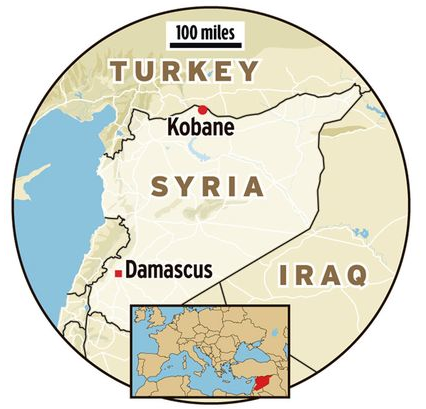
To repeat myself, where are you, Turkey?  The Turks share a southern border with both Iraq and Syria.  (A large part of that geographical piece is considered by the Kurds to be part of Kurdistan).  For centuries, back to the years of the Ottoman Empire, the Turks and the Kurds have struggled for control of this part of the world (since its not Asia Minor, and its not really Mesopotamia, I will just refer to it as "Asia Minopotamia").  Some of the blackest pages in Turkey's personal history book have to do with Kurdistan.  On more than a few occasions over the past two centuries, the Turks have committed acts of genocide against the Kurds.  I realize that by saying this, I royally piss off a number of very close Turkish friends, but it is my interpretation of history; believe me, I wish it weren't so.  The Kurds have always been a thorn in Turkey's side, and when historically bad famines and droughts hit Turkey, the Kurds were last to receive help.  I won't spend anymore time on the subject, especially since there is so much open source material available.  Fast forward to 2014, the Kurds are fighting for their lives not against the Turks or famine, or even Saddam Hussein, but against the IS.  At present, its not really possible to draw a static map of who-occupies-what.  The Kurds are in possession of some territory in northern Syria, but the main theater of war at the moment is in Iraq.  In the north, the Kurds are fighting the IS, and the central part of Iraq, the Iraqi Army and Shia Brigades are opposing the IS.  Back in Syria, the regular Syrian Army continues to occasionally engage IS forces.  For the time being, though, all eyes seem to be on very north central Syria and the town of Kobani.

At times I find it difficult to accept that Syria and Turkey share such a continuous, strategic border. For many centuries, the border did not exist, as Syria and Turkey were both part of the Ottoman Empire.  Now, for all practical purposes, the border separates wealth from poverty, Europe from the Levant, and West from East.  I know many will disagree, and argue (effectively, I'm sure) that Asia Minor is not Europe and that Turkey is not a first-world country.  I make my call through personal experience.  I was obsessed with Turkey in my younger days, and loved every chance I had to visit.  The Turks are a friendly, proud people; you will rarely see beggars or hungry children in Turkey.  But the Turkey of my youth is disappearing.  Secular Turkey (with its handful of generals ready to take charge if the civilians get too ambitious) has seen a rise in Islamist political activities and a movement to strengthen Turkey's Islamic cultural heritage and traditions.  President Recep Erdogan, who was elected in August 2014 with a 51% to 38% margin over his nearest competitor, is not fan of the Army.  During the later half of the last century, the Turkish military did not hesitate to remove elected leaders at the slightest sign of movement away from secularism.  I believe Erdogan is too popular for the military to act against, so I just keep my fingers crossed that he doesn't allow Turkey to suffer an Islamic revolution like the one that swallowed Iran in 1979.

Regarding the situation in Syria and Iraq, where does Turkey stand?  One thing to keep in mind: Turkey has a FORMIDABLE Armed Forces.  There was a time when Turkey was only interested in keeping an army larger than Greece's, but membership in NATO changed everything.  For all practical purposes, Turkey's military was created, nursed and raised to adulthood by the United States military.  Because of the all-important NATO missile sites located in Turkey (and aimed at Russia, I believe, although there may be one aimed at the Eifel Tower), The United States was more than willing to train and equip the Turkish Army.  Roughly 15 years ago, the Turkish military took the surprising step of conducting joint operations with Israel (the advent of Erdogan has cooled relations between Ankara and Jerusalem).  In equipment, size, and readiness, I believe that the Turkish military is en par with France, the UK and Germany (Greece who?).  Where does Turkey stand?  Why haven't the Turks taken a stand against the IS, which is about as nasty a group as there is?  Allegedly, Erdogan offered to join the Coalition and use the Turkish Army if Obama would guarantee the removal of Assad in Damascus.  Obama does not have the testicular fortitude for such a call, which would piss off Putin to no end.  At the moment, Turkey sees no strategy that benefits Turkey, with the exception of waiting until the dust settles.  If Turkey mobilizes, they would sweep the IS from the face of the earth in a matter of days (Turkish Special Forces....Bad Ass).

 But what good does that do if Assad, the thorn in Turkey's backside, stays in power?  Maybe Erdogan is thinking that an IS government in Damascus is preferable to the Ba'athists and Assad?  Wouldn't that be something...Turkey joins the conflict ON THE SIDE of the IS!  Its just a thought; it can't happen.  Turkey is a functioning Democracy with a Tiger of an economy (which is headed for a fall, say many forecasters...hope not), a thriving tourist industry and a military that would make Suleyman the Magnificent jealous.  An on its southern border Turkey nurses two recurring boils; Kurdistan and the civil war in Syria.  Although Erdogan has been willing to snuggle up to the Kurds for political expediency, I don't think he feels compelled to resolve the issue of Kurdistan at the moment.  Besides, the Kurds have proven to be reasonable.  The IS conflict, though, threatens to spill over into Turkey proper (not to mention the steady flow of refugees).  Surprisingly, the Turks have yet to really mobilize militarily.  What would happen if one of the combatants (count 'em again, folks: Al-Nusra Front, IS, Khorasan, Kurds, regular Syrian Army, and the free Syrian Army) began using Turkish territory as a staging point for military operations?  Unfortunately, I don't see Erdogan acting proactively in this situation.  He is content to let the circumstances come to him.