Twitter and email info

Saturday, October 18, 2014

Why Is Kobani So Important To The Islamic State?

Links: Lots Of Targets For U.S. Air Force
           Islamic State Air Force?
           Ramadi Under Seige

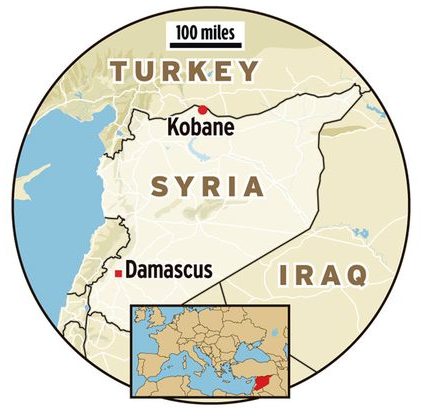
The spokesmen for the Allied effort to defeat the Islamic State in the Levant (IS) has informed us that the IS is pouring men and resources into the effort to take Kobani.  Has anyone asked why?  What is so important to the IS, that they would sacrifice so many resources for its possession?  True, Kobani is strategically located, in the far north of Syria, on the Turkish border.  Would occupying Kobani improve the IS supply network?  Is it possible that Kobani has become a must-win situation for the IS from a public relations perspective?  You know what they say: no one likes a loser.  Maybe the IS believes it must win in order to keep up morale amongst the faithful.  It's a very interesting question that I assume the Pentagon has been pondering as well.  As for the situation on the ground, it's still David versus Goliath, with a small number of Peshmerga hanging on against the IS onslaught. Still nothing from the Turks.  I am pleased with the havoc visited upon the IS by our heroes in the air.  I hope we will keep it up, and even make things hotter for the bad guys, if possible.  We have an unfair advantage: a handful of air forces against....nothing.  But I'll take it, because a similar unfair balance exists on the ground, but in reverse.  And the sad truth is that for the Kurds defending Kobani, there is no other hope for relief unless we can magically stand-up a Kurdish army over the weekend and deliver them by airlift. This is because our surrogate army won't be finished cooking for another three or four months (did you set the timer?).  The naked truth is that when it comes to a ground battle in this conflict, the United States will not deploy forces and that means the Kurds are left to their own devices on the streets of Kobani.  The message from the United States and her allies to the Kurds in Kobani?  We will bomb the shit out of the bad guys, and try to keep you supplied, but when it comes to bleeding, you guys are on your own.

Speaking of air forces, the second link has me a bit excited that the IS may try and add some offensive air capability.  The link mentioned three Migs (a combination of 21s and 23s, I believe). These birds are probably not much younger than Snoopy's Sopwith Camel doghouse, but I have it on reliable authority that the IS is in possession of more than three workable Migs.  A search on Google Maps  for "Taqba Dam, Syria", will take you to Al-Taqbah, Syria (don't try diving in with a direct search for "Al-Taqbah, Syria" . . . it got me nowhere).  Just south of the lovely desert oasis of Al-Taqbah is a (former) Syrian Air Force Base.  Flip your view from map to satillite photo, zoom in, and observe the eight to ten Migs sitting on the tarmac.
Again, my trusty source tells me that those planes were present when the IS captured the Al-Taqbah Air Base.  The IS has also captured a few other airbases, so it's no wonder that the Syrian Conflict rumor mill has former Iraqi Air Force pilots training IS operatives to fly Migs.  The minute the IS came into possession of jets, they started searching for pilots and trainers.  But I don't think we have anything to worry about here directly.  What, exactly, will the IS do with ten or fifteen old Migs?  I can't imagine that they would attempt combat with a U.S. F16 (or Qatari for that matter) or a French Eurofighter.  What concerns me more is that they have the opportunity to create more than a handful of jet pilots.  And it doesn't take much to fly a jumbo jet after you've had even limited flight training (the killers on September 11 had little to no real flight experience with a jumbo jet).  My real concern is that the Syrian Air Force has provided the IS with the best kind of teaching tools for wannabe pilots . . . real jets.

The last link I've provided gives us our daily update on the situation in Anbar Province, in western Iraq.  After reading the article, one might be tempted to adopt a more optimistic perspective about the effort to save Baghdad.  According to the Iraqi spokesman, efforts are underway to eliminate any pockets of IS infiltrators in the city of Ramadi.  The article quotes the Shia's Grand Ayatollah Ali al-Sistani as calling all the tribes in the area to rally behind the Iraqi Army to defeat "the Daesh (IS)".  Well, I have a newsflash for everyone involved: Al-Sistani is preaching to Sunni Shaykhs and Sunni Tribal Leaders.  Al-Sistani is a Shia, and the Shia tend to be found a bit further south than the Ramadi-Fallujah line.  Does anyone really expect the Sunni Shaykhs to rise up against a Sunni movement (IS), at the behest of a Shia spiritual leader?  During Operation Enduring Freedom, when the Sunni-supported insurgency became a serious threat, the United States Army and the CIA went to the Shaykhs, met them face to face, and provided them with a much more positive vision for the future than what Al-Qaeda in Iraq was able to do.  Sunni leaders knew that Al-Qaeda had become too violent, and that it had become more of an enemy-to than a representative of the Sunni community.    The few Sunni tribes who have currently moved against IS have done so out of self-preservation; no "save-Baghdad and Iraq" about it. Somehow or another, the government in Baghdad (or the Allies) must find a way to deliver this same message now, and not from a Shia cleric who in the past has advocated the slaughter of Sunnis.

Friday, October 17, 2014

Kurds Taking It To The Islamic State

Links: Islamic State Suffers Losses In Kobani
            Turkey Waits And Watches

We could all use a bit of good news.  I am pleased to observe that the U.S. air campaign against the Islamic State in the Levant (IS) has really made an impact, at least for the Kurds and the poor still stuck in Kobani. 
I had hoped that the Turks would have moved in by now, and wiped out the IS forces with a massive armor blitz, but it hasn't happened.  Believe me, the Turks are more than capable of sweeping up IS like an ardvaark finishes off an anthill (language lesson: aardvark comes from the original Afrikaans work "erdvark", which translated means "earth pig"; I dig Afrikaans).  Instead, the good
 www.mirror.co.uk
www.mirror.co.uk
guys have to rely on the Kurds to defend Kobani, and they will, to the last man or woman.  Thursday's solid, well-timed and well-targeted air strikes proved what can be accomplished with air power alone.  On the other hand, it demonstrated the importance of ground forces.  Rats like the IS love to dig holes in which to hide.  The U.S. Army learned a great deal in World War Two and in Vietnam about the digging of holes and tunnel networks that can reach for miles.  It demonstrated the usefulness of the flame thrower, that's for sure.

According to the first link, the IS now controls only 30 percent of Kobani, as opposed to yesterday's 50 percent.  Interestingly enough, the IS has not made use of any of the armor that it has captured over the past six months.  My sources tell me that the fighting in Kobani has been house-to-house, street -to-street.  Booby-traps and all variety of homemade mines and other exploding weapons are being used.  The IS units are well-armed, although as should be expected they carry a wide variety of weaponry.    I'm hopeful that the air campaign alone can lift the siege of Kobani.  Obviously ground units are needed, but the Kurds are still there, and if we can get the IS to abandon Kobani, it should be a victory.  Why?  Not for the obvious reason that we liberated a town from those hateful bastards, but because it proves the usefulness of an air campaign in disrupting the flow of supplies and replacement troops to the battlefield.  Its great to see video clips of U.S. bombs taking out an IS outpost, but the analytical guy in me is much more interested in how successful we have been disrupting their flow of supplies.  Every army, no matter how small, needs supplies and needs to eat.  Deprive the IS of this element, and the citizens of Kobani will wake up in the morning with a particularly nasty stench removed from the air . . . the IS will be gone.

A couple weeks back I wrote a post about the defense of Baghdad.  It has been one of the more popular posts since I began this blog in late August.  I received a number of fascinating emails, and I would like to encourage folks to make these comments here on the blog (at the end of each post) or on Twitter @mukhabaratbaby, so we can get a conversation started.  I can't think of anything more interesting than for all of us armchair generals to plan the defense of Baghdad together!  Back to the post I mentioned . . . I believe the key to defending Baghdad is the proper use of air resources.  Once the IS raised its black flag in Fallujah, the allied air forces should have been on top of them like Bill Clinton on a pair of XL panties.

The IS is using the same strategy in Anbar as it has used in northern Iraq and in Syria.  They like to be mobile, and they strike quickly.  Once the IS has a foothold in the bedroom communities of Baghdad, the only way to save the capital city is with U.S. ground troops, which we know won't happen.  So we have to look at the battle map and decide how best to halt the IS advance from western Anbar.  My sources tell me that the IS is already implementing its version of law, courts, etc., in the recently captured Anbar communities.  If these guys are out in the streets, parading around, staging the odd public execution, then where is the allied air force? I realize that towns like Fallujah and Ramadi guarantee collateral casualties, but this isn't the time to nit-pick.  Let's just do our best to avoid civilians, and lets rain havoc down on the IS.  We need to come at them, day and night, no schedule, so they have no opportunity for sleep.  Anything that remotely resembles an IS vehicle should be a target.  One thing to keep in mind, any resupplying of IS in western Anbar cannot be done unobserved.  Its a bloody desert, for goodness sake.  I know, I've been there.  I've had that sand up my ass, and I've seen it from the air.  Granted, the IS will take what it needs from the local Sunni population.  But the key is, to not give the IS the time it needs to seed the poorer Sunni neighborhoods of Baghdad with operatives.  I realize we may be too late, but since we are still playing the game, lets play to win.