Links: A.
Russia Wikipedia
B.
Description of Organized Crime in Russia
C.
Useful Background on Russian Political Structure
D.
Putin Wikipedia
Of all the posts I've written for the blog, this one has been the most difficult to put together. When the Cold War ended and Boris Yeltsin was singing the praises of capitalism, I was truly optimistic about Russia's future. There can be no doubt that the Russian people work hard and take pride in their country. In July 1998, when the bodies of the former ruling Romanov family were interred in St. Petersburg, and the streets were lined with people showing their respect as the coffins made their way to the St. Peter and Paul Cathedral, I thought to myself that Russia had come to terms with its past and was ready to embrace the future. I had this crazy notion that the United States and Russia would lead the world on a crusade for peace, economic freedom for all, and ecological responsibility. It was a serious dose of wishful thinking. Since that time, I have been reminded that the Russian people are obsessed with the need for a strong leader, regardless of the freedoms they must relinquish. The everyday, on the street Russian is fairly well-read and educated. They watch the news, read the paper and listen to the radio. Granted, it's mostly propaganda bullshit, but they know how to read between the lines. They just chose not to. The average Russian is well aware of President Vladimir Putin's ties to organized crime and his manipulation of the political system to allow for his permanence in power. They are not blind to the fact that Putin cut every state budget, while increasing defense spending by twenty percent. Does anyone see a threat to Russia? Is there a need for the Russians to be stocking up on equipment and weapons to defend the Motherland? Of course not; and the increase in defense spending was for offensive intentions, vice defense. The next reasonable question to ask is, "if Russia doesn't have an outside threat, then what offensive operations are being considered?"
Obviously Putin is not satisfied with the situation in Ukraine. I imagine that he expected the Ukrainians to have folded by now, and accepted the loss of the Crimea in order to secure the integrity of Eastern Ukraine. Putin keeps up the charade of a Donbas indigenous
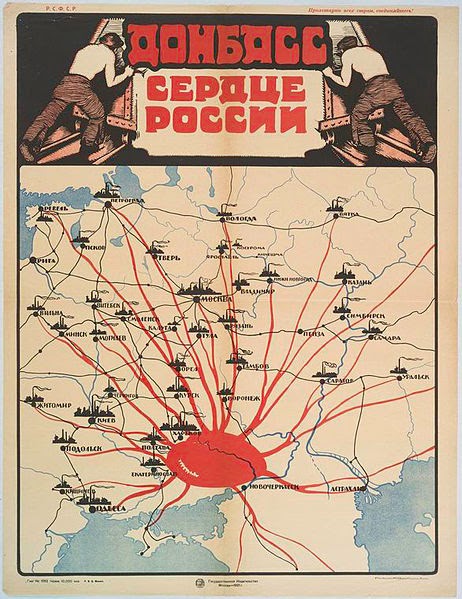 |
1921 Soviet propaganda poster praising
Donets Basin as Heart of Russia; PD-1923 |
movement to be annexed by Russia, in order to keep his military active in the region. His military and the equipping of the guerilla forces around Donets'k, Luhans'k and Mariupol' is singularly intended to create a bargaining chip. Putin will pull out of Eastern Ukraine, if Ukraine and the west will recognize the annexation of Crimea to Russia. I believe that Putin expected the Ukrainian government to fold, given their dependence on Russian oil and natural gas, and the apparent sorry state of affairs in the Ukrainian military. But the people of Kiev and Western Ukraine have had just about enough of Russian military bullying. The people of Ukraine have suffered heavily from Russian intervention over the years, and, particularly in western Ukraine, they want nothing to do with old school "business-as -usual". They want a Ukraine as part of Europe, a member of NATO and hopefully one day a member of the EU. Ukrainian military officials were not prepared for the number of volunteers from western Ukraine who have flooded recruitment centers, and the new government has been given a free-reign to conduct the war as it sees fit, as long as no concessions are made to Russia. If the current government gave any indication that it was considering a swap of Crimea for peace in Donbas, they would be under siege from protesters in Kiev. The unexpected success of sanctions imposed by the United States and Europe has steeled the nerve of the government in Kiev, but for how long is anybody's guess. The reality is, if it weren't for certain decisions being made in Saudi Arabia, then the price of oil would not have fallen dramatically and the EU and U.S. sanctions would have been basically harmless. Make no mistake, the real impact of sanctions on Russia are only causing hardship because of the combined impact of the fall of the price of crude.

Contrary to what many in the west want to believe, Putin is not losing any sleep. If he were, then he wouldn't have initiated a costly, aggressive move into the Arctic region. Putin knows that the low price of a barrel of crude is a temporary factor, and that the Ruble will rebound sooner rather than later. Putin's actions in the Arctic are not a short-term strategy. He realizes that taking control of the desolate islands in the Arctic (by right of simple possession) won't give him overnight access to thirty percent of the world's natural gas reserves and thirteen percent of it's oil reserves. This move, to rebuild airbases, relocate naval squadrons, position troops and begin a diplomatic offensive, will take time. Putin is counting on a Hillary Clinton presidency, as he sees her as little more than a shorter, fatter version of Barrack Obama (have a look at the provisions of the "New Start" Treaty that Hillary negotiated with Putin in 2010; believe me, Vlad is salivating at the thought of another President Clinton). He knows that he can threaten and bluff all the way to Spitsbergen/Svalbard and back, if necessary. Norway has a huge stake in the future debate over the Arctic, as does Canada and the United States. Heck, even Denmark (Greenland) should be part of the discussion. Even if the U.S. elects a Republican as president in 2016, it will be hard to displace Russia once she has militarized Novaya Zemlya and Franz Josef Land. The real issue of contention will be the area of the Berents Sea and anything close to Norway. Frankly, the majority of the deposits sit well within Russian territory as it is. I can only assume that the military build-up in the region is to ensure that any contentious strikes, or new discoveries, will go Russia's way as well.


